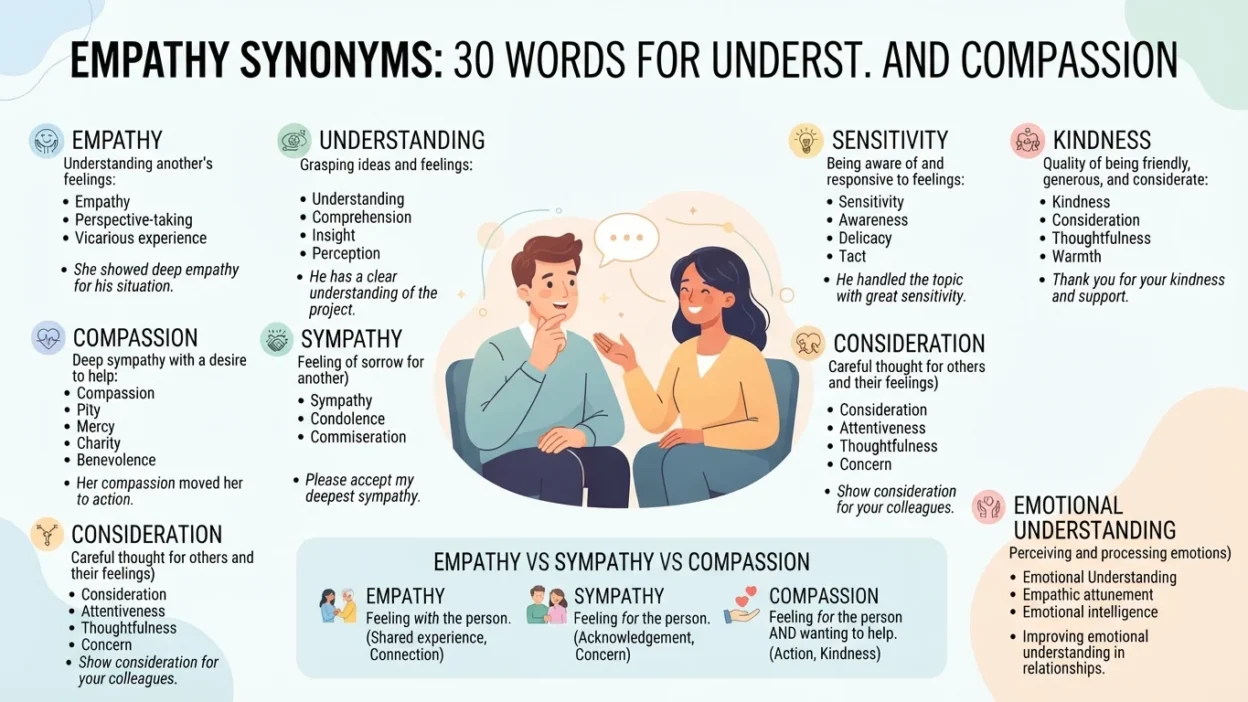
Empathy is one of the most important words for describing emotional understanding and human connection. It means being able to understand or share another person’s feelings, emotions, or experiences. Whether you are writing an essay, improving your vocabulary, creating content, or simply trying to communicate more thoughtfully, knowing different synonyms for empathy can help you express subtle differences in meaning.
Although words such as compassion, sympathy, understanding, sensitivity, and kindness are related to empathy, they are not always exact replacements. Some focus on feeling another person’s emotions, while others emphasize caring, helping, or recognizing what someone is going through. In this guide, you’ll discover 30 useful empathy synonyms, along with simple meanings, natural examples, and the best context for using each one.
What Does Empathy Mean?
Empathy means the ability to understand and emotionally connect with another person’s feelings or experiences.
In simple English:
Empathy = understanding how another person feels.
For example:
- She showed great empathy toward her friend.
- A good teacher needs empathy for students who are struggling.
- His response showed that he understood my feelings with empathy.
Empathy can involve imagining yourself in another person’s situation and trying to understand their emotional experience.
30 Synonyms for Empathy
1. Understanding
Meaning: The ability to recognize and understand another person’s feelings or situation.
Example: Her understanding helped me feel less alone.
Best use: Everyday conversation, relationships, and emotional support.
2. Compassion
Meaning: Deep concern for someone who is suffering, often accompanied by a desire to help.
Example: The nurse treated every patient with compassion.
Best use: Healthcare, relationships, humanitarian situations, and emotional writing.
3. Sympathy
Meaning: Feelings of concern or sadness for someone experiencing difficulty.
Example: We expressed our sympathy after hearing the sad news.
Best use: Difficult situations, grief, and emotional support.
4. Sensitivity
Meaning: Awareness of other people’s feelings and emotional needs.
Example: She handled the conversation with great sensitivity.
Best use: Communication, relationships, workplace situations, and social issues.
5. Kindness
Meaning: Being caring, helpful, and considerate toward others.
Example: His kindness made a difficult day easier.
Best use: Everyday interactions and positive behavior.
6. Consideration
Meaning: Thoughtful awareness of another person’s needs or feelings.
Example: She showed consideration for everyone’s feelings.
Best use: Relationships, professional communication, and social situations.
7. Compassionateness
Meaning: The quality of being compassionate and caring toward others.
Example: Her compassionateness made her an excellent counselor.
Best use: Formal or descriptive writing.
8. Emotional Understanding
Meaning: The ability to recognize and understand another person’s emotional experience.
Example: Effective counselors need strong emotional understanding.
Best use: Psychology, education, counseling, and professional writing.
9. Sympathy
Meaning: Concern or sorrow for another person’s difficulties.
Example: He expressed his sympathy for the family.
Best use: Condolences and difficult circumstances.
10. Fellow Feeling
Meaning: A shared or sympathetic feeling with another person.
Example: Her story created a strong sense of fellow feeling among the audience.
Best use: Formal, literary, or expressive writing.
More Empathy Synonyms
| # | Synonym | Simple Meaning | Best Usage |
|---|---|---|---|
| 11 | Altruism | Concern for the well-being of others | Helping others |
| 12 | Caring | Showing concern for someone | Everyday relationships |
| 13 | Warmth | Friendly and affectionate feeling | Personal relationships |
| 14 | Humanity | Compassionate concern for people | Social and humanitarian writing |
| 15 | Gentleness | Kind and careful treatment | Emotional or interpersonal situations |
| 16 | Generosity | Willingness to give or help | Support and assistance |
| 17 | Thoughtfulness | Careful consideration of others | Relationships and manners |
| 18 | Concern | Worry or care about someone’s situation | General communication |
| 19 | Supportiveness | Willingness to provide emotional help | Relationships and teamwork |
| 20 | Tolerance | Acceptance of differences or difficulties | Social and cultural contexts |
| 21 | Acceptance | Recognizing someone without unfair judgment | Relationships and counseling |
| 22 | Patience | Ability to remain calm and understanding | Teaching and relationships |
| 23 | Attentiveness | Giving careful attention to another person | Communication |
| 24 | Receptiveness | Willingness to listen and understand | Communication and counseling |
| 25 | Identification | Feeling a connection with another person’s experience | Literature and psychology |
| 26 | Rapport | A comfortable relationship based on mutual understanding | Professional and social settings |
| 27 | Solidarity | Unity with people facing a shared difficulty | Social causes and communities |
| 28 | Mercy | Compassion shown toward someone in a difficult position | Moral, religious, or formal contexts |
| 29 | Pity | Sorrow for another person’s suffering | Emotional situations; use carefully |
| 30 | Humaneness | Kindness and compassion toward others | Formal and humanitarian writing |
Empathy Synonyms Comparison Table
Not every synonym has exactly the same meaning as empathy. This table can help you choose the most accurate word.
| Word | Main Idea | Similarity to Empathy |
|---|---|---|
| Empathy | Understanding another person’s feelings | Exact target word |
| Understanding | Recognizing another person’s feelings | Very close |
| Compassion | Caring about someone’s suffering | Closely related |
| Sympathy | Feeling concern for someone’s difficulties | Related but different |
| Sensitivity | Awareness of emotional needs | Closely related |
| Kindness | Caring and helpful behavior | Related |
| Consideration | Thinking about another person’s needs | Related |
| Caring | Showing concern | Related |
| Rapport | Mutual understanding and connection | Context-dependent |
| Solidarity | Standing with others | Context-dependent |
| Pity | Feeling sorrow for another person | Related but often different in tone |
How to Choose the Right Empathy Synonym
The best synonym depends on the exact idea you want to express.
For emotional understanding
Use:
- empathy
- understanding
- emotional understanding
- sensitivity
Example:
The counselor showed remarkable empathy toward her client.
For caring about suffering
Use:
- compassion
- sympathy
- concern
- humaneness
Example:
The organization provides support with compassion.
For kindness and helpful behavior
Use:
- kindness
- caring
- generosity
- thoughtfulness
Example:
Her kindness made everyone feel welcome.
For mutual connection
Use:
- rapport
- fellow feeling
- identification
Example:
The teacher developed excellent rapport with her students.
For standing together
Use:
- solidarity
- humanity
- supportiveness
Example:
The community showed solidarity with the affected families.
Empathy Synonyms in Sentences
Here are some additional examples showing how these words work naturally.
- She listened with genuine empathy.
- His compassion for vulnerable people was admirable.
- I appreciated her understanding during a difficult time.
- The teacher showed remarkable sensitivity toward her students.
- A little kindness can make a huge difference.
- He treated the older woman with gentleness.
- Her thoughtfulness made everyone feel respected.
- The counselor created a strong sense of rapport with the client.
- The community demonstrated solidarity after the disaster.
- His supportiveness helped me regain confidence.
- Good communication requires attentiveness and patience.
- The organization is known for its humaneness.
- She showed consideration for everyone’s circumstances.
- His response reflected genuine concern.
- The group developed a strong sense of fellow feeling.
Empathy vs Sympathy
One of the most important distinctions is between empathy and sympathy.
Empathy involves understanding or emotionally connecting with another person’s feelings.
I understand how painful this must feel.
Sympathy involves feeling concern or sorrow for someone else’s difficulties.
I’m sorry that you’re going through this.
A simple way to remember the difference is:
Empathy = feeling with someone.
Sympathy = feeling for someone.
The distinction is not always absolute in everyday English, but it is useful for understanding their typical meanings.
Empathy vs Compassion
Empathy focuses primarily on understanding or sharing another person’s emotional experience.
Compassion goes a step further by emphasizing concern and often a desire to help.
For example:
She showed empathy by understanding his fear.
She showed compassion by understanding his fear and helping him through it.
Both are positive qualities, but compassion often has a stronger action-oriented meaning.
Common Mistakes When Using Empathy Synonyms
1. Treating sympathy and empathy as identical
Although they are related, they are not perfect synonyms.
Empathy focuses more on understanding another person’s emotional experience, while sympathy usually expresses concern or sorrow.
2. Using pity as a positive synonym in every situation
Pity can sometimes suggest looking down on someone or viewing them as helpless.
For respectful emotional communication, empathy, compassion, or understanding may be better choices.
3. Confusing kindness with empathy
A person can be kind without necessarily understanding another person’s emotions.
Kindness describes caring or helpful behavior, whereas empathy focuses more specifically on emotional understanding.
4. Assuming compassion and empathy mean exactly the same thing
They overlap, but compassion often includes a desire to help or reduce suffering, while empathy emphasizes understanding feelings.
Memory Trick
Here’s an easy way to remember the difference:
EMPATHY = EXPERIENCE
Think:
Empathy means trying to understand another person’s emotional experience.
SYMPATHY = SORROW
Think:
Sympathy means feeling concern or sorrow for someone.
COMPASSION = CARE + ACTION
Think:
Compassion means caring about someone’s suffering and often wanting to help.
These simple associations can make the differences easier to remember.
American vs British English
Empathy and its common synonyms are used in both American and British English.
There is no major spelling difference between American and British English for words such as:
- empathy
- compassion
- sympathy
- understanding
- sensitivity
- kindness
- consideration
The main difference is usually context and preferred expression, not spelling.
For example:
She showed great empathy toward her colleague.
This sentence is natural in both American and British English.
Similar Words Related to Empathy
Several words are closely associated with empathy but have distinct meanings.
Emotional intelligence
The ability to recognize, understand, and manage emotions in yourself and others.
Sympathy
Concern or sorrow for another person’s difficulties.
Compassion
Deep concern for someone’s suffering, often combined with a desire to help.
Kindness
Friendly, caring, and helpful behavior.
Sensitivity
Awareness of other people’s emotions and needs.
Altruism
Concern for the welfare of others, often involving selfless behavior.
Understanding
The ability to recognize and comprehend another person’s situation or feelings.
Frequently Asked Questions
What is the closest synonym for empathy?
Understanding is one of the closest general synonyms for empathy. Depending on the context, compassion and emotional understanding can also be very close.
What are five synonyms for empathy?
Five common synonyms or closely related words are understanding, compassion, sympathy, sensitivity, and consideration.
What is a stronger word for empathy?
Compassion can be a stronger alternative when you want to emphasize not only understanding someone’s suffering but also caring about helping them.
What is a synonym for empathy in relationships?
Useful choices include understanding, sensitivity, compassion, caring, thoughtfulness, and emotional understanding.
What is the difference between empathy and sympathy?
Empathy involves understanding or sharing another person’s feelings, while sympathy usually means feeling concern or sorrow for someone’s situation.
Is compassion the same as empathy?
No. They overlap, but empathy focuses on understanding another person’s feelings, while compassion generally adds concern and a desire to help.
What is the opposite of empathy?
Depending on context, possible opposites include insensitivity, indifference, apathy, callousness, and lack of understanding.
Final Verdict
The best synonym for empathy depends on the specific meaning you want to communicate. If you mean emotional understanding, understanding, sensitivity, and emotional understanding work well. If you want to emphasize concern for suffering, compassion and sympathy are useful choices. For kindness and supportive behavior, words such as caring, kindness, consideration, and thoughtfulness may be more appropriate.
Remember that synonyms are rarely interchangeable in every sentence. Empathy is specifically connected to understanding another person’s emotional experience, while related words can emphasize concern, kindness, support, or action. Choosing the right word makes your English more precise and natural.
Conclusion
Learning empathy synonyms gives you more ways to describe emotional understanding, compassion, kindness, and human connection. Words such as understanding, compassion, sympathy, sensitivity, and consideration can all be useful, but each carries its own shade of meaning. This makes them valuable for essays, professional communication, personal writing, and everyday conversations.
The most important thing is to consider the context before choosing a synonym. If you are describing someone who understands another person’s feelings, empathy or understanding may be best. If you are describing care for someone’s suffering, choose compassion. If you are describing helpful behavior, kindness or caring may be more accurate. Using these distinctions will make your vocabulary richer, clearer, and more expressive.
Remember This
Empathy = understanding another person’s feelings.
- Understanding → recognizing someone’s feelings
- Compassion → caring about suffering and wanting to help
- Sympathy → feeling concern for someone’s difficulties
- Sensitivity → being aware of emotional needs
- Kindness → behaving in a caring and helpful way
- Consideration → thinking carefully about another person’s needs
- Rapport → developing a comfortable mutual connection

A creative writer with a deep interest in word usage and meaning.
He explores synonyms to enhance both academic and creative expression.
Zayn’s work aims to make language richer and more accessible for everyone.