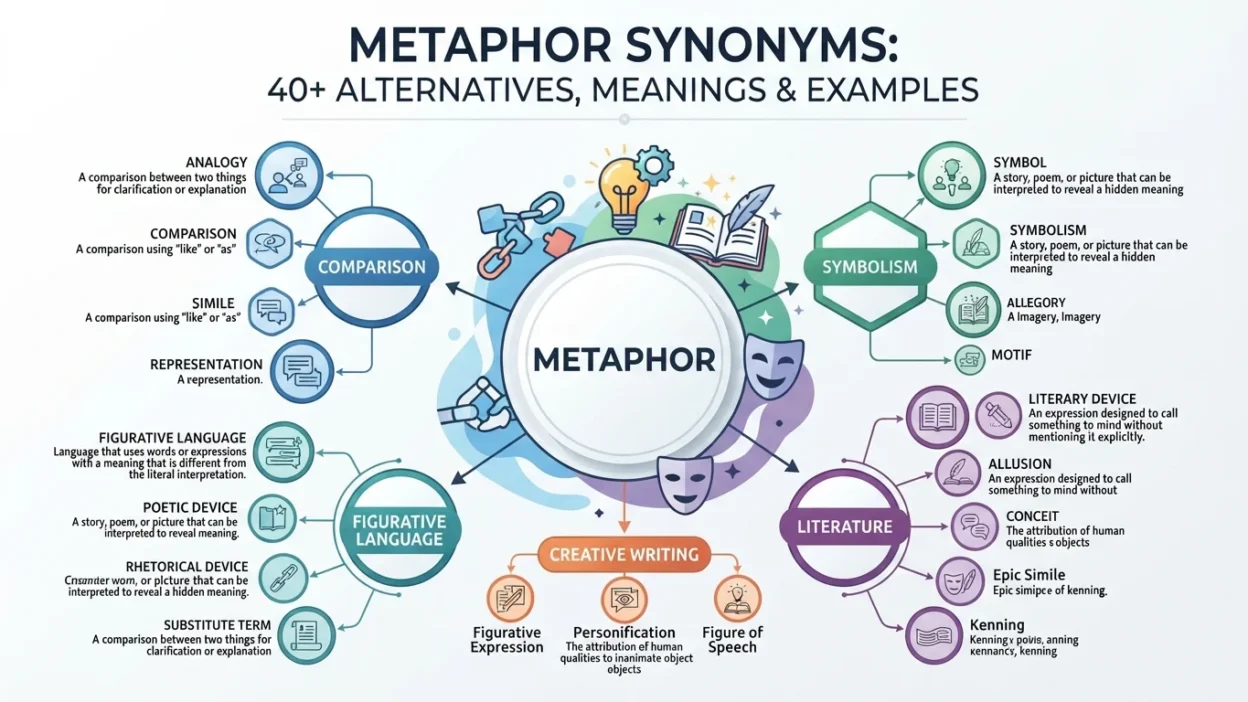
Metaphor is a figure of speech in which one thing is described as another to create a comparison or deeper meaning, without using “like” or “as.” Depending on context, you may be looking for synonyms for the word “metaphor” or alternative ways to describe a figurative comparison.
Quick Answer
Common metaphor synonyms and related terms include:
- Analogy
- Comparison
- Symbol
- Representation
- Figure of speech
- Figurative expression
- Figurative language
- Image
- Imagery
- Illustration
- Allegory
- Symbolism
- Conceit
- Trope
- Allusion
- Parable
- Emblem
- Motif
- Parallel
- Correspondence
- Equivalence
- Association
- Suggestion
- Implication
- Expression
- Description
- Characterization
- Personification
- Simile
- Extended metaphor
- Dead metaphor
- Conceptual metaphor
- Figurative comparison
- Implied comparison
- Poetic comparison
- Rhetorical device
- Literary device
- Evocative image
- Symbolic representation
- Figurative analogy
What Does Metaphor Mean?
A metaphor directly compares two unrelated things by saying that one thing is another.
Time is a thief.
Time is not literally a thief. The metaphor suggests that time takes moments away from us.
Another example:
Her voice was music.
This means her voice was beautiful or pleasing, not that it was literally music.
Analogy
An analogy explains or illustrates an idea by showing how it is similar to another idea.
Learning a language is like building a house: you need a strong foundation first.
Best for: Explanations, teaching, arguments, and comparisons.
Difference: An analogy is usually more explanatory and logical than a metaphor.
Comparison
Comparison is a broad term for showing similarities between two things.
The writer uses a comparison between life and a journey.
Best for: General writing and analysis.
Symbol
A symbol is something that represents a deeper idea or meaning.
The dove is a symbol of peace.
Best for: Literature, art, culture, and visual communication.
Difference: A metaphor makes a comparison; a symbol represents an idea or concept.
Representation
Representation means something that stands for or portrays another thing.
The character is a representation of human ambition.
Best for: Literary criticism, art, and academic writing.
Figure of Speech
A figure of speech is a creative or nonliteral use of language.
“The world is a stage” is a figure of speech.
Best for: Grammar, literature, and language education.
Figurative Expression
A figurative expression communicates meaning indirectly rather than literally.
“He has a heart of stone” is a figurative expression.
Best for: Writing and literary analysis.
Figurative Language
Figurative language is the broad category that includes metaphors, similes, personification, hyperbole, and other nonliteral expressions.
The poem uses vivid figurative language.
Best for: Literature and education.
Image
An image can be a mental picture created through descriptive language.
The poet creates a powerful image of a storm.
Best for: Poetry, literature, and creative writing.
Imagery
Imagery refers to descriptive language that creates sensory or mental pictures.
The poem is rich in imagery.
Best for: Poetry, fiction, literary analysis, and creative writing.
Allegory
An allegory is a story, character, or narrative that represents a deeper meaning, often a moral, political, or philosophical idea.
The novel is an allegory for the struggle between freedom and control.
Best for: Literature, philosophy, politics, and storytelling.
Important: An allegory is generally broader and more sustained than a single metaphor.
Symbolism
Symbolism is the use of symbols to represent ideas or qualities.
The darkness in the story represents fear through symbolism.
Best for: Literature, art, film, and cultural analysis.
Conceit
A conceit is an elaborate or unusual metaphor, especially one developed over a longer passage.
The poem develops an extended conceit comparing love to a voyage.
Best for: Poetry and literary criticism.
Trope
A trope is a recurring figurative idea, expression, or literary device.
The journey is a common literary trope.
Best for: Literature, media, storytelling, and criticism.
Allusion
An allusion is an indirect reference to a person, event, text, or idea.
The character’s journey contains an allusion to Greek mythology.
Best for: Literature, history, culture, and writing.
Note: An allusion is not necessarily a metaphor.
Parable
A parable is a short story used to communicate a moral or spiritual lesson.
The story functions as a parable about forgiveness.
Best for: Religious, moral, and educational contexts.
Emblem
An emblem is a visual or symbolic representation of an idea.
The rose became an emblem of love.
Best for: Art, culture, symbolism, and design.
Motif
A motif is a recurring image, idea, symbol, or element in a work.
Water is a recurring motif throughout the novel.
Best for: Literature, film, art, and storytelling.
Personification
Personification gives human qualities to nonhuman things.
The wind whispered through the trees.
This is a specific type of figurative language.
Best for: Poetry, fiction, and creative writing.
Simile
A simile compares two things using “like” or “as.”
Her smile was like sunshine.
A metaphor would be:
Her smile was sunshine.
Best for: Creative writing and poetry.
Metaphor vs Analogy
These are closely related but not identical.
Metaphor:
Life is a journey.
Analogy:
Life is like a journey because both involve choices, obstacles, changes, and destinations.
A metaphor is usually shorter and more imaginative, while an analogy is generally more explanatory.
Metaphor vs Simile
Metaphor:
He is a lion.
Simile:
He is like a lion.
Both create comparisons, but a metaphor makes the comparison more directly.
Metaphor vs Symbol
A metaphor creates a comparison.
A symbol represents a deeper idea.
“She is a rose” → metaphor.
A rose represents love → symbol.
Metaphor Synonyms by Context
For Academic Writing
Use:
- Analogy
- Figurative comparison
- Figurative expression
- Representation
- Literary device
- Rhetorical device
- Conceptual metaphor
- Symbolic representation
For Creative Writing
Use:
- Image
- Imagery
- Figurative expression
- Comparison
- Symbol
- Conceit
- Poetic comparison
- Figurative language
For Literature Analysis
Use:
- Symbolism
- Allegory
- Motif
- Conceit
- Trope
- Imagery
- Representation
- Figurative language
For Simple English
Use:
- Comparison
- Image
- Symbol
- Figurative expression
- Figure of speech
- Analogy
Types of Metaphor
Direct Metaphor
She is a star.
A direct comparison between two things.
Implied Metaphor
He barked orders at everyone.
The comparison to a dog is implied rather than directly stated.
Extended Metaphor
A metaphor developed across multiple sentences or an entire work.
Life is a journey. We encounter crossroads, take wrong turns, climb difficult hills, and eventually reach our destination.
Conceptual Metaphor
A metaphorical concept used to understand one idea through another.
Time is money.
This connects the concept of time with the concept of money.
Dead Metaphor
A metaphor so commonly used that people may no longer notice its figurative origin.
The leg of a table.
Metaphor Synonyms Comparison Table
| Term | Meaning | Best Context |
|---|---|---|
| Analogy | Comparison used to explain | Education |
| Comparison | Showing similarities | General |
| Symbol | Represents a deeper idea | Literature/art |
| Representation | Stands for something | Academic |
| Figure of speech | Nonliteral expression | Language |
| Figurative expression | Indirect/nonliteral wording | Writing |
| Figurative language | Broad category of nonliteral language | Literature |
| Image | Mental picture or representation | Poetry |
| Imagery | Language creating sensory images | Literature |
| Allegory | Extended symbolic narrative | Literature |
| Symbolism | Use of symbols | Art/literature |
| Conceit | Elaborate metaphor | Poetry |
| Trope | Recurring figurative device | Media/literature |
| Allusion | Indirect reference | Literature |
| Parable | Story conveying a lesson | Religion/education |
| Emblem | Symbolic representation | Culture |
| Motif | Recurring symbolic element | Literature |
| Personification | Human qualities given to nonhuman things | Poetry |
| Simile | Comparison using like/as | Creative writing |
| Rhetorical device | Technique used for effect | Public speaking |
| Literary device | Technique used in literature | Literary analysis |
Frequently Asked Questions
What is the closest synonym for metaphor?
The closest alternatives are analogy, comparison, figurative expression, figure of speech, and figurative comparison. However, none is an exact synonym in every context.
What is another word for a metaphor?
You can use figurative comparison, figure of speech, figurative expression, analogy, symbolic comparison, or image, depending on the context.
Is analogy the same as metaphor?
No. An analogy usually explains a similarity, while a metaphor makes a more direct figurative comparison.
What is a synonym for metaphor in literature?
Useful terms include figurative language, symbolism, imagery, allegory, trope, conceit, and literary device.
What is a metaphorical expression?
A metaphorical expression is a phrase whose meaning is figurative rather than literal.
“She has a heart of gold.”
This means she is kind or generous.
What is the opposite of a metaphor?
There is no exact opposite, but literal language or a literal expression is the clearest contrast.
Conclusion
A metaphor is a powerful way to communicate an idea through an imaginative comparison. While analogy and comparison are the closest general alternatives, terms such as symbolism, imagery, allegory, conceit, and figurative language describe related but distinct concepts.
For simple writing, use comparison or figurative expression. For literary analysis, symbolism, imagery, allegory, motif, or conceit may be more precise. Always choose the term based on the exact function of the expression.
Actionable Takeaway
- General: Comparison
- Explanatory: Analogy
- Nonliteral language: Figurative expression
- Broad category: Figurative language
- Deeper meaning: Symbol
- Repeated symbolism: Motif
- Extended story: Allegory
- Elaborate metaphor: Conceit
- Mental picture: Imagery
- Indirect reference: Allusion
- Human qualities: Personification
- Like/as comparison: Simile
- Recurring figurative idea: Trope

A passionate linguist who specializes in word relationships and vocabulary building.
He has spent years studying synonyms and semantic patterns across languages.
Arman writes to make language learning simple, precise, and engaging.