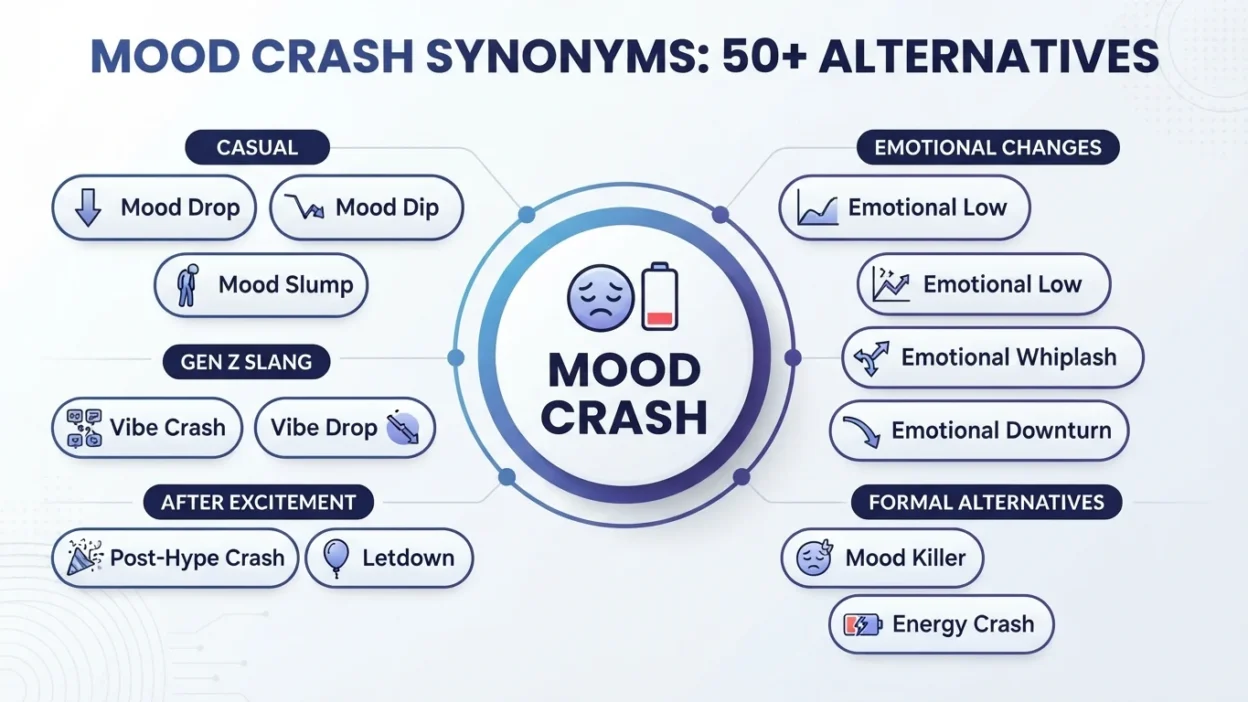
Looking for the best mood crash synonyms? A sudden drop in happiness, excitement, motivation, or emotional energy can be described in many different ways. The best phrase depends on whether you’re talking about everyday feelings, a sudden change in emotions, internet slang, or formal writing.
Mood crash is an informal expression that usually describes a noticeable or sudden shift from feeling good to feeling low, disappointed, drained, or emotionally flat. Depending on the situation, alternatives such as mood drop, mood dip, emotional slump, vibe crash, emotional whiplash, post-hype crash, and emotional downturn can communicate the same general idea.
Quick Answer
The best mood crash synonyms include:
- Mood drop
- Mood dip
- Mood slump
- Emotional slump
- Emotional low
- Vibe crash
- Vibe drop
- Mood shift
- Emotional downturn
- Emotional dip
- Sudden mood change
- Energy crash
- Emotional whiplash
- Post-hype crash
- Mood killer
- Vibe killer
- Instant downer
- Sudden letdown
- Feeling down
- Feeling off
For casual conversations, mood drop and mood dip are natural choices. For internet slang, vibe crash, vibe drop, and emotional whiplash work well. For formal writing, emotional downturn, negative mood shift, or sudden change in mood are clearer.
What Does “Mood Crash” Mean?
Mood crash is an informal phrase used when someone’s emotional state suddenly becomes much less positive.
It can describe a change from:
- Happy to sad
- Excited to disappointed
- Energetic to drained
- Motivated to discouraged
- Positive to emotionally flat
- Excited to emotionally exhausted
For example:
I had so much fun last night, but now I’m having a mood crash.
The phrase can also describe a temporary emotional low after an exciting event.
After the concert ended, I experienced a serious mood crash.
The exact meaning depends on context.
Best Mood Crash Synonyms
1. Mood Drop
Mood drop is one of the closest and most natural alternatives to mood crash.
Meaning: A noticeable decrease in someone’s mood.
Example:
I had a sudden mood drop after reading the message.
Best for: Everyday conversation, texting, and social media.
2. Mood Dip
A mood dip suggests a temporary decrease in happiness or emotional energy.
Example:
I had a little mood dip this afternoon.
Best for: Casual and gentle descriptions.
3. Mood Slump
A mood slump describes a period when someone feels emotionally low or less motivated.
Example:
I’ve been in a mood slump all week.
Best for: Longer-lasting low moods and everyday conversations.
4. Emotional Slump
Emotional slump is slightly more descriptive and neutral than mood crash.
Example:
She went through an emotional slump after the project ended.
Best for: Personal writing and general discussions.
5. Emotional Low
An emotional low refers to a period of particularly low emotional well-being or happiness.
Example:
After the excitement ended, he experienced an emotional low.
Best for: Personal and reflective writing.
6. Vibe Crash
Vibe crash is a modern, informal alternative that describes a sudden loss of positive energy or atmosphere.
Example:
That awkward conversation caused a total vibe crash.
Best for: Social media, memes, texting, and Gen Z language.
7. Vibe Drop
A vibe drop describes a sudden decrease in the positive atmosphere or energy of a situation.
Example:
The music stopped and there was an instant vibe drop.
Best for: Social situations and internet slang.
8. Emotional Whiplash
Emotional whiplash describes a sudden and sometimes intense change from one emotional state to another.
Example:
Going from laughing to crying gave me serious emotional whiplash.
Best for: Dramatic or humorous descriptions of sudden emotional changes.
9. Post-Hype Crash
A post-hype crash happens when excitement disappears after a highly anticipated event.
Example:
I always get a post-hype crash after finishing a great TV series.
Best for: Entertainment, events, travel, celebrations, and social media.
10. Mood Killer
A mood killer is something that causes the positive atmosphere or emotional energy to disappear.
Example:
That negative comment was a total mood killer.
Best for: Casual conversations and social situations.
Mood Crash Synonyms for Gen Z and Internet Slang
If you’re looking for modern social media alternatives, try:
- Vibe crash
- Vibe drop
- Mood drop
- Mood switch
- Mood ruined
- Vibes gone
- Energy crash
- Emotional whiplash
- Post-hype crash
- Mood killer
- Vibe killer
- Instant downer
- Sad arc
- Spiral mode
- Feeling cooked
- Depresso
- Down bad
- Fun killer
- Buzzkill
- The vibes are gone
Examples
Bro had a vibe crash instantly.
One message and my mood was ruined.
The party ended and now it’s post-hype crash time.
That was an emotional whiplash moment.
These expressions are informal and are best suited to social media, texting, memes, and casual conversations.
Mood Crash Synonyms for Sudden Sadness
If you specifically mean suddenly feeling sad, consider:
- Sudden sadness
- Mood drop
- Emotional low
- Emotional dip
- Feeling down
- Feeling low
- Sadness
- Disappointment
- Emotional letdown
- Sudden discouragement
- Low spirits
- Downturn in mood
Examples
I experienced a sudden mood drop after hearing the news.
She was in low spirits after the disappointing result.
The cancellation caused an emotional letdown.
Mood Crash Synonyms for Losing Motivation
Sometimes a mood crash is less about sadness and more about suddenly losing motivation.
Useful alternatives include:
- Motivation drop
- Loss of motivation
- Motivation slump
- Energy drop
- Emotional fatigue
- Mental fatigue
- Discouragement
- Loss of enthusiasm
- Burnout feeling
- Motivation dip
- Productivity slump
- Energy slump
Examples
After finishing the deadline, I had a huge motivation drop.
The rejection caused a temporary loss of motivation.
I’ve been dealing with an energy slump lately.
Mood Crash After Excitement
A mood crash can happen after an exciting event, celebration, trip, concert, vacation, or achievement.
Useful phrases include:
- Post-hype crash
- Post-event slump
- Emotional comedown
- Post-excitement slump
- Letdown
- Emotional drop
- Mood dip
- Energy crash
- Post-celebration slump
- After-event blues
Examples
I always get the post-event slump after a vacation.
The emotional comedown after the concert was real.
We experienced the post-hype crash the next morning.
Mood Crash vs Mood Swing
These terms are related but have different meanings.
A mood crash usually describes a sudden drop into a less positive emotional state.
A mood swing describes a change from one emotional state to another and does not necessarily imply that the new mood is negative.
For example:
I had a mood crash after the good news turned out to be false.
But:
Her mood swung from excitement to frustration.
Therefore, mood swing is broader, while mood crash emphasizes a downward change.
Mood Crash vs Emotional Whiplash
Emotional whiplash emphasizes how sudden or dramatic the emotional transition feels.
The ending gave me emotional whiplash.
Mood crash emphasizes the resulting decline in mood.
I had a mood crash after the ending.
Both can work, but they highlight different aspects of the experience.
Mood Crash vs Burnout
A mood crash can be temporary and situation-specific.
Burnout usually refers to prolonged physical, emotional, or mental exhaustion associated with ongoing stress or demands.
For example:
The disappointing news caused a mood crash.
This describes a specific reaction.
Months of overwork left him feeling burned out.
This describes a longer-term condition.
Mood Crash vs Letdown
A letdown occurs when reality is less satisfying than expected.
The canceled event was a huge letdown.
A mood crash focuses more directly on the resulting emotional decline.
The cancellation caused a major mood crash.
Formal Alternatives to “Mood Crash”
Because mood crash is informal, professional or academic writing may require clearer language.
Consider:
- Sudden change in mood
- Negative mood shift
- Emotional downturn
- Decline in mood
- Sudden emotional change
- Change in emotional state
- Emotional fluctuation
- Temporary decline in mood
- Reduction in positive affect
- Emotional decline
Informal
The news caused a huge mood crash.
Neutral
The news caused a sudden change in mood.
Formal
The news was followed by a noticeable negative shift in emotional state.
Mood Crash Synonyms: Comparison Table
| Synonym | Main Meaning | Tone | Best Context |
|---|---|---|---|
| Mood drop | Sudden decrease in mood | Casual | General |
| Mood dip | Temporary decrease | Casual | Everyday use |
| Mood slump | Low mood over a period | Casual | Personal |
| Emotional slump | Period of emotional difficulty | Neutral | General |
| Emotional low | Low emotional state | Neutral | Reflective writing |
| Vibe crash | Sudden loss of positive energy | Slang | Social media |
| Vibe drop | Decline in atmosphere | Slang | Social situations |
| Emotional whiplash | Sudden emotional change | Casual | Dramatic situations |
| Post-hype crash | Low after excitement | Slang | Events, entertainment |
| Mood killer | Something that ruins the mood | Casual | Social situations |
| Vibe killer | Something that ruins the atmosphere | Slang | Social media |
| Energy crash | Sudden loss of energy | Casual | Daily life |
| Letdown | Disappointment | Neutral | General |
| Emotional comedown | Drop after excitement | Casual | Events |
| Emotional downturn | Decline in emotional state | Formal | Professional writing |
| Negative mood shift | Change toward a worse mood | Formal | Academic writing |
How to Choose the Right Synonym
If You Mean a Small Temporary Change
Use:
Mood dip, emotional dip, or mood drop.
If You Mean a Longer Low Period
Use:
Mood slump, emotional slump, or emotional low.
If You Mean a Sudden Dramatic Change
Use:
Emotional whiplash, sudden mood change, or sudden emotional drop.
If You Mean Losing the Fun
Use:
Vibe crash, vibe killer, mood killer, or buzzkill.
If You Mean Losing Energy
Use:
Energy crash, energy drop, or energy slump.
If You Mean a Drop After Excitement
Use:
Post-hype crash, emotional comedown, post-event slump, or after-event blues.
If You Need Formal English
Use:
Emotional downturn, negative mood shift, decline in mood, or change in emotional state.
Common Mistakes When Using “Mood Crash”
Using “Mood Swing” as an Exact Replacement
A mood swing can go in either direction, while a mood crash specifically suggests a downward shift.
Using “Burnout” for Every Mood Drop
Burnout usually suggests prolonged exhaustion rather than a brief change in mood.
Confusing “Mood Killer” With “Mood Crash”
A mood killer is usually the person, event, or thing that causes the positive atmosphere to disappear.
A mood crash describes the resulting change in emotional state.
Using Slang in Formal Writing
Expressions such as vibe crash, sad arc, depresso, and gremlin mode are highly informal.
Use neutral alternatives such as emotional downturn or negative mood shift in professional contexts.
American vs British English
The phrase mood crash and most of its alternatives are understandable in both American and British English. Internet expressions such as vibe crash, mood drop, post-hype crash, and emotional whiplash are especially common in informal online communication.
For formal writing in either variety, phrases such as sudden change in mood, emotional downturn, and negative mood shift are more appropriate.
Related Words and LSI Keywords
Relevant terms related to mood crash synonyms include:
- Mood drop
- Mood dip
- Mood slump
- Emotional slump
- Emotional low
- Vibe crash
- Vibe drop
- Mood shift
- Emotional whiplash
- Emotional comedown
- Post-hype crash
- Post-event slump
- Energy crash
- Energy drop
- Mood killer
- Vibe killer
- Buzzkill
- Letdown
- Disappointment
- Feeling down
- Feeling low
- Emotional downturn
- Negative mood shift
- Sudden mood change
- Emotional fluctuation
Frequently Asked Questions
What is the closest synonym for mood crash?
The closest general alternatives are mood drop, mood dip, emotional slump, emotional low, and emotional downturn.
What is a Gen Z synonym for mood crash?
Popular slang alternatives include vibe crash, vibe drop, emotional whiplash, post-hype crash, mood ruined, and sad arc.
Is “mood crash” formal English?
No. Mood crash is an informal expression. For professional or academic writing, use sudden change in mood or emotional downturn.
What is the difference between a mood crash and a mood swing?
A mood crash specifically emphasizes a downward change, while a mood swing can describe a change in either direction.
What is a synonym for a sudden mood drop?
Useful alternatives include mood dip, emotional drop, sudden change in mood, emotional whiplash, and negative mood shift.
What is a synonym for feeling down?
You can say feeling low, feeling sad, being in a slump, feeling discouraged, or experiencing an emotional low.
What is a post-hype crash?
A post-hype crash is a temporary low or loss of excitement that can occur after a highly anticipated event or experience ends.
What is a formal synonym for mood crash?
Formal alternatives include emotional downturn, negative mood shift, decline in mood, and change in emotional state.
Summary
Mood crash is an informal phrase describing a noticeable drop in happiness, excitement, energy, motivation, or emotional positivity. Depending on the exact situation, you can use alternatives such as mood drop, mood dip, emotional slump, emotional low, vibe crash, emotional whiplash, or post-hype crash.
The most suitable synonym depends on your intended meaning and audience. Use mood dip for a mild temporary change, mood slump for a longer low period, vibe crash for internet slang, post-hype crash after excitement, and emotional downturn for more formal writing. Choosing the right expression makes your writing more precise and natural.
Actionable Takeaway
Choose your synonym based on the situation:
- General: Mood drop
- Mild: Mood dip
- Longer low: Mood slump
- Sudden change: Emotional whiplash
- Social media: Vibe crash
- After excitement: Post-hype crash
- Energy-related: Energy crash
- Disappointment: Letdown
- Formal: Emotional downturn
- Neutral: Negative mood shift
Using the most accurate phrase will help you communicate the exact type of emotional change you mean without relying on repetitive wording.

A passionate linguist who specializes in word relationships and vocabulary building.
He has spent years studying synonyms and semantic patterns across languages.
Arman writes to make language learning simple, precise, and engaging.