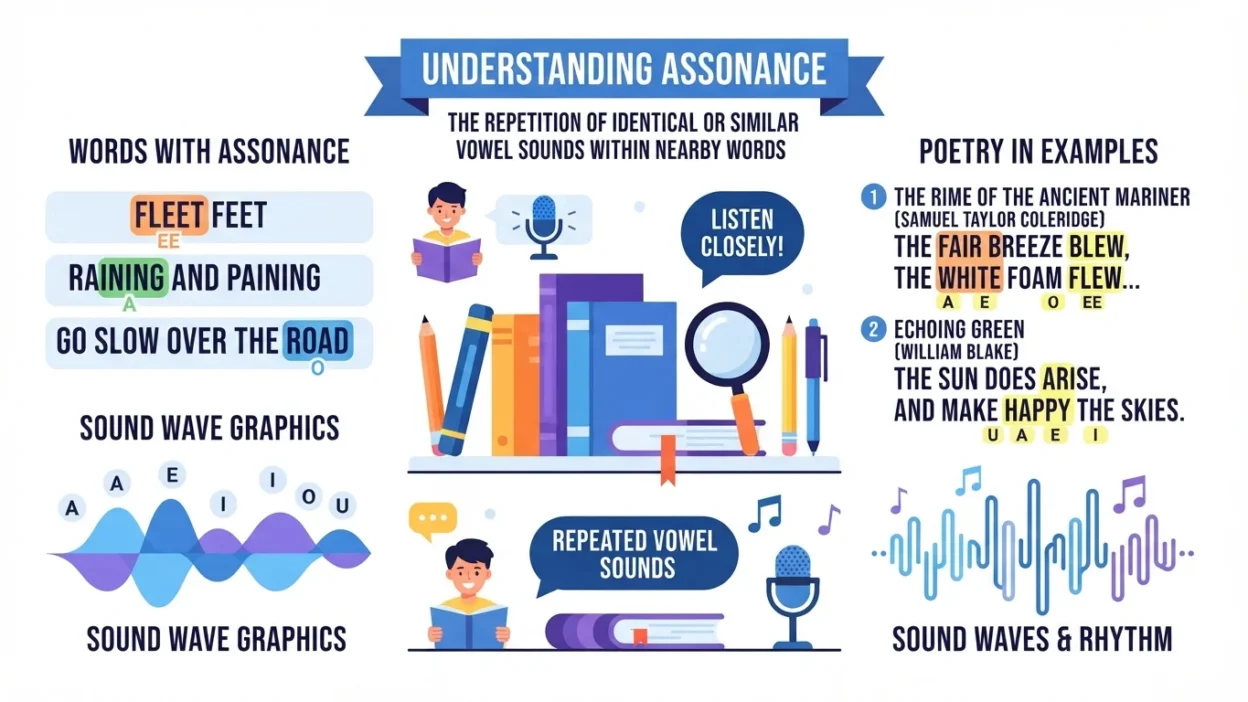
Assonance is a literary device in which the same or similar vowel sounds are repeated within nearby words to create rhythm, musicality, and emphasis. While assonance has no perfect one-word synonym, several literary and linguistic terms describe similar sound patterns or closely related stylistic techniques. Learning the synonyms of assonance can help students, writers, poets, and literature enthusiasts better understand and analyze poetic language.
Whether you’re studying literature, writing poetry, or improving your vocabulary, knowing alternatives and related terms to assonance can deepen your understanding of sound devices.
What Does “Assonance” Mean?
Assonance means:
- The repetition of similar vowel sounds in nearby words
- A literary technique that creates rhythm and musicality
- A sound pattern used in poetry and prose
Example Sentences
- The poem uses assonance to create a soothing rhythm.
- Writers often employ assonance to make lines more memorable.
- The repeated vowel sounds are an example of assonance.
Usage Tip
Since assonance is a specific literary term, most alternatives are related literary devices rather than exact synonyms. Use them according to the sound pattern or stylistic effect you wish to describe.
30 Synonyms and Related Terms for Assonance (With Meanings, Examples & Usage)
1. Vowel Repetition
Meaning: Repeating vowel sounds in nearby words.
Example: The verse relies on vowel repetition for rhythm.
Best Usage Context: Literary analysis.
2. Vowel Harmony
Meaning: Repetition or agreement of vowel sounds.
Example: The poem features subtle vowel harmony.
Best Usage Context: Linguistics and poetry.
3. Sound Repetition
Meaning: Repeating speech sounds for effect.
Example: Sound repetition gives the poem a lyrical quality.
Best Usage Context: General literary discussions.
4. Phonetic Repetition
Meaning: Repetition of speech sounds.
Example: Phonetic repetition strengthens the poem’s rhythm.
Best Usage Context: Linguistics.
5. Vocalic Repetition
Meaning: Repetition of vowel sounds.
Example: Vocalic repetition enhances the musical tone.
Best Usage Context: Academic writing.
6. Euphony
Meaning: Pleasant and harmonious sound.
Example: The poet created euphony through careful word choice.
Best Usage Context: Poetry and literature.
7. Musicality
Meaning: A pleasing rhythmic sound quality.
Example: The poem’s musicality captivates readers.
Best Usage Context: Literary criticism.
8. Sound Pattern
Meaning: A repeated arrangement of sounds.
Example: The sound pattern reinforces the poem’s theme.
Best Usage Context: Literary studies.
9. Internal Rhyme
Meaning: Rhyming words within the same line.
Example: Internal rhyme complements the assonance.
Best Usage Context: Poetry.
10. Alliteration
Meaning: Repetition of initial consonant sounds.
Example: The sentence uses alliteration and assonance together.
Best Usage Context: Literary analysis.
11. Consonance
Meaning: Repetition of consonant sounds.
Example: Consonance gives the poem added texture.
Best Usage Context: Poetry.
12. Rhyme
Meaning: Similar ending sounds in words.
Example: The rhyme scheme is easy to follow.
Best Usage Context: Poetry.
13. Half Rhyme
Meaning: Partial or imperfect rhyme.
Example: Half rhyme creates subtle sound effects.
Best Usage Context: Modern poetry.
14. Slant Rhyme
Meaning: Words with similar but not identical sounds.
Example: The poet frequently uses slant rhyme.
Best Usage Context: Creative writing.
15. Near Rhyme
Meaning: An approximate rhyme.
Example: Near rhyme adds complexity to the verse.
Best Usage Context: Poetry.
16. Echo Effect
Meaning: Repeated sounds that resemble an echo.
Example: The echo effect emphasizes emotion.
Best Usage Context: Descriptive literary writing.
17. Sonic Pattern
Meaning: A recurring arrangement of sounds.
Example: The sonic pattern enhances the mood.
Best Usage Context: Literary criticism.
18. Harmonic Sound
Meaning: Pleasant sound repetition.
Example: Harmonic sound gives the passage flow.
Best Usage Context: Poetry.
19. Rhythmic Device
Meaning: A technique used to create rhythm.
Example: Assonance is a common rhythmic device.
Best Usage Context: Literature classes.
20. Poetic Device
Meaning: A stylistic technique in poetry.
Example: The poet uses several poetic devices.
Best Usage Context: Literary discussions.
21. Literary Device
Meaning: A writing technique used for artistic effect.
Example: Assonance is an important literary device.
Best Usage Context: Academic writing.
22. Phonetic Pattern
Meaning: A recurring arrangement of speech sounds.
Example: The phonetic pattern strengthens the poem.
Best Usage Context: Linguistics.
23. Vocal Harmony
Meaning: Harmony created through repeated vowel sounds.
Example: Vocal harmony contributes to the poem’s elegance.
Best Usage Context: Literary analysis.
24. Acoustic Repetition
Meaning: Repeated sound elements.
Example: Acoustic repetition creates emphasis.
Best Usage Context: Linguistic studies.
25. Sound Device
Meaning: A literary technique based on sound.
Example: Assonance is a widely used sound device.
Best Usage Context: Literature education.
26. Oral Rhythm
Meaning: The rhythmic quality of spoken language.
Example: Oral rhythm improves memorability.
Best Usage Context: Speech and poetry.
27. Melodic Effect
Meaning: A musical quality in language.
Example: The melodic effect makes the poem enjoyable.
Best Usage Context: Creative writing.
28. Lyricism
Meaning: A musical and expressive quality.
Example: Lyricism is enhanced through assonance.
Best Usage Context: Poetry analysis.
29. Harmonic Pattern
Meaning: A repeated sound arrangement.
Example: The harmonic pattern supports the poem’s mood.
Best Usage Context: Literary criticism.
30. Prosodic Feature
Meaning: A feature related to rhythm and sound in language.
Example: Assonance is an important prosodic feature.
Best Usage Context: Linguistics and advanced literary studies.
Comparison Table: When to Use Different Assonance-Related Terms
| Context | Best Terms |
|---|---|
| Literary Analysis | Vowel Repetition, Sound Pattern, Poetic Device |
| Poetry | Euphony, Musicality, Lyricism |
| Linguistics | Phonetic Repetition, Prosodic Feature, Vocalic Repetition |
| General Writing | Sound Device, Rhythmic Device, Literary Device |
| Sound Comparisons | Alliteration, Consonance, Internal Rhyme |
How to Choose the Right Term
For Literary Analysis
Use:
- Vowel Repetition
- Sound Pattern
- Literary Device
For Poetry Discussions
Use:
- Euphony
- Musicality
- Lyricism
For Linguistics
Use:
- Phonetic Repetition
- Vocalic Repetition
- Prosodic Feature
For Comparing Sound Devices
Use:
- Alliteration
- Consonance
- Internal Rhyme
Conclusion
Learning the synonyms and related terms for assonance helps you better understand how writers use sound to create rhythm, mood, and emphasis. Although assonance is a specialized literary term with no exact one-word synonym, related expressions such as vowel repetition, euphony, musicality, sound pattern, and phonetic repetition describe similar concepts or effects.
Understanding these related terms will strengthen your knowledge of poetry, literary analysis, and creative writing while helping you recognize how sound enhances the beauty and impact of language.

A passionate linguist who specializes in word relationships and vocabulary building.
He has spent years studying synonyms and semantic patterns across languages.
Arman writes to make language learning simple, precise, and engaging.