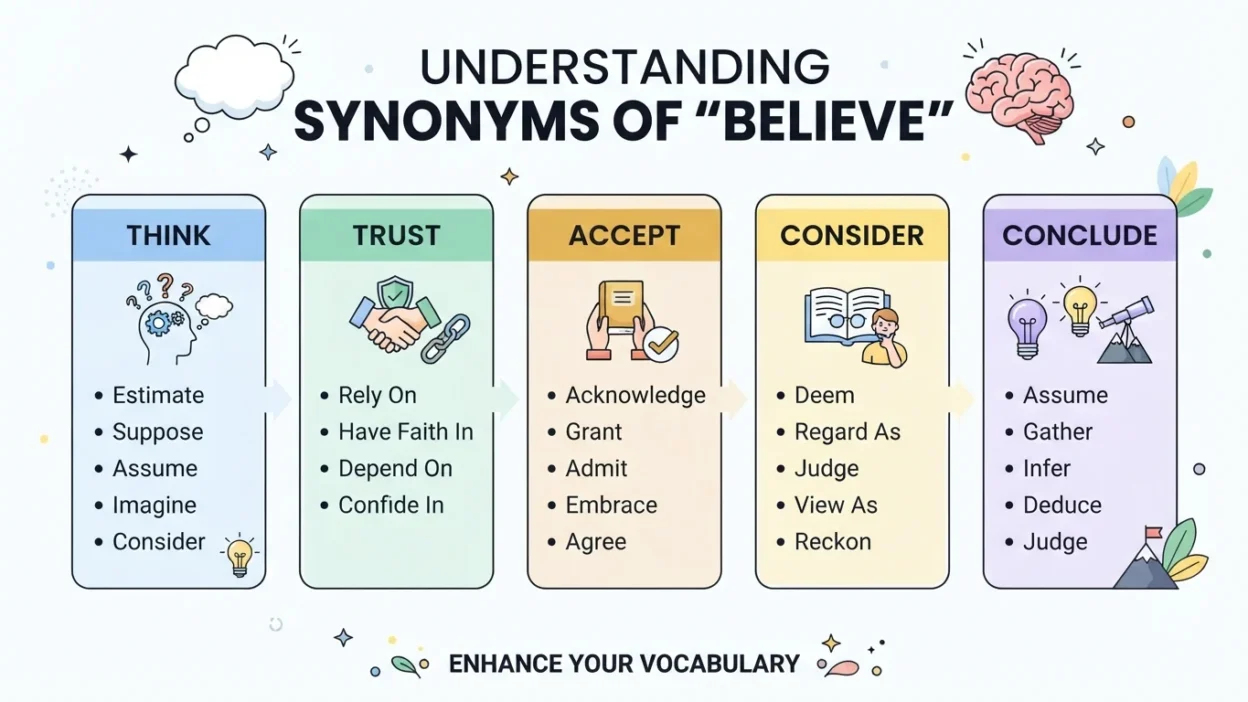
The word believe means to accept something as true, have confidence in someone or something, or hold a particular opinion. Learning the synonyms of believe can help students, ESL learners, writers, and professionals expand their vocabulary and express different levels of certainty, trust, and opinion more accurately.
Whether you’re writing an essay, business report, novel, or having everyday conversations, using alternatives to believe can make your communication clearer and more engaging.
What Does “Believe” Mean?
Believe means:
- To accept something as true
- To trust or have faith in someone or something
- To think or suppose something is correct
- To have confidence in an idea or person
Example Sentences
- I believe your explanation is correct.
- She believes in working hard.
- They believe the project will succeed.
Usage Tip
Use believe when expressing trust, confidence, acceptance, or personal opinion about a person, fact, or idea.
1. Think
Meaning: To have an opinion or idea.
Example: I think the meeting will start soon.
Best Usage Context: Everyday conversations.
2. Trust
Meaning: To have confidence in someone or something.
Example: I trust her judgment.
Best Usage Context: Personal and professional relationships.
3. Accept
Meaning: To regard something as true.
Example: They accepted the explanation without question.
Best Usage Context: Formal and general writing.
4. Assume
Meaning: To suppose something is true without proof.
Example: Don’t assume everyone agrees.
Best Usage Context: Academic and business writing.
5. Suppose
Meaning: To think something is likely.
Example: I suppose he will arrive later.
Best Usage Context: Everyday communication.
6. Consider
Meaning: To think carefully or regard in a certain way.
Example: I consider her an expert.
Best Usage Context: Formal writing.
7. Expect
Meaning: To think something will happen.
Example: We expect good results.
Best Usage Context: Business and everyday use.
8. Presume
Meaning: To believe something based on probability.
Example: I presumed the office was closed.
Best Usage Context: Formal writing.
9. Imagine
Meaning: To think or picture something mentally.
Example: I can’t imagine life without music.
Best Usage Context: Creative writing.
10. Suspect
Meaning: To believe something may be true.
Example: I suspect he’s already left.
Best Usage Context: Investigations and discussions.
11. Feel
Meaning: To have a personal opinion or impression.
Example: I feel this is the right decision.
Best Usage Context: Informal communication.
12. Be Convinced
Meaning: To be certain something is true.
Example: She is convinced the plan will work.
Best Usage Context: Formal and persuasive writing.
13. Have Faith In
Meaning: To trust completely.
Example: We have faith in our team.
Best Usage Context: Personal and motivational writing.
14. Count On
Meaning: To rely on someone or something.
Example: You can count on me.
Best Usage Context: Everyday conversations.
15. Credit
Meaning: To accept as true.
Example: Few people credited the rumor.
Best Usage Context: Journalism and formal writing.
16. Rely On
Meaning: To depend on with confidence.
Example: Businesses rely on accurate data.
Best Usage Context: Professional writing.
17. Endorse
Meaning: To support or approve publicly.
Example: Experts endorsed the proposal.
Best Usage Context: Business and politics.
18. Affirm
Meaning: To state or accept as true.
Example: The witness affirmed the statement.
Best Usage Context: Legal and formal writing.
19. Acknowledge
Meaning: To recognize or accept.
Example: She acknowledged the importance of education.
Best Usage Context: Academic and professional writing.
20. Recognize
Meaning: To accept or realize something.
Example: We recognize the need for change.
Best Usage Context: General communication.
21. Maintain
Meaning: To continue believing or asserting.
Example: He maintains that he is innocent.
Best Usage Context: Formal writing.
22. Hold
Meaning: To have a particular opinion.
Example: Many people hold different views.
Best Usage Context: Academic discussions.
23. Deem
Meaning: To regard or judge.
Example: The proposal was deemed acceptable.
Best Usage Context: Formal writing.
24. Infer
Meaning: To reach a conclusion based on evidence.
Example: We can infer the cause from the data.
Best Usage Context: Academic and research writing.
25. Gather
Meaning: To conclude from available information.
Example: I gather that the event was successful.
Best Usage Context: Everyday and formal writing.
26. Conclude
Meaning: To decide after reasoning.
Example: Scientists concluded the experiment was successful.
Best Usage Context: Research and academic writing.
27. Estimate
Meaning: To form an approximate opinion.
Example: Experts estimate the costs will increase.
Best Usage Context: Business and finance.
28. Reckon
Meaning: To think or believe (mainly British English).
Example: I reckon we’ll arrive before noon.
Best Usage Context: Informal British English.
29. Be Certain
Meaning: To have no doubt.
Example: She is certain the answer is correct.
Best Usage Context: Formal and everyday writing.
30. Be Sure
Meaning: To feel confident about something.
Example: I’m sure everything will be fine.
Best Usage Context: Everyday conversations.
Comparison Table: When to Use Different Believe Synonyms
| Context | Best Synonyms |
|---|---|
| Everyday Conversations | Think, Suppose, Feel |
| Trust & Confidence | Trust, Have Faith In, Rely On |
| Academic Writing | Infer, Conclude, Consider |
| Formal Writing | Affirm, Deem, Maintain |
| Opinions | Hold, Recognize, Accept |
How to Choose the Right Synonym
For Everyday Use
Use:
- Think
- Suppose
- Feel
For Trust and Confidence
Use:
- Trust
- Have Faith In
- Rely On
For Academic Writing
Use:
- Infer
- Conclude
- Consider
For Formal Writing
Use:
- Affirm
- Maintain
- Deem
For Expressing Opinions
Use:
- Hold
- Accept
- Recognize
Conclusion
Learning the synonyms of believe helps you express opinions, trust, confidence, and certainty with greater precision. While believe is one of the most commonly used verbs in English, alternatives such as think, trust, accept, consider, and conclude can better match specific situations and writing styles.
Choosing the right synonym makes your writing more natural, varied, and engaging. Whether you’re expressing a personal opinion, showing confidence in someone, presenting research findings, or writing professionally, these alternatives to believe will help you communicate your ideas more effectively.

An expert in English grammar and expressive writing techniques.
She focuses on helping readers expand their vocabulary with clarity.
Elina believes the right word can transform ordinary writing into powerful communication.