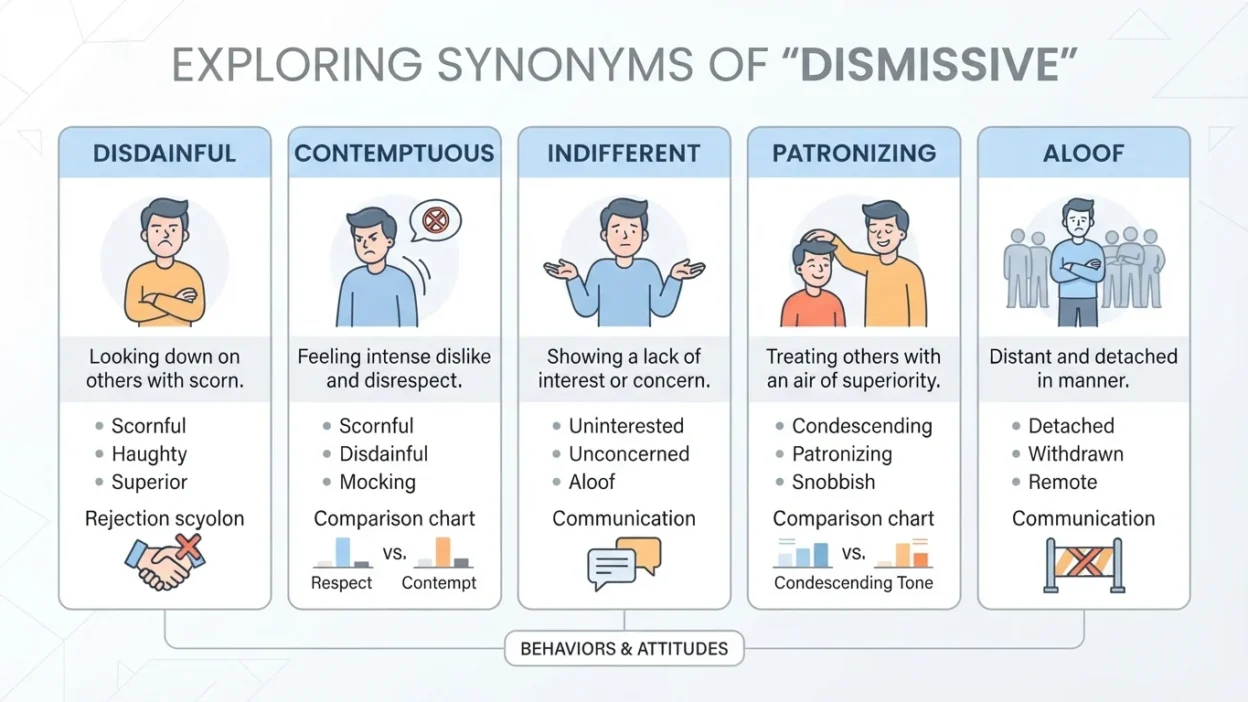
The word dismissive describes an attitude or behavior that shows someone considers a person, idea, or suggestion to be unimportant, unworthy of attention, or not deserving serious consideration. Learning the synonyms of dismissive can help students, ESL learners, writers, and professionals express different shades of disregard, indifference, or rejection more accurately.
Whether you’re writing an essay, novel, business email, or blog post, knowing alternatives to dismissive can make your writing more expressive and precise.
What Does “Dismissive” Mean?
Dismissive means:
- Showing a lack of interest or respect
- Treating someone or something as unimportant
- Rejecting an idea without serious consideration
- Displaying indifference or contempt
Example Sentences
- His dismissive attitude upset the team.
- She gave a dismissive wave and walked away.
- The manager was dismissive of the employee’s concerns.
Usage Tip
Use dismissive when describing someone who ignores, rejects, or undervalues people, opinions, or ideas.
30 Synonyms of Dismissive (With Meanings, Examples & Usage)
1. Disdainful
Meaning: Showing strong dislike or contempt.
Example: She gave him a disdainful look.
Best Usage Context: Formal writing and literature.
2. Contemptuous
Meaning: Expressing scorn or disrespect.
Example: His contemptuous remarks offended everyone.
Best Usage Context: Professional and literary writing.
3. Scornful
Meaning: Showing open disrespect or ridicule.
Example: The critic made a scornful comment.
Best Usage Context: Reviews and discussions.
4. Derisive
Meaning: Expressing mockery or ridicule.
Example: The audience responded with derisive laughter.
Best Usage Context: Journalism and storytelling.
5. Indifferent
Meaning: Showing little or no interest.
Example: She seemed indifferent to the outcome.
Best Usage Context: Everyday communication.
6. Unconcerned
Meaning: Not worried or interested.
Example: He remained unconcerned despite the criticism.
Best Usage Context: General writing.
7. Apathetic
Meaning: Showing a lack of enthusiasm or emotion.
Example: The students appeared apathetic during the lecture.
Best Usage Context: Psychology and education.
8. Aloof
Meaning: Emotionally distant or detached.
Example: She remained aloof throughout the meeting.
Best Usage Context: Personality descriptions.
9. Detached
Meaning: Emotionally uninvolved.
Example: He gave a detached response.
Best Usage Context: Professional writing.
10. Offhand
Meaning: Casual and lacking careful thought.
Example: She made an offhand remark.
Best Usage Context: Everyday conversations.
11. Curt
Meaning: Rudely brief.
Example: His curt reply ended the discussion.
Best Usage Context: Workplace communication.
12. Brusque
Meaning: Abrupt and unfriendly.
Example: The receptionist sounded brusque.
Best Usage Context: Professional interactions.
13. Cold
Meaning: Lacking warmth or sympathy.
Example: He gave a cold response.
Best Usage Context: Emotional descriptions.
14. Unresponsive
Meaning: Failing to react or reply.
Example: The customer service team was unresponsive.
Best Usage Context: Business and customer support.
15. Disinterested
Meaning: Lacking interest or involvement.
Example: She seemed disinterested in the conversation.
Best Usage Context: General communication.
16. Condescending
Meaning: Treating others as inferior.
Example: His condescending tone annoyed the staff.
Best Usage Context: Workplace and social settings.
17. Patronizing
Meaning: Appearing kind while showing superiority.
Example: She found his patronizing comments insulting.
Best Usage Context: Professional writing.
18. Snobbish
Meaning: Behaving as though superior to others.
Example: His snobbish attitude made him unpopular.
Best Usage Context: Personality descriptions.
19. Arrogant
Meaning: Showing excessive self-importance.
Example: The executive appeared arrogant during the meeting.
Best Usage Context: Leadership and workplace discussions.
20. Haughty
Meaning: Proud and disdainfully superior.
Example: The noblewoman had a haughty expression.
Best Usage Context: Literary writing.
21. Supercilious
Meaning: Behaving as though others are inferior.
Example: His supercilious smile irritated everyone.
Best Usage Context: Formal and literary writing.
22. Insolent
Meaning: Showing rude disrespect.
Example: The student gave an insolent reply.
Best Usage Context: Education and formal writing.
23. Rude
Meaning: Impolite or discourteous.
Example: His rude behavior shocked the guests.
Best Usage Context: Everyday use.
24. Disrespectful
Meaning: Showing a lack of respect.
Example: The comment was disrespectful to the speaker.
Best Usage Context: General writing.
25. Neglectful
Meaning: Failing to give proper attention.
Example: The neglectful attitude affected the project.
Best Usage Context: Workplace and caregiving.
26. Rejecting
Meaning: Refusing to accept or consider.
Example: She was rejecting every suggestion.
Best Usage Context: General discussions.
27. Belittling
Meaning: Making someone seem less important.
Example: His belittling remarks hurt her confidence.
Best Usage Context: Workplace and relationships.
28. Minimizing
Meaning: Treating something as less important than it is.
Example: The manager kept minimizing employee concerns.
Best Usage Context: Business and communication.
29. Skeptical
Meaning: Doubting the value or truth of something.
Example: She remained skeptical of the proposal.
Best Usage Context: Academic and professional writing.
30. Unimpressed
Meaning: Not showing admiration or approval.
Example: The judges were unimpressed by the performance.
Best Usage Context: Reviews and everyday conversations.
Comparison Table: When to Use Different Dismissive Synonyms
| ContextBest Synonyms | |
|---|---|
| Everyday Conversations | Indifferent, Cold, Rude |
| Workplace | Condescending, Patronizing, Curt |
| Formal Writing | Disdainful, Contemptuous, Supercilious |
| Personality Traits | Aloof, Arrogant, Haughty |
| Criticism & Rejection | Scornful, Derisive, Belittling |
How to Choose the Right Synonym
For Everyday Use
Use:
- Indifferent
- Cold
- Rude
For Professional Settings
Use:
- Curt
- Condescending
- Patronizing
For Formal Writing
Use:
- Disdainful
- Contemptuous
- Supercilious
For Personality Descriptions
Use:
- Aloof
- Haughty
- Arrogant
For Negative Feedback
Use:
- Belittling
- Scornful
- Derisive
Conclusion
Learning the synonyms of dismissive helps you describe attitudes of indifference, disrespect, or rejection with greater accuracy. While dismissive is a versatile word, alternatives such as disdainful, contemptuous, aloof, patronizing, and belittling can better convey specific emotions and behaviors depending on the context.
Choosing the right synonym improves clarity, strengthens your vocabulary, and makes your writing more engaging. Whether you’re describing workplace interactions, personal relationships, literary characters, or everyday conversations, using varied alternatives to dismissive will make your communication more natural and expressive.

An expert in English grammar and expressive writing techniques.
She focuses on helping readers expand their vocabulary with clarity.
Elina believes the right word can transform ordinary writing into powerful communication.