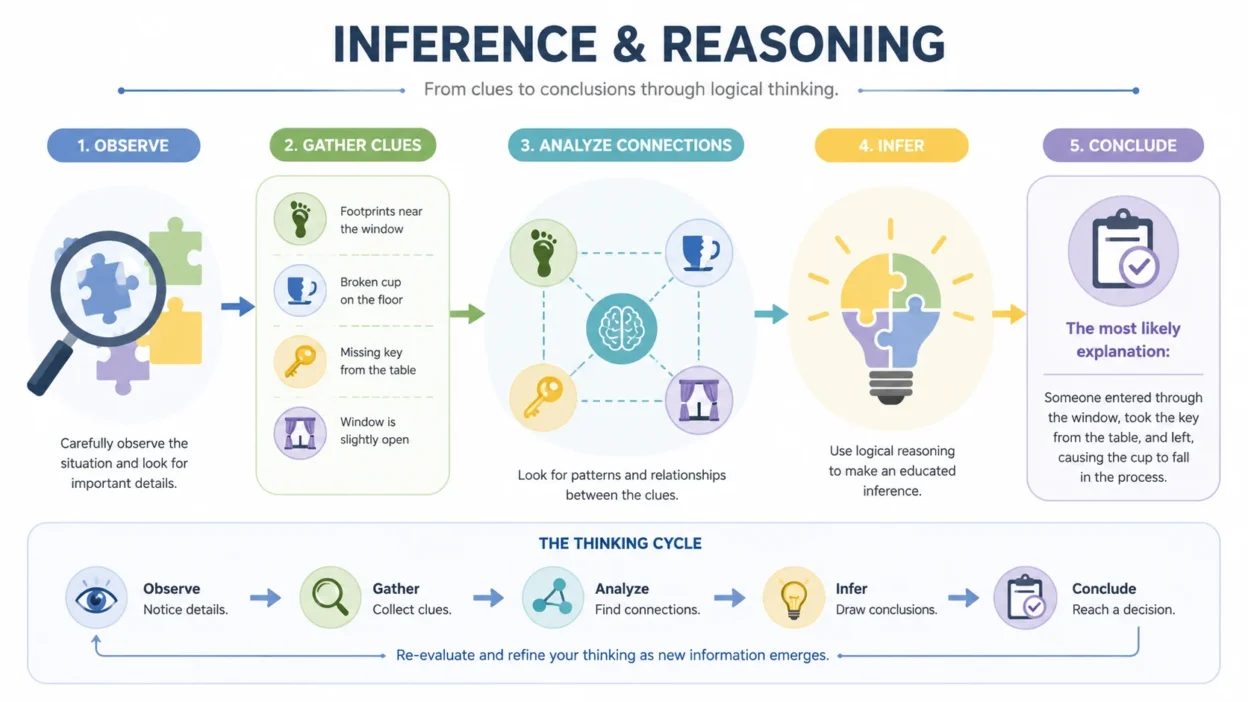
Learning the synonyms of infer can help you improve your reading, writing, and communication skills. Whether you’re a student, ESL learner, writer, or content creator, understanding these alternatives will help you express conclusions, assumptions, and logical thinking more clearly.
The word infer is commonly used in academic writing, conversations, and analysis. It means reaching a conclusion based on evidence or clues rather than direct statements. Since different situations require different tones, learning synonyms of infer can make your vocabulary richer and more precise.
What Does “Infer” Mean?
Infer means:
- To reach a conclusion using evidence or reasoning
- To understand something that is not directly stated
Example:
From his tone, I inferred that he was upset.
Readers can infer the character’s feelings from the story.
Usage Tip:
Use infer when describing logical conclusions based on clues, observations, or indirect information.
30 Synonyms of Infer (With Meanings, Examples & Usage)
1. Conclude
Meaning: To decide after thinking about evidence
Example: Scientists concluded the test was successful.
Best Use: Academic or formal writing
2. Deduce
Meaning: To logically figure something out
Example: Detectives deduced the truth quickly.
Best Use: Logic or investigations
3. Understand
Meaning: To realize or comprehend something
Example: I understood what she meant.
Best Use: Everyday conversation
4. Gather
Meaning: To understand from information or clues
Example: I gathered that the meeting was canceled.
Best Use: Informal use
5. Assume
Meaning: To think something is true without full proof
Example: He assumed they were friends.
Best Use: Casual or uncertain contexts
6. Interpret
Meaning: To explain the meaning of something
Example: She interpreted the message differently.
Best Use: Analysis or communication
7. Derive
Meaning: To obtain a conclusion from information
Example: Researchers derived insights from the data.
Best Use: Academic or scientific writing
8. Reason
Meaning: To think logically about something
Example: He reasoned that it was the best option.
Best Use: Formal discussions
9. Read between the lines
Meaning: To understand hidden meaning
Example: You must read between the lines.
Best Use: Informal or literary contexts
10. Surmise
Meaning: To guess based on limited evidence
Example: She surmised the answer correctly.
Best Use: Formal writing
11. Guess
Meaning: To form an opinion without certainty
Example: I guessed he was tired.
Best Use: Everyday language
12. Presume
Meaning: To suppose something is true
Example: We presumed the train was late.
Best Use: Formal communication
13. Figure out
Meaning: To understand after thinking
Example: She figured out the problem.
Best Use: Casual conversation
14. Discern
Meaning: To notice or understand clearly
Example: He discerned a hidden meaning.
Best Use: Literary or formal writing
15. Detect
Meaning: To discover or notice something
Example: Experts detected signs of change.
Best Use: Science or investigation
16. Perceive
Meaning: To become aware of something
Example: She perceived tension in the room.
Best Use: Formal or emotional contexts
17. Recognize
Meaning: To identify or realize
Example: He recognized the importance immediately.
Best Use: General use
18. Extract meaning
Meaning: To find understanding from information
Example: Students extracted meaning from the text.
Best Use: Educational contexts
19. Decipher
Meaning: To understand something difficult
Example: She deciphered the hidden code.
Best Use: Puzzles or analysis
20. Analyze
Meaning: To study carefully for understanding
Example: Researchers analyzed the results.
Best Use: Academic or professional writing
21. Think
Meaning: To form ideas or conclusions
Example: I think he agrees with us.
Best Use: Everyday language
22. Speculate
Meaning: To form ideas without clear proof
Example: People speculated about the future.
Best Use: Uncertain discussions
23. Comprehend
Meaning: To fully understand
Example: Students comprehended the lesson easily.
Best Use: Formal education contexts
24. Conjecture
Meaning: To form an opinion from incomplete evidence
Example: His statement was pure conjecture.
Best Use: Formal or academic writing
25. Sense
Meaning: To feel or understand indirectly
Example: I sensed something was wrong.
Best Use: Emotional or intuitive contexts
26. Observe
Meaning: To notice carefully
Example: Scientists observed unusual behavior.
Best Use: Research or science
27. Realize
Meaning: To suddenly understand
Example: She realized the truth later.
Best Use: Everyday conversation
28. Determine
Meaning: To establish after analysis
Example: Experts determined the cause quickly.
Best Use: Formal or scientific contexts
29. Read into
Meaning: To find extra meaning in something
Example: Don’t read too much into his words.
Best Use: Informal speaking
30. Draw a conclusion
Meaning: To decide based on evidence
Example: The jury drew a conclusion carefully.
Best Use: Formal analysis
Quick Comparison Table
| Context | Best Synonyms |
|---|---|
| Formal reasoning | Deduce, conclude, determine |
| Casual understanding | Guess, figure out, think |
| Hidden meaning | Read between the lines, discern |
| Academic analysis | Analyze, derive, interpret |
| Uncertain assumptions | Assume, speculate, conjecture |
How to Choose the Right Synonym
✔ For Formal or Academic Writing
Use:
- Deduce
- Conclude
- Determine
✔ For Everyday Conversation
Use:
- Guess
- Figure out
- Realize
✔ For Hidden Meanings
Use:
- Discern
- Read between the lines
- Interpret
✔ For Analysis or Research
Use:
- Analyze
- Derive
- Observe
✔ For Uncertain Conclusions
Use:
- Assume
- Speculate
- Conjecture
Conclusion
Learning the synonyms of infer helps you express reasoning, understanding, and conclusions more clearly. Since infer often involves logic and interpretation, different synonyms fit different situations and tones.

An expert in English grammar and expressive writing techniques.
She focuses on helping readers expand their vocabulary with clarity.
Elina believes the right word can transform ordinary writing into powerful communication.