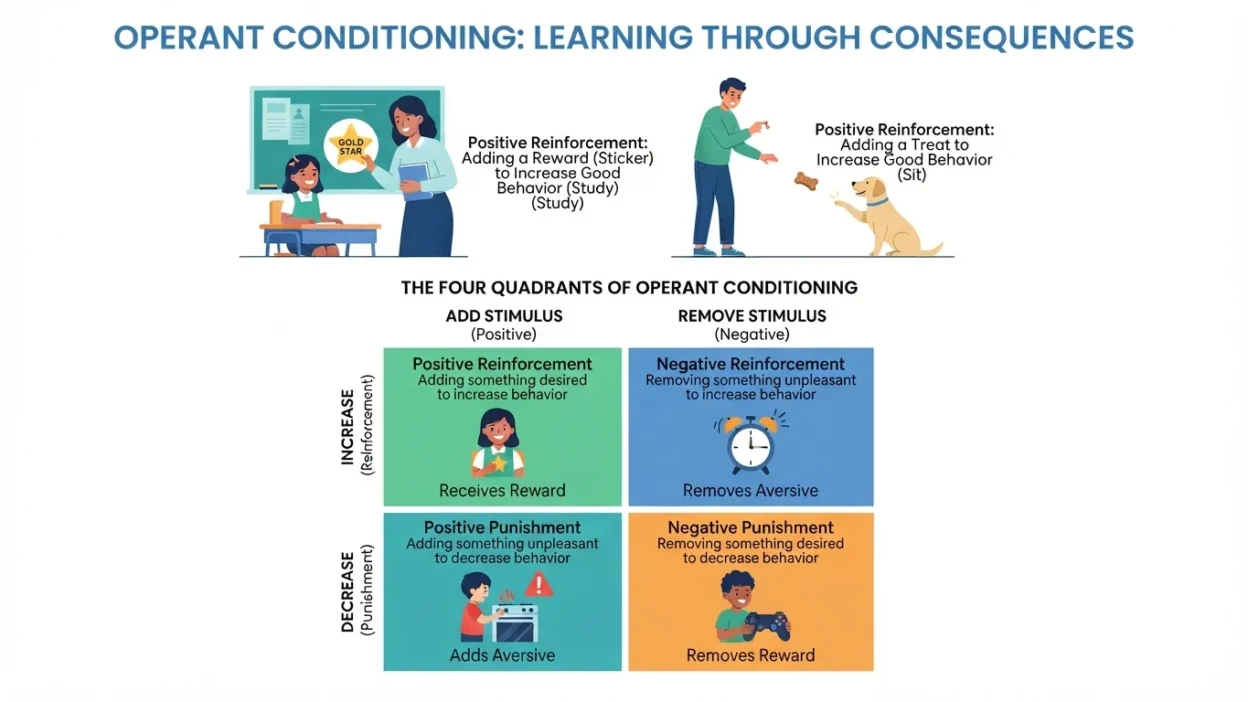
Operant conditioning is a psychological learning process in which behavior is influenced by its consequences, such as rewards and punishments. Introduced by B. F. Skinner, this concept is widely used in psychology, education, animal training, and behavioral science.
Since operant conditioning is a specialized scientific term, there are few exact synonyms. However, many related terms and alternative expressions describe the same concept or closely associated learning methods.
What Does “Operant Conditioning” Mean?
Operant conditioning means:
- Learning through rewards and punishments
- Behavior modification based on consequences
- A learning process where actions become more or less likely depending on outcomes
- A form of associative learning
Example Sentences
- Teachers often use operant conditioning to encourage positive classroom behavior.
- Dog trainers rely on operant conditioning techniques.
- Positive reinforcement is one of the key principles of operant conditioning.
Usage Tip
Use operant conditioning in psychology, education, behavioral science, and animal training. Many alternatives below are closely related concepts rather than exact replacements.
30 Synonyms and Related Terms for Operant Conditioning (With Meanings, Examples & Usage)
1. Instrumental Conditioning
Meaning: Another name for operant conditioning.
Example: Instrumental conditioning explains how consequences influence behavior.
Best Usage Context: Psychology textbooks.
2. Behavioral Conditioning
Meaning: Training behavior through consequences.
Example: Behavioral conditioning improved workplace safety.
Best Usage Context: Psychology and education.
3. Behavior Modification
Meaning: Changing behavior through reinforcement techniques.
Example: The therapist used behavior modification strategies.
Best Usage Context: Psychology and counseling.
4. Reinforcement Learning
Meaning: Learning through rewards and feedback.
Example: Reinforcement learning encourages desirable habits.
Best Usage Context: Psychology and artificial intelligence.
5. Reward-Based Learning
Meaning: Learning driven by rewards.
Example: Reward-based learning motivates young children.
Best Usage Context: Education.
6. Consequence-Based Learning
Meaning: Learning influenced by outcomes.
Example: Consequence-based learning shapes future decisions.
Best Usage Context: Behavioral science.
7. Behavioral Training
Meaning: Training that develops desired behaviors.
Example: Behavioral training improved customer service skills.
Best Usage Context: Education and workplace training.
8. Reinforcement Theory
Meaning: A theory explaining behavior through reinforcement.
Example: Reinforcement theory is widely applied in management.
Best Usage Context: Psychology and business.
9. Response Conditioning
Meaning: Conditioning that alters behavioral responses.
Example: Response conditioning strengthened positive habits.
Best Usage Context: Psychology.
10. Learned Behavior
Meaning: Behavior acquired through experience.
Example: Sharing is often a learned behavior.
Best Usage Context: General psychology.
11. Associative Learning
Meaning: Learning by forming connections between events or behaviors.
Example: Operant conditioning is a type of associative learning.
Best Usage Context: Educational writing.
12. Positive Reinforcement
Meaning: Encouraging behavior by adding a reward.
Example: Praise is a form of positive reinforcement.
Best Usage Context: Education and parenting.
13. Negative Reinforcement
Meaning: Encouraging behavior by removing something unpleasant.
Example: Completing work early eliminated extra assignments.
Best Usage Context: Psychology.
14. Positive Punishment
Meaning: Discouraging behavior by adding an unpleasant consequence.
Example: Additional chores served as positive punishment.
Best Usage Context: Behavioral psychology.
15. Negative Punishment
Meaning: Discouraging behavior by removing a desirable item.
Example: Losing screen time was negative punishment.
Best Usage Context: Parenting and education.
16. Reward Conditioning
Meaning: Conditioning through rewards.
Example: Reward conditioning encouraged participation.
Best Usage Context: Training.
17. Incentive Learning
Meaning: Learning motivated by incentives.
Example: Incentive learning increased productivity.
Best Usage Context: Business and education.
18. Habit Formation
Meaning: Developing behaviors through repetition.
Example: Habit formation requires consistent reinforcement.
Best Usage Context: Self-improvement.
19. Behavioral Reinforcement
Meaning: Strengthening desired behavior.
Example: Behavioral reinforcement improved attendance.
Best Usage Context: Education.
20. Contingency Learning
Meaning: Learning based on consequences.
Example: Contingency learning explains many workplace behaviors.
Best Usage Context: Psychology.
21. Response Shaping
Meaning: Gradually reinforcing desired behaviors.
Example: Trainers used response shaping to teach new skills.
Best Usage Context: Animal training.
22. Shaping
Meaning: Reinforcing successive improvements toward a target behavior.
Example: Shaping helped the dolphin learn new tricks.
Best Usage Context: Behavioral psychology.
23. Behavioral Management
Meaning: Controlling behavior through structured techniques.
Example: Schools use behavioral management strategies.
Best Usage Context: Education.
24. Incentive Conditioning
Meaning: Learning influenced by rewards.
Example: Incentive conditioning improved employee performance.
Best Usage Context: Business.
25. Reward System
Meaning: A structured method of encouraging behavior.
Example: The classroom reward system motivated students.
Best Usage Context: Schools.
26. Behavioral Adaptation
Meaning: Adjusting behavior based on experience.
Example: Behavioral adaptation occurs through repeated reinforcement.
Best Usage Context: Psychology.
27. Learning by Consequences
Meaning: Acquiring behaviors through outcomes.
Example: Children often learn by consequences.
Best Usage Context: Educational writing.
28. Reinforcement-Based Training
Meaning: Training centered on reinforcement principles.
Example: Reinforcement-based training is effective for pets.
Best Usage Context: Animal training.
29. Contingency Management
Meaning: A behavior-change approach using rewards.
Example: Contingency management is used in addiction treatment.
Best Usage Context: Clinical psychology.
30. Behavioral Learning
Meaning: Learning that focuses on observable behavior changes.
Example: Behavioral learning theories emphasize reinforcement.
Best Usage Context: Education and psychology.
Comparison Table: When to Use Different Operant Conditioning Synonyms
| Context | Best Terms |
|---|---|
| Psychology | Instrumental Conditioning, Behavior Modification, Associative Learning |
| Education | Behavioral Conditioning, Reward-Based Learning, Positive Reinforcement |
| Animal Training | Shaping, Reinforcement-Based Training, Response Shaping |
| Workplace | Reinforcement Theory, Incentive Learning, Behavioral Management |
| Clinical Psychology | Contingency Management, Behavior Modification, Behavioral Reinforcement |
How to Choose the Right Term
For Psychology
Use:
- Instrumental Conditioning
- Associative Learning
- Behavior Modification
For Education
Use:
- Behavioral Conditioning
- Positive Reinforcement
- Reward-Based Learning
For Animal Training
Use:
- Shaping
- Reinforcement-Based Training
- Response Shaping
For Business
Use:
- Reinforcement Theory
- Incentive Learning
- Behavioral Management
For Clinical Settings
Use:
- Contingency Management
- Behavior Modification
- Behavioral Reinforcement
Conclusion
Learning the synonyms of operant conditioning helps you understand and explain one of psychology’s most important learning theories. Although instrumental conditioning is the closest true synonym, many related terms—such as behavior modification, reinforcement learning, behavioral conditioning, and contingency management—describe specific aspects or applications of the same concept.
Selecting the most appropriate term for your audience and context will make your writing more accurate, informative, and professional.