“To” is a very common English word with several grammatical uses. Because its meaning changes depending on the sentence, there is no single synonym that works everywhere.
Quick Answer
Depending on context, alternatives for to can include:
- Toward
- Towards
- Into
- Onto
- Until
- For
- In order to
- So as to
- Up to
- As far as
- In the direction of
- With
- At
- Against
- Regarding
- Concerning
- Compared with
- Relative to
- According to
- Per
- Via
- Through
- By
- For the purpose of
- With the aim of
- In relation to
- Leading to
- Resulting in
- Next to
- Adjacent to
“To” Meaning Direction
When to shows movement toward a place or person, use:
Toward / Towards
She walked to the door.
She walked toward the door.
Best synonym: toward / towards
In the Direction of
He drove to the city.
He drove in the direction of the city.
This is more formal and less natural in everyday English.
Into
Use into when movement goes inside something.
She went to the room.
She went into the room.
Note: “Into” is not always interchangeable with “to.”
“To” Meaning Purpose
When to + verb expresses purpose, use:
In Order To
I went outside to get some fresh air.
I went outside in order to get some fresh air.
So As To
She studied hard to pass the exam.
She studied hard so as to pass the exam.
“So as to” is more formal.
For the Purpose of
They met to discuss the problem.
They met for the purpose of discussing the problem.
This is formal and useful in academic or professional writing.
With the Aim of
The campaign was created to raise awareness.
The campaign was created with the aim of raising awareness.
“To” Meaning Recipient
When to identifies the person receiving something:
I gave the book to Sarah.
Possible alternatives depend on the sentence:
- For
- Into the hands of
- In the possession of
However, these are not always direct replacements.
I bought a gift for Sarah.
Notice that for changes the meaning: Sarah is the intended recipient, not necessarily the person receiving it at that moment.
“To” Meaning Until
To can indicate an endpoint in time.
The store is open from 9 to 5.
Possible alternatives:
- Until
- Up until
- Through
Until
The store is open from 9 to 5.
The store is open until 5.
Up Until
Wait to five o’clock.
Wait up until five o’clock.
Up until is more emphatic.
“To” Meaning Comparison
In expressions such as prefer A to B, “to” means comparison.
I prefer tea to coffee.
Possible alternatives:
- Rather than
- Over
- Compared with
I prefer tea rather than coffee.
However, prefer A to B is the standard natural construction.
“To” Meaning Relationship
In some expressions, to means “in relation to” or “regarding.”
This is important to me.
Possible alternatives in certain contexts:
- For
- Regarding
- Concerning
- In relation to
- With respect to
Example
The issue is important to the company.
The issue is important for the company.
Here, changing to to for can slightly change the meaning, so context matters.
“To” in Common Expressions
| Expression | Possible Alternative |
|---|---|
| Go to school | Go toward school |
| Walk to the park | Walk toward the park |
| Study to pass | Study in order to pass |
| From Monday to Friday | From Monday until Friday |
| Give it to me | Give it for me (different meaning) |
| Similar to this | Similar to this (usually keep “to”) |
| According to him | As stated by him |
| Next to me | Beside me |
| Close to the house | Near the house |
| Related to science | Related to science |
| Prefer tea to coffee | Prefer tea over coffee |
| Due to rain | Because of rain |
| In addition to | Along with |
| According to | As stated by |
| Thanks to | Because of |
“To” vs “Too” vs “Two”
These three words sound similar but have completely different meanings.
To
Usually shows direction, relationship, or purpose.
I went to school.
Too
Means also or excessively.
I want to go too.
It is too hot.
Two
The number 2.
I have two books.
“To” vs “Toward”
To usually indicates a destination.
She went to the store.
Toward indicates movement in a particular direction, but not necessarily reaching the destination.
She walked toward the store.
“To” vs “For”
These are frequently confused.
Use to for movement or direction:
I went to the office.
Use for for purpose, benefit, or intended recipient:
I bought this for my sister.
Compare:
I gave the letter to John.
I bought a gift for John.
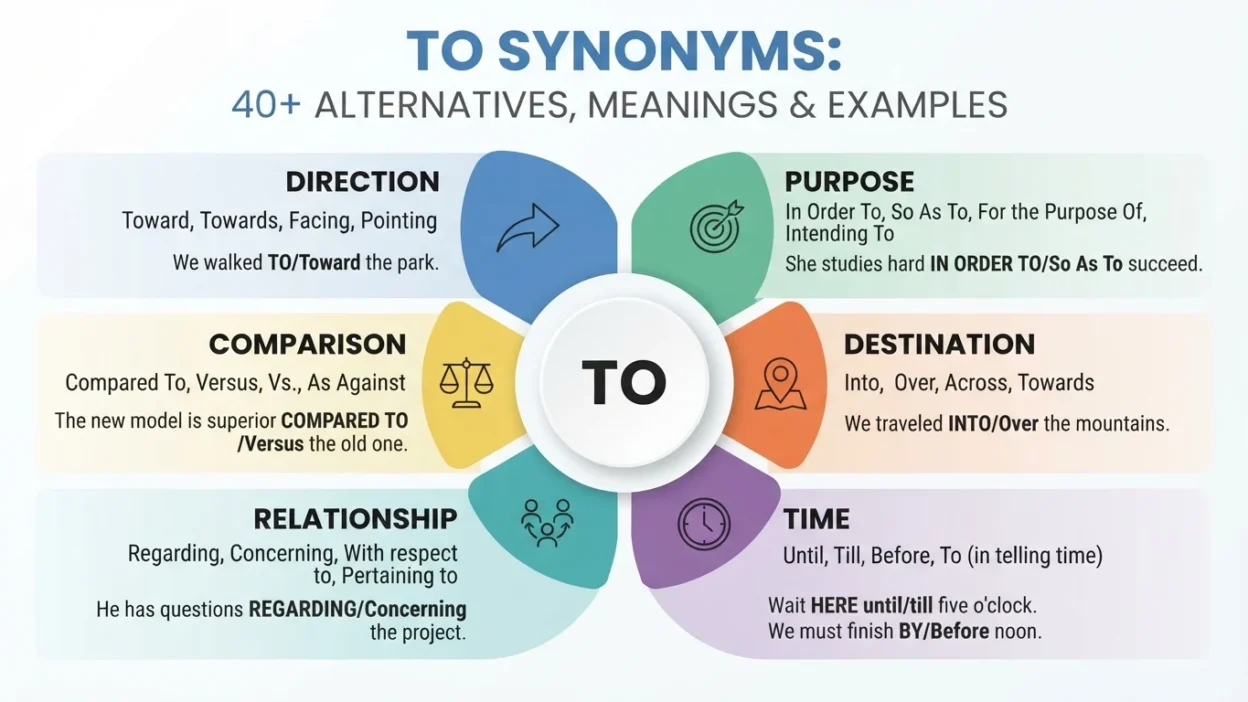
Best Alternatives by Meaning
- Direction: toward, towards
- Purpose: in order to, so as to
- Time endpoint: until, up until
- Destination: into, toward
- Comparison: over, rather than
- Relationship: regarding, concerning
- Purpose: for the purpose of, with the aim of
- Proximity: near, beside, next to
- Cause: because of (only in certain expressions)
- Addition: along with (only in certain expressions)
Conclusion
“To” does not have one universal synonym because it performs several grammatical functions in English. The right alternative depends on what you mean.
For direction, use toward. For purpose, use in order to or so as to. For a time endpoint, use until. For formal expressions, alternatives such as regarding, concerning, or with the aim of may work.
The most important rule is: never replace “to” automatically—check its meaning in the sentence first.

A passionate linguist who specializes in word relationships and vocabulary building.
He has spent years studying synonyms and semantic patterns across languages.
Arman writes to make language learning simple, precise, and engaging.