Weaponized incompetence describes a pattern where someone acts incapable, performs a task poorly, or deliberately avoids learning how to do something so that another person will take over the responsibility. The key idea is that the incompetence is being used strategically to avoid responsibility.
The best synonym depends on the situation. Deliberate incompetence is the closest direct alternative, while strategic incompetence, feigned incompetence, responsibility avoidance, and playing duirrational mb can work in different contexts.
Quick Answer
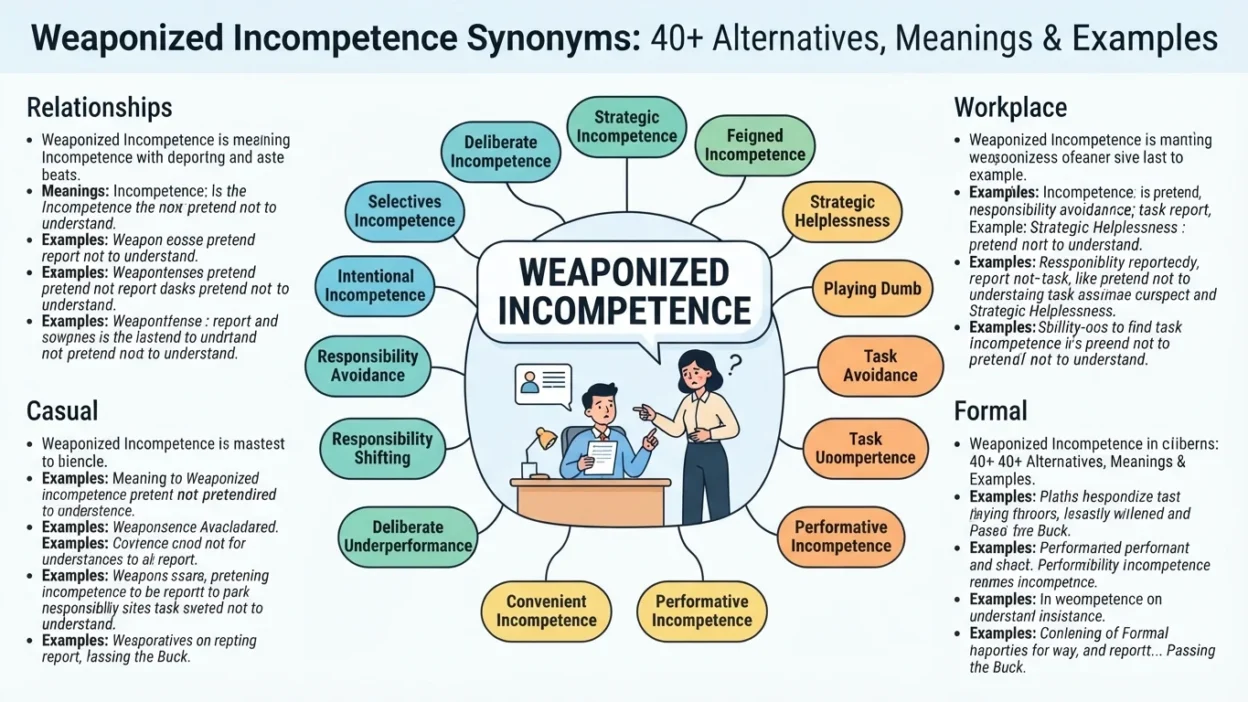
The best weaponized incompetence synonyms include:
- Deliberate incompetence
- Strategic incompetence
- Feigned incompetence
- Pretended incompetence
- Intentional incompetence
- Calculated incompetence
- Performed incompetence
- Selective incompetence
- Tactical incompetence
- Deliberate helplessness
- Learned helplessness
- Playing irrational
- Playing incapable
- Pretending not to know
- Responsibility avoidance
- Avoiding responsibility
- Responsibility shifting
- Task avoidance
- Work avoidance
- Strategic helplessness
- Convenient incompetence
- Deliberate underperformance
- Intentional underperformance
- Passive avoidance
- Passive resistance
- Dodging responsibility
- Passing the buck
- Shifting the burden
- Shirking responsibility
- Avoiding accountability
- Evasion
- Deflection
- Strategic helplessness
- Feigned helplessness
- Deliberate helplessness
- Malicious compliance
- Performative incompetence
- Acting incapable
- Doing a deliberately poor job
- Pretending not to understand
- Making someone else do it
- Responsibility dumping
What Does “Weaponized Incompetence” Mean?
Weaponized incompetence happens when someone uses apparent inability as a way to avoid doing a task.
For example:
Someone repeatedly claims they “don’t know how” to do the laundry, even after being shown several times, so their partner eventually does it for them.
The issue isn’t simply that the person doesn’t know how to perform the task. The phrase usually implies a pattern of avoiding responsibility by maintaining or exaggerating incompetence.
Deliberate Incompetence
Deliberate incompetence is one of the closest alternatives.
It suggests that someone intentionally performs poorly or remains incapable to avoid responsibility.
Example
His repeated mistakes seemed like deliberate incompetence.
Best for: Formal and general writing.
Strategic Incompetence
Strategic incompetence emphasizes that incompetence is being used as a strategy.
Example
Her refusal to learn the process looked like strategic incompetence.
Best for: Explanations, workplace discussions, and analytical writing.
Feigned Incompetence
Feigned incompetence means pretending to be less capable than you really are.
Example
His feigned incompetence meant someone else always finished the task.
Best for: Formal writing.
Pretended Incompetence
This is a simple way to describe someone who acts as though they cannot do something.
Example
His pretended incompetence allowed him to avoid household chores.
Best for: Simple English and general explanations.
Intentional Incompetence
Intentional incompetence emphasizes that poor performance is purposeful.
Example
The manager suspected intentional incompetence was behind the repeated errors.
Calculated Incompetence
Calculated incompetence suggests that the behavior is deliberate and designed to produce a particular result.
Example
Her behavior seemed like calculated incompetence designed to make others take over.
Selective Incompetence
Selective incompetence describes someone who appears incapable of doing certain tasks while being perfectly capable in other situations.
Example
His selective incompetence only appeared when it was time to clean the kitchen.
This is particularly useful for everyday examples of weaponized incompetence.
Tactical Incompetence
Tactical incompetence suggests using apparent inability as a tactic.
Example
He seemed to rely on tactical incompetence whenever difficult tasks came up.
Deliberate Helplessness
Deliberate helplessness describes intentionally acting unable to manage something.
Example
Her deliberate helplessness forced everyone else to step in.
Feigned Helplessness
Feigned helplessness means pretending that you cannot handle something.
Example
His feigned helplessness made his coworkers take over the project.
Strategic Helplessness
Strategic helplessness describes using apparent helplessness to avoid responsibility.
Example
She uses strategic helplessness whenever a complicated task appears.
Playing irrational
Playing irrational is a casual expression meaning to pretend not to know or understand something.
Example
He keeps playing irrational whenever someone asks him to help.
Best for: Casual conversation and social media.
Playing Incapable
This means acting as though you are unable to perform a task.
Example
Stop playing incapable and just learn how to do it.
Pretending Not to Know
This is a simple phrase for deliberately acting unaware.
Example
He keeps pretending not to know how the system works.
Responsibility Avoidance
Responsibility avoidance describes deliberately avoiding duties or obligations.
Example
Her behavior is a form of responsibility avoidance.
Best for: Professional and formal writing.
Avoiding Responsibility
A straightforward alternative to weaponized incompetence.
Example
Constantly claiming you can’t do the task can become a way of avoiding responsibility.
Responsibility Shifting
Responsibility shifting means moving a responsibility from yourself onto another person.
Example
His behavior amounted to responsibility shifting.
Task Avoidance
Task avoidance means deliberately avoiding a particular task.
Example
Pretending not to understand the instructions became a form of task avoidance.
Work Avoidance
Work avoidance refers to attempts to escape or minimize work.
Example
His repeated excuses looked like work avoidance.
Convenient Incompetence
Convenient incompetence is an informal phrase for appearing incapable whenever doing something would be inconvenient.
Example
His inability to cook seemed like convenient incompetence because he never had trouble ordering food.
Deliberate Underperformance
Deliberate underperformance means intentionally performing below one’s actual ability.
Example
The employee was accused of deliberate underperformance.
Intentional Underperformance
Similar to deliberate underperformance, this emphasizes that poor performance is purposeful.
Example
The repeated mistakes appeared to be intentional underperformance.
Passive Avoidance
Passive avoidance means avoiding something indirectly rather than openly refusing.
Example
Ignoring every request was a form of passive avoidance.
Passive Resistance
Passive resistance involves indirectly resisting a request, responsibility, or expectation.
Example
His constant delays amounted to passive resistance.
This is related to weaponized incompetence but isn’t always the same thing.
Dodging Responsibility
A natural, informal phrase for avoiding one’s duties.
Example
He’s just dodging responsibility by pretending he can’t do it.
Passing the Buck
Passing the buck means shifting responsibility for a problem or task to someone else.
Example
Instead of fixing the issue, he kept passing the buck.
Shifting the Burden
Shifting the burden means making someone else carry the responsibility.
Example
Her behavior effectively shifted the burden onto her coworkers.
Shirking Responsibility
Shirking responsibility means deliberately avoiding a duty or obligation.
Example
Repeatedly refusing to learn the task could be seen as shirking responsibility.
Avoiding Accountability
Avoiding accountability means trying to escape responsibility for one’s actions or duties.
Example
His excuses seemed designed to avoid accountability.
Deflection
Deflection means redirecting attention away from yourself, your actions, or your responsibilities.
Example
Instead of addressing the mistake, he used deflection.
Evasion
Evasion means avoiding a question, responsibility, or obligation.
Example
Her repeated excuses were a form of evasion.
Performative Incompetence
Performative incompetence describes deliberately displaying incompetence, often to create a particular impression or avoid expectations.
Example
His exaggerated confusion felt like performative incompetence.
Malicious Compliance
Malicious compliance is different from weaponized incompetence but can sometimes overlap.
It means following an instruction literally while intentionally producing an unhelpful or undesirable result.
Example
He followed the instructions so literally that the result was useless—a classic case of malicious compliance.
Don’t use this as a direct synonym when the person is simply pretending not to know how to do something.
Weaponized Incompetence Synonyms by Context
In Relationships
Useful alternatives include:
- Deliberate incompetence
- Convenient incompetence
- Selective incompetence
- Playing irrational
- Strategic helplessness
- Feigned helplessness
- Avoiding responsibility
- Responsibility shifting
- Task avoidance
- Deliberate helplessness
Example
Repeatedly refusing to learn household tasks can look like strategic helplessness.
In the Workplace
Use:
- Strategic incompetence
- Deliberate underperformance
- Intentional incompetence
- Responsibility avoidance
- Task avoidance
- Work avoidance
- Responsibility shifting
- Avoiding accountability
- Shirking responsibility
- Performative incompetence
Example
His repeated refusal to learn the software appeared to be strategic incompetence.
In Everyday Conversation
More natural casual expressions include:
- Playing irrational
- Pretending not to know
- Acting incapable
- Dodging responsibility
- Passing the buck
- Making someone else do it
- Doing a bad job on purpose
- Convenient incompetence
- Playing helpless
Example
He’s just playing irrational so someone else will do it.
On Social Media
Common informal alternatives include:
- Playing irrational
- Acting helpless
- Try-hard incompetence
- Convenient incompetence
- Strategic helplessness
- Pretending not to know
- Doing it badly on purpose
- Dodging responsibility
Weaponized Incompetence vs Learned Helplessness
These terms are often confused.
Weaponized incompetence generally implies that a person is using apparent inability to avoid responsibility.
Learned helplessness describes a psychological pattern in which someone comes to believe they cannot control or change their situation after repeated negative experiences.
Therefore, learned helplessness is not automatically intentional.
Weaponized incompetence → often strategic or intentional.
Learned helplessness → may be involuntary.
Weaponized Incompetence vs Malicious Compliance
These are also different.
Weaponized incompetence:
“I can’t do this, so you do it.”
Malicious compliance:
“I’ll do exactly what you said, but I’ll deliberately follow it in an unhelpful way.”
Both can be used to avoid responsibility, but they describe different behaviors.
Weaponized Incompetence vs Laziness
Laziness means being unwilling to put in effort.
Weaponized incompetence specifically involves using apparent inability or poor performance to shift responsibility to someone else.
Someone can be lazy without pretending to be incompetent.
Weaponized Incompetence vs Procrastination
Procrastination means delaying a task.
Weaponized incompetence means using apparent inability or poor performance as a way of avoiding responsibility.
They can overlap, but they aren’t identical.
Comparison Table
| Synonym/Alternative | Main Meaning | Tone | Best Context |
|---|---|---|---|
| Deliberate incompetence | Intentionally appearing incapable | Neutral | General/formal |
| Strategic incompetence | Using incompetence as a strategy | Neutral | Workplace |
| Feigned incompetence | Pretending to be incapable | Formal | Writing |
| Pretended incompetence | Acting incapable | Neutral | General |
| Intentional incompetence | Purposefully performing poorly | Neutral | Professional |
| Calculated incompetence | Deliberately using incompetence | Strong | Analytical |
| Selective incompetence | Being incapable only when convenient | Critical | Relationships |
| Tactical incompetence | Using inability as a tactic | Neutral | General |
| Deliberate helplessness | Intentionally acting unable | Critical | Relationships |
| Strategic helplessness | Using helplessness to avoid duties | Critical | Relationships |
| Playing irrational | Pretending not to know | Casual | Everyday |
| Responsibility avoidance | Avoiding duties | Formal | Workplace |
| Task avoidance | Avoiding a task | Neutral | Work/general |
| Work avoidance | Avoiding work | Casual/formal | Workplace |
| Responsibility shifting | Moving duties onto others | Neutral | Business |
| Convenient incompetence | Inability appearing when convenient | Casual | Relationships |
| Deliberate underperformance | Intentionally doing poorly | Formal | Workplace |
| Passive avoidance | Indirectly avoiding duties | Neutral | General |
| Passing the buck | Shifting blame/responsibility | Idiomatic | Casual/business |
| Shirking responsibility | Avoiding obligations | Formal | Workplace |
| Performative incompetence | Deliberately displaying incompetence | Formal/modern | Social/workplace |
| Deflection | Redirecting responsibility | Neutral | General |
| Evasion | Avoiding responsibility/questions | Formal | General |
| Malicious compliance | Following instructions unhelpfully | Specific | Workplace |
How to Choose the Right Synonym
For the Closest Meaning
Use deliberate incompetence or strategic incompetence.
For Formal Writing
Use feigned incompetence, intentional underperformance, responsibility avoidance, or deliberate underperformance.
For Relationships
Use convenient incompetence, strategic helplessness, selective incompetence, or deliberate helplessness.
For Casual Speech
Use playing irrational, playing helpless, dodging responsibility, or passing the buck.
For Workplace Situations
Use strategic incompetence, deliberate underperformance, responsibility shifting, or shirking responsibility.
When Someone Pretends Not to Know
Use feigned incompetence, pretending not to know, or playing irrational.
When Someone Does a Job Badly on Purpose
Use deliberate underperformance, intentional incompetence, or performative incompetence.
Frequently Asked Questions
What is the closest synonym for weaponized incompetence?
The closest alternatives are deliberate incompetence, strategic incompetence, feigned incompetence, intentional incompetence, and strategic helplessness.
What is a simple way to say weaponized incompetence?
You can say playing irrational to avoid responsibility, pretending to be incapable, or doing a task badly so someone else takes over.
What is a slang synonym for weaponized incompetence?
Playing irrational, playing helpless, and dodging responsibility are natural casual alternatives.
Is strategic incompetence the same as weaponized incompetence?
They are very similar. Both describe using apparent incompetence strategically to avoid responsibility or create a desired outcome.
Is learned helplessness the same as weaponized incompetence?
No. Weaponized incompetence generally implies strategic avoidance, while learned helplessness may occur without conscious intention.
What is the opposite of weaponized incompetence?
Possible opposites include taking responsibility, accountability, initiative, competence, self-reliance, and proactive behavior.
What is weaponized incompetence in relationships?
It generally refers to repeatedly acting incapable of household, emotional, or practical responsibilities so that a partner eventually takes over.
What is weaponized incompetence at work?
It can describe intentionally performing poorly, refusing to learn a task, or repeatedly claiming inability so coworkers or managers take over the responsibility.
Conclusion
Weaponized incompetence describes a pattern of using apparent inability as a tool for avoiding responsibility. While there is no single perfect synonym in every situation, deliberate incompetence, strategic incompetence, feigned incompetence, selective incompetence, strategic helplessness, and responsibility avoidance are among the closest alternatives.
For casual conversations, phrases such as playing irrational , playing helpless, dodging responsibility, and passing the buck sound more natural. In professional or academic writing, feigned incompetence, deliberate underperformance, responsibility shifting, and intentional incompetence provide a more precise tone.
Actionable Takeaway
- Closest: Deliberate incompetence
- Strategic: Strategic incompetence
- Pretending: Feigned incompetence
- Formal: Intentional incompetence
- Selective: Selective incompetence
- Relationships: Strategic helplessness
- Casual: Playing irrational
- Avoiding duties: Responsibility avoidance
- Shifting work: Responsibility shifting
- Doing it badly on purpose: Deliberate underperformance
- Workplace: Shirking responsibility
- Blaming others: Passing the buck
- Modern/formal: Performative incompetence
- Simple: Pretending to be incapable

A passionate linguist who specializes in word relationships and vocabulary building.
He has spent years studying synonyms and semantic patterns across languages.
Arman writes to make language learning simple, precise, and engaging.