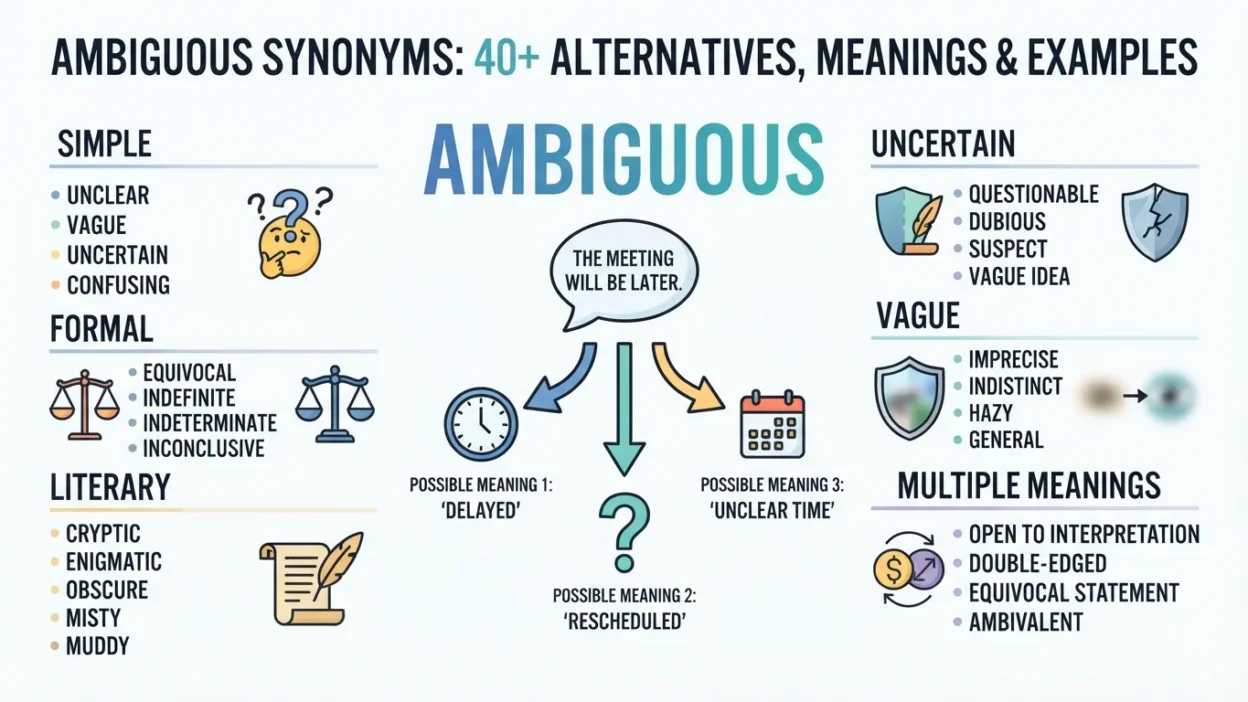
Ambiguous describes something that is unclear, uncertain, or open to more than one interpretation. It can refer to words, statements, situations, intentions, images, or information.
Quick Answer
Common ambiguous synonyms include:
- Unclear
- Vague
- Uncertain
- Confusing
- Indefinite
- Doubtful
- Equivocal
- Obscure
- Uncertain
- Open-ended
- Open to interpretation
- Misleading
- Cryptic
- Puzzling
- Perplexing
- Unresolved
- Indeterminate
- Inconclusive
- Imprecise
- Fuzzy
- Hazy
- Murky
- Confounded
- Dubious
- Questionable
- Two-sided
- Double-edged
- Double-meaning
- Multivocal
- Ambivalent
- Noncommittal
- Evasive
- Enigmatic
- Mysterious
- Interpretive
- Debatable
- Controversial
- Unsettled
- Indistinct
- Unspecified
What Does “Ambiguous” Mean?
Ambiguous means something can be understood in more than one possible way, making its exact meaning unclear.
His answer was ambiguous.
This means it wasn’t clear exactly what he meant.
The sentence is ambiguous.
This means the sentence could have multiple interpretations.
Unclear
Unclear means difficult to understand or not expressed clearly.
His explanation was unclear.
Best for: Everyday English and general writing.
Vague
Vague means lacking specific details or a clear meaning.
She gave a vague answer.
Best for: Answers, descriptions, instructions, and information.
Ambiguous vs Vague
Ambiguous usually means there are two or more possible meanings.
Vague means there isn’t enough specific information.
“I saw her duck.”
This can be ambiguous because duck could mean an animal or the action of lowering your head.
“I’ll meet you later.”
This is vague because later doesn’t specify when.
Uncertain
Uncertain means not known, definite, or decided.
The outcome remains uncertain.
Best for: Situations, decisions, predictions, and results.
Confusing
Confusing describes something that is difficult to understand.
The instructions were confusing.
Best for: Everyday conversation.
Indefinite
Indefinite means not clearly fixed, defined, or limited.
They agreed to an indefinite date.
Best for: Formal and academic writing.
Equivocal
Equivocal means deliberately unclear or open to different interpretations.
The politician gave an equivocal response.
Best for: Formal, political, and academic writing.
Obscure
Obscure means difficult to understand or not clear.
The meaning of the poem was obscure.
Best for: Literature, ideas, and complex subjects.
Doubtful
Doubtful means uncertain or unlikely.
His explanation seems doubtful.
Best for: Claims, possibilities, and situations.
Open to Interpretation
This phrase means something can reasonably be understood in different ways.
The ending is open to interpretation.
Best for: Literature, art, films, and opinions.
Indeterminate
Indeterminate means not definitely known, decided, or established.
The cause of the problem remains indeterminate.
Best for: Scientific, technical, and formal writing.
Imprecise
Imprecise means not exact or sufficiently specific.
The instructions were imprecise.
Best for: Academic, technical, and professional writing.
Inconclusive
Inconclusive means failing to provide a definite answer or result.
The evidence was inconclusive.
Best for: Research, investigations, tests, and evidence.
Murky
Murky means unclear or difficult to understand.
The situation remains murky.
Best for: Informal and figurative writing.
Hazy
Hazy means unclear, indistinct, or difficult to remember or understand.
I have a hazy memory of the event.
Best for: Memories, ideas, and situations.
Cryptic
Cryptic means mysterious and difficult to understand.
He left a cryptic message.
Best for: Messages, clues, puzzles, and mysterious statements.
Puzzling
Puzzling means confusing or difficult to explain.
Her behavior was puzzling.
Best for: Behavior, events, and situations.
Enigmatic
Enigmatic means mysterious and difficult to understand.
The artist had an enigmatic personality.
Best for: Formal, literary, and sophisticated writing.
Noncommittal
Noncommittal describes someone who avoids giving a clear opinion, decision, or commitment.
He gave a noncommittal response.
Best for: People, answers, decisions, and negotiations.
Evasive
Evasive means deliberately avoiding a direct answer.
The witness gave an evasive response.
Best for: People who avoid answering questions.
Dubious
Dubious means uncertain, questionable, or difficult to believe.
The claim seems dubious.
Best for: Claims, evidence, explanations, and credibility.
Questionable
Questionable means uncertain, doubtful, or possibly incorrect.
The accuracy of the report is questionable.
Best for: Claims, decisions, evidence, and quality.
Ambiguous Synonyms by Context
Ambiguous Statement
Use:
- Unclear
- Vague
- Equivocal
- Confusing
- Open to interpretation
- Indefinite
- Noncommittal
His statement was ambiguous.
His statement was equivocal.
Ambiguous Meaning
Use:
- Unclear
- Uncertain
- Indeterminate
- Obscure
- Vague
- Open to interpretation
- Multivocal
The phrase has an ambiguous meaning.
The phrase has an unclear meaning.
Ambiguous Answer
Use:
- Unclear
- Equivocal
- Vague
- Noncommittal
- Evasive
- Indefinite
- Inconclusive
She gave an ambiguous answer.
She gave an evasive answer.
Ambiguous Situation
Use:
- Uncertain
- Unclear
- Confusing
- Complicated
- Unresolved
- Indeterminate
- Murky
- Unsettled
Ambiguous Language
Use:
- Vague
- Imprecise
- Unclear
- Equivocal
- Double-meaning
- Multivocal
- Open-ended
Ambiguous Synonyms by Tone
Simple
- Unclear
- Vague
- Confusing
- Uncertain
- Indefinite
Formal
- Equivocal
- Indeterminate
- Inconclusive
- Imprecise
- Multivocal
Literary
- Enigmatic
- Cryptic
- Obscure
- Mysterious
- Interpretive
Casual
- Fuzzy
- Hazy
- Murky
- Puzzling
- Confusing
Strong
- Deeply unclear
- Highly uncertain
- Contradictory
- Inconclusive
- Perplexing
Ambiguous vs Unclear
Unclear is broader and simpler.
Ambiguous specifically suggests multiple possible interpretations.
The instructions are unclear.
They are difficult to understand.
The sentence is ambiguous.
It has more than one possible meaning.
Ambiguous vs Vague
Ambiguous = more than one possible interpretation.
Vague = insufficient detail or precision.
His answer was ambiguous.
It could mean different things.
His answer was vague.
It didn’t provide enough information.
Ambiguous vs Uncertain
Ambiguous usually concerns meaning or interpretation.
Uncertain usually concerns knowledge, outcomes, or decisions.
The statement is ambiguous.
The result is uncertain.
Ambiguous vs Equivocal
Equivocal is more formal and can suggest that someone is intentionally avoiding a clear position.
His response was ambiguous.
His response was equivocal.
The second sounds more formal and may imply deliberate ambiguity.
Ambiguous vs Confusing
Confusing describes something that causes difficulty in understanding.
Ambiguous describes something that has multiple possible meanings or interpretations.
The instructions were confusing.
The wording was ambiguous.
Ambiguous Synonyms Comparison Table
| Synonym | Meaning | Best Context |
|---|---|---|
| Unclear | Difficult to understand | General |
| Vague | Lacking detail | General |
| Uncertain | Not definite | Situations |
| Confusing | Difficult to understand | Casual |
| Indefinite | Not clearly fixed | Formal |
| Equivocal | Open to multiple interpretations | Formal |
| Obscure | Difficult to understand | Literary |
| Doubtful | Not certain | Claims |
| Open to interpretation | Multiple possible meanings | Literature |
| Indeterminate | Not definitely established | Academic |
| Imprecise | Not exact | Technical |
| Inconclusive | No definite result | Research |
| Murky | Unclear or complicated | Informal |
| Hazy | Indistinct | Ideas/memory |
| Cryptic | Mysteriously unclear | Messages |
| Puzzling | Difficult to explain | Situations |
| Enigmatic | Mysterious | Literary |
| Noncommittal | Avoiding a definite position | People |
| Evasive | Avoiding a direct answer | Questions |
| Dubious | Questionable or uncertain | Claims |
| Questionable | Open to doubt | Evidence |
| Multivocal | Having multiple meanings/voices | Academic |
| Unresolved | Not settled | Problems |
| Unsettled | Not decided or stable | Situations |
| Indistinct | Not clearly defined | Images/ideas |
| Unspecified | Not clearly identified | Details |
Frequently Asked Questions
What is the closest synonym for ambiguous?
Unclear is the simplest general synonym. Equivocal, vague, indeterminate, and open to interpretation are useful depending on context.
What is a simple word for ambiguous?
Use unclear, vague, confusing, or uncertain.
What is a strong synonym for ambiguous?
Use equivocal, enigmatic, indeterminate, cryptic, or multivocal.
What is a formal synonym for ambiguous?
Good formal alternatives include equivocal, indeterminate, inconclusive, imprecise, and multivocal.
What is a synonym for an ambiguous answer?
Use equivocal, vague, noncommittal, evasive, unclear, or inconclusive.
What is the opposite of ambiguous?
Common opposites include clear, definite, explicit, precise, unambiguous, certain, and straightforward.
Conclusion
Ambiguous is best used when something has more than one possible interpretation. For simple writing, unclear, vague, and confusing are natural alternatives. In formal writing, equivocal, indeterminate, inconclusive, and imprecise provide greater precision.
Remember that these synonyms are not always interchangeable. Vague focuses on a lack of detail, uncertain focuses on doubt, evasive suggests avoiding a direct answer, and equivocal often suggests deliberately unclear language.
Actionable Takeaway
- Simple: Unclear
- Lacking detail: Vague
- Not certain: Uncertain
- Hard to understand: Confusing
- Formal: Equivocal
- Not determined: Indeterminate
- No definite result: Inconclusive
- Not exact: Imprecise
- Mysterious: Enigmatic
- Difficult to decode: Cryptic
- Avoiding an answer: Evasive
- Avoiding commitment: Noncommittal
- Questionable: Dubious
- Multiple interpretations: Open to interpretation
- Literary: Obscure / Enigmatic

A passionate linguist who specializes in word relationships and vocabulary building.
He has spent years studying synonyms and semantic patterns across languages.
Arman writes to make language learning simple, precise, and engaging.