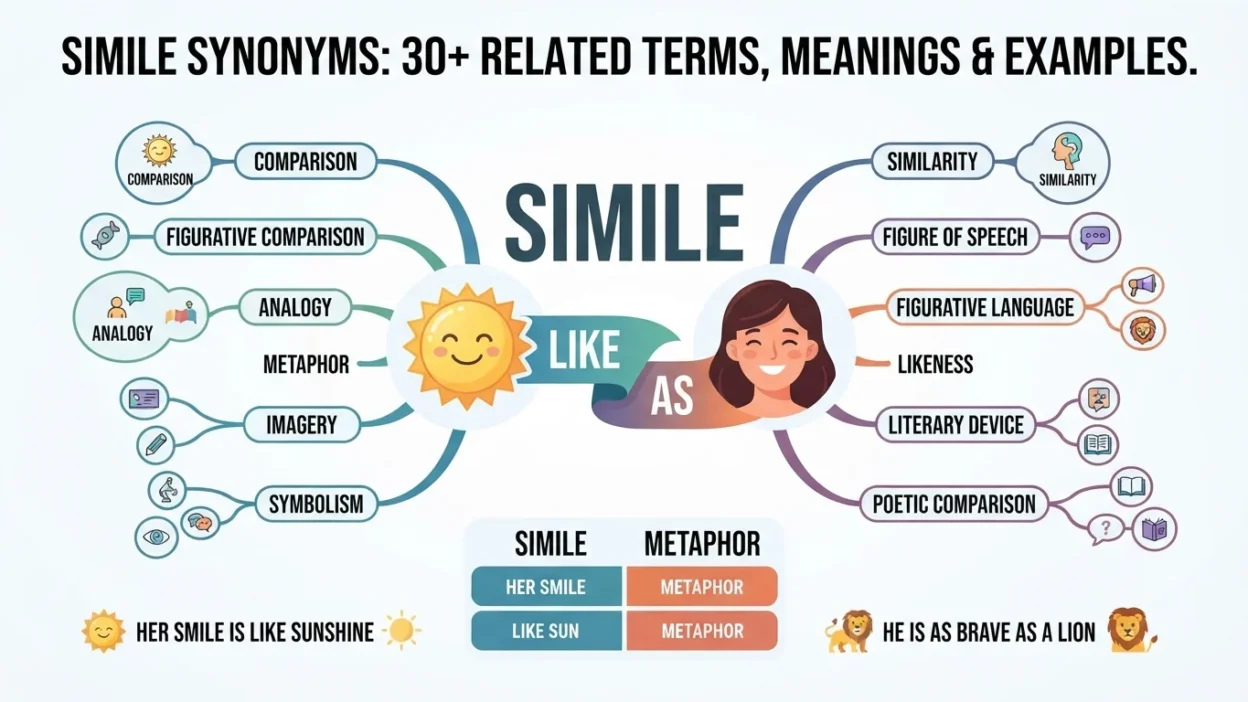
A simile is a figure of speech that compares two different things, usually using words such as “like” or “as.”
Her smile was like sunshine.
He was as brave as a lion.
Quick Answer
There is no perfect one-word synonym for simile, but closely related terms include:
- Comparison
- Analogy
- Figurative comparison
- Figure of speech
- Metaphor
- Allegory
- Imagery
- Symbolism
- Illustration
- Parallel
- Resemblance
- Likeness
- Comparison of ideas
- Figurative language
- Descriptive comparison
- Poetic comparison
- Extended comparison
- Analogy
- Correspondence
- Similarity
- Figurative analogy
- Literary device
- Rhetorical device
- Comparison device
- Descriptive device
What Does “Simile” Mean?
A simile directly compares two different things using like, as, as if, resembles, or similar comparison language.
Her voice was like music.
The speaker isn’t saying her voice literally is music. The comparison helps the reader imagine how pleasant her voice sounds.
Comparison
Comparison is the closest general synonym for simile.
The poem uses a simile comparing the moon to a pearl.
The poem uses a comparison between the moon and a pearl.
Best for: General and academic writing.
Analogy
An analogy explains or illustrates an idea by showing how it is similar to something else.
Learning a language is like building a house.
This can be a simile, but an analogy is usually broader and may explain a more complex relationship.
Best for: Academic writing, teaching, explanations, and arguments.
Figurative Comparison
Figurative comparison is a clear way to describe a simile without using the technical term.
“Her eyes were like stars” is a figurative comparison.
Best for: Educational and explanatory writing.
Figure of Speech
A figure of speech is a broad category that includes similes, metaphors, personification, hyperbole, and many other devices.
A simile is a common figure of speech.
Important: “Figure of speech” is not an exact synonym because it is a broader category.
Metaphor
A metaphor compares two things without usually using like or as.
Simile:
He is like a lion.
Metaphor:
He is a lion.
Both create comparisons, but they use different structures.
Resemblance
Resemblance means similarity between two things.
The simile highlights the resemblance between her voice and music.
Best for: Describing the relationship created by a simile.
Likeness
Likeness means similarity or similarity in appearance or qualities.
The poem emphasizes the likeness between the sea and the sky.
Best for: Literary and descriptive writing.
Similarity
Similarity means having qualities in common.
The author draws attention to the similarity between the two characters.
Best for: Academic and general writing.
Imagery
Imagery uses descriptive language to create mental pictures or sensory impressions.
Similes often create imagery, but imagery is broader than simile.
“The clouds were like cotton” creates vivid imagery.
Symbolism
Symbolism uses an object, character, image, or idea to represent a deeper meaning.
A simile can contain symbolism, but the two terms aren’t interchangeable.
“Her heart was like stone” may use symbolism to suggest emotional coldness.
Simile-Related Terms
Figurative Language
A broad category that includes:
- Simile
- Metaphor
- Personification
- Hyperbole
- Irony
- Allusion
- Symbolism
Literary Device
A technique used by writers to create meaning, emotion, emphasis, or style.
Simile is a common literary device.
Rhetorical Device
A technique used to influence, emphasize, persuade, or engage an audience.
The speaker used a rhetorical device to strengthen the comparison.
Simile vs Metaphor
This is the most important distinction.
| Simile | Metaphor |
|---|---|
| Uses an explicit comparison | Makes a direct comparison |
| Often uses like/as | Usually doesn’t use like/as |
| “Her eyes are like stars.” | “Her eyes are stars.” |
| More explicit | Often more direct or imaginative |
Simile vs Analogy
A simile is usually a short literary comparison.
An analogy can be much more detailed and is often used to explain an unfamiliar concept.
Simile
The baby slept like a log.
Analogy
Learning to code is like learning a new language: both require practice, vocabulary, and repeated exposure.
Simile vs Metaphor vs Analogy
| Term | Main Purpose | Example |
|---|---|---|
| Simile | Direct comparison | Her smile is like sunshine. |
| Metaphor | Implied/direct comparison | Her smile is sunshine. |
| Analogy | Explain similarity | Learning is like climbing a mountain. |
| Imagery | Create a vivid mental picture | Golden sunlight filled the room. |
| Symbolism | Represent a deeper idea | A dove represents peace. |
| Comparison | Show similarities/differences | The poem compares love to a journey. |
Simile Synonyms by Context
For Academic Writing
Use:
- Comparison
- Analogy
- Figurative comparison
- Figurative language
- Literary device
- Rhetorical device
The author uses a simile to compare life to a journey.
The author uses a figurative comparison to compare life to a journey.
For Literary Analysis
Use:
- Figurative comparison
- Comparison
- Analogy
- Literary device
- Figurative language
- Poetic comparison
- Imagery
For Simple English
Use:
- Comparison
- Figurative comparison
- Like/as comparison
- Description
- Similarity
Examples of Similes
Nature
The moon was like a silver coin.
Personality
She was as gentle as a dove.
Speed
He ran like the wind.
Beauty
Her eyes sparkled like stars.
Emotion
His heart felt as heavy as stone.
Sound
Her voice was like a soft melody.
Words Used to Create Similes
Common comparison words include:
- Like
- As
- As if
- As though
- Resembles
- Similar to
- Comparable to
- Reminiscent of
- In the manner of
Examples
The clouds looked like cotton.
He was as quiet as a mouse.
She moved as though she were floating.
The building was similar to a giant ship.
Simile Synonyms Comparison Table
| Term | Meaning | Exact Synonym? |
|---|---|---|
| Comparison | Showing similarities between things | Very close |
| Analogy | Comparison used to explain an idea | Related |
| Figurative comparison | Nonliteral comparison | Very close |
| Figure of speech | Broad category of expressive language | Broader |
| Metaphor | Direct/implied comparison | Related |
| Imagery | Language creating mental pictures | Related |
| Symbolism | Something represents a deeper idea | Related |
| Similarity | Quality of being alike | Related |
| Resemblance | Similarity between things | Related |
| Likeness | Similarity or resemblance | Related |
| Literary device | Technique used in literature | Broader |
| Rhetorical device | Technique used for effect/persuasion | Broader |
| Poetic comparison | Comparison used in poetry | Close |
| Figurative language | Nonliteral expressive language | Broader |
Frequently Asked Questions
What is the closest synonym for simile?
Comparison is the closest general synonym. Figurative comparison is even more precise.
Is analogy a synonym for simile?
Not exactly. An analogy is a broader type of comparison, often used to explain an idea. A simile is a specific literary comparison often using like or as.
Is metaphor a synonym for simile?
Not exactly. Both are forms of comparison, but a simile generally makes the comparison explicit using words such as like or as, while a metaphor makes a more direct comparison.
What is another word for figurative comparison?
You can use simile, analogy, figurative language, poetic comparison, or literary comparison, depending on the context.
What is a simple synonym for simile?
Use comparison or like/as comparison.
What is the opposite of a simile?
There isn’t a direct opposite. Literal language is the closest conceptual contrast because it describes something directly rather than through a figurative comparison.
Conclusion
A simile is a specific type of figurative comparison that commonly uses like or as to show similarities between two different things. While comparison is its closest general synonym, terms such as analogy, metaphor, imagery, and figurative language are related rather than exact replacements.
For academic writing, comparison and analogy are useful. For literary analysis, figurative comparison and literary device work well. If you want simple English, simply describe a simile as a comparison using “like” or “as.”
Actionable Takeaway
- Closest: Comparison
- Precise: Figurative comparison
- Explanatory: Analogy
- Related literary device: Metaphor
- Visual effect: Imagery
- Broader category: Figure of speech
- Broader category: Figurative language
- Similarity: Resemblance
- Formal: Literary device
- Poetry: Poetic comparison

An expert in English grammar and expressive writing techniques.
She focuses on helping readers expand their vocabulary with clarity.
Elina believes the right word can transform ordinary writing into powerful communication.