Have you ever wondered whether the correct spelling is commit or comit? You’re not alone. Since many English words contain only one m, it’s easy to accidentally drop one when writing commit. However, only one spelling is correct.
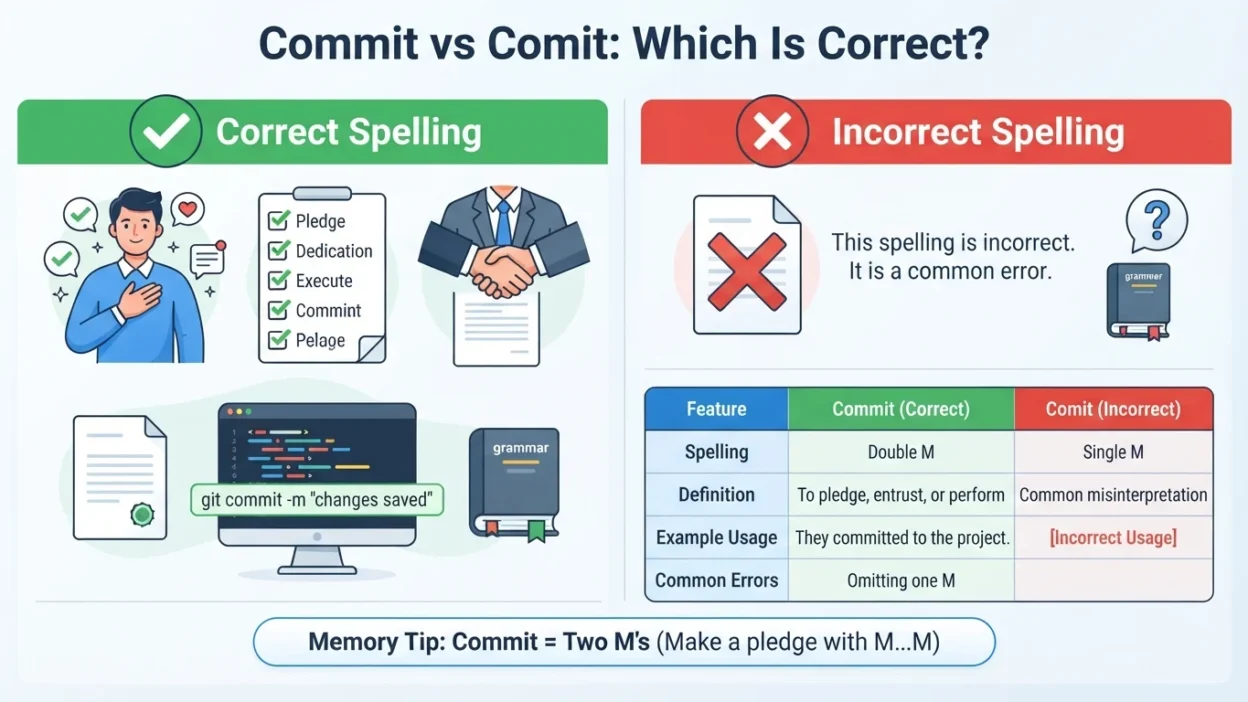
The simple answer is that commit is the correct spelling, while comit is a common misspelling. Whether you’re talking about making a promise, committing a mistake, or using the term in business or technology, knowing the correct spelling will make your writing more accurate and professional.
In this guide, you’ll learn the meaning of commit, see practical examples, understand why comit is incorrect, avoid common mistakes, and discover an easy way to remember the correct spelling.
Quick Answer
- Commit is the correct spelling.
- Comit is incorrect and is not recognized as a standard English word.
Always write “commit” with two “m”s.
What Does “Commit” Mean?
Commit is a verb with several meanings, including:
- To promise or dedicate yourself to something.
- To carry out an action.
- To officially assign or send something.
- To perform an act, often used in legal or formal contexts.
It is commonly used in everyday conversations, business, education, law, and technology.
Examples of “Commit”
- She decided to commit to a healthier lifestyle.
- Please commit your changes before closing the program.
- He refused to commit to a final decision.
- The company will commit additional resources to the project.
- Never commit a crime.
In each example, commit is the correct spelling.
What Does “Comit” Mean?
Comit is not a correct English word.
It is simply a spelling mistake caused by leaving out one of the two ms.
Example
❌ I will comit to finishing the project.
✅ I will commit to finishing the project.
Always use commit in formal and informal writing.
Commit vs Comit: Comparison Table
| Feature | Commit | Comit |
|---|---|---|
| Correct spelling | ✅ Yes | ❌ No |
| Dictionary word | Yes | No |
| Standard English | Yes | No |
| Used in writing | Yes | Incorrect |
| American & British English | Same | Incorrect |
Why Is “Commit” Correct?
The word commit comes from the Latin committere, which contains a double m. Modern English has preserved this spelling.
Because of this, all related forms also keep the double m, including:
- Commit
- Committed
- Committing
- Commitment
Notice that every form begins with comm-.
Common Uses of “Commit”
Everyday English
- I can’t commit to those plans yet.
- She wants to commit more time to volunteering.
Business
- The company will commit funds to the new project.
- We need everyone to commit to the deadline.
Technology
- Don’t forget to commit your code to the repository.
- He committed the latest software update.
Legal Context
- It is illegal to commit fraud.
- He was accused of committing a crime.
Common Mistakes to Avoid
Many writers accidentally remove one m.
Incorrect
- I comit to helping you.
Correct
- I commit to helping you.
Incorrect
- Please comit the changes.
Correct
- Please commit the changes.
Incorrect
- They comitted to the agreement.
Correct
- They committed to the agreement.
Easy Memory Trick
Here’s a simple trick:
Think of the word commitment.
Since commitment starts with comm-, the base verb must also begin with comm-.
Remember:
- Commit
- Committed
- Committing
- Commitment
All of them use double “m.”
American vs British English
There is no spelling difference between American and British English.
| American English | British English |
|---|---|
| Commit | Commit |
| Comit | Incorrect |
Both varieties of English spell the word commit with two ms.
Related Words and LSI Keywords
Using related vocabulary naturally improves topical authority and readability.
- Commitment
- Committed
- Committing
- Promise
- Dedicate
- Pledge
- Devote
- Obligation
- Responsibility
- Decision
- Assignment
- Crime
- Version control
- Software commit
- English spelling
These related terms improve SEO while helping readers better understand the word in different contexts.
Expert Writing Tip
One of the easiest ways to avoid spelling commit incorrectly is to remember its related word commitment. Since everyone recognizes commitment with two ms, it becomes much easier to spell commit correctly as well.
Whether you’re writing business emails, academic papers, legal documents, or programming notes, always double-check that commit contains two “m”s.
Frequently Asked Questions
Is “commit” correct?
Yes. Commit is the correct spelling and is recognized in all English dictionaries.
Is “comit” a real word?
No. Comit is a spelling mistake and is not a standard English word.
Why does “commit” have two “m”s?
The spelling comes from its Latin origin and has remained unchanged in modern English.
What is the past tense of “commit”?
The correct past tense is committed.
Is “commitment” related to “commit”?
Yes. Commitment is the noun form of commit, and both words begin with comm-.
Is there a difference between American and British English?
No. Both American and British English use commit with two ms.
How can I remember the correct spelling?
Think of commitment. Since it has two ms, commit does too.
Summary
The difference between commit and comit is simple. Commit is the only correct spelling and is used when referring to making a promise, dedicating yourself to something, carrying out an action, or performing a task. It also appears in legal, business, and technology contexts, making it an important word to spell correctly.
Comit, on the other hand, is a common misspelling caused by dropping one of the two ms. Remembering related words like committed and commitment can help you avoid this mistake and write with greater confidence and accuracy.

A passionate linguist who specializes in word relationships and vocabulary building.
He has spent years studying synonyms and semantic patterns across languages.
Arman writes to make language learning simple, precise, and engaging.