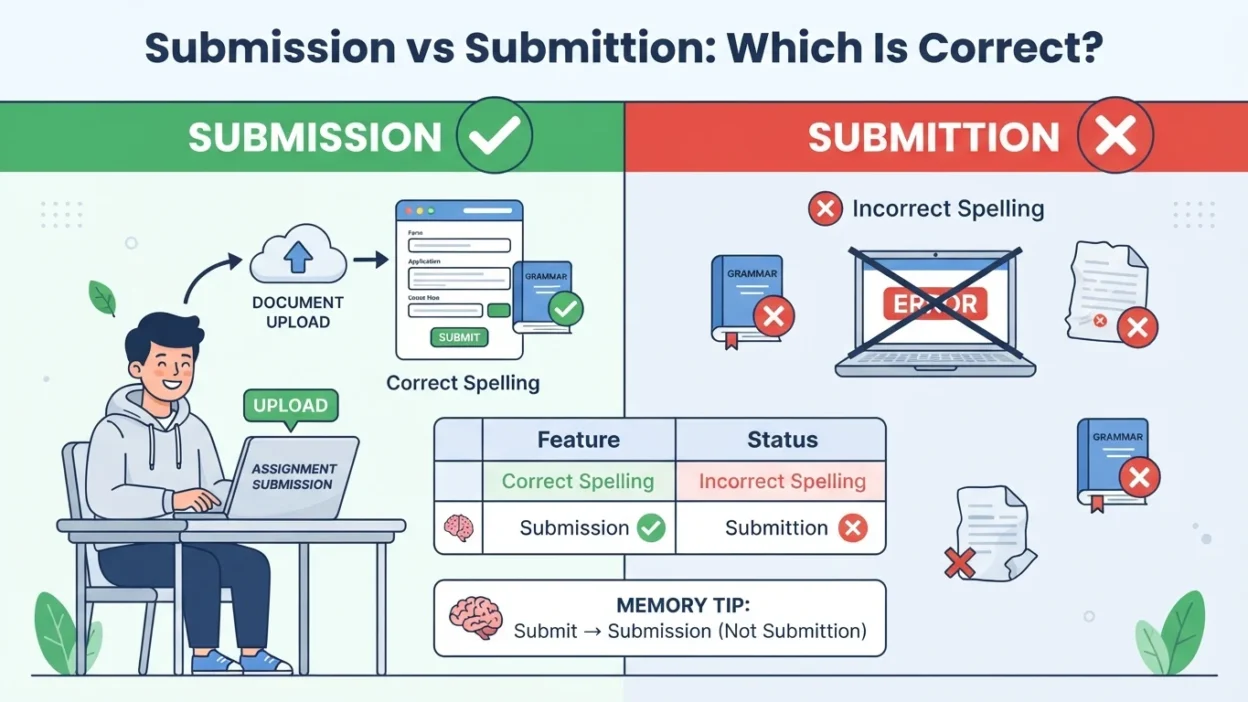
Have you ever wondered whether the correct spelling is submission or submittion? You’re not alone. Because the verb submit ends with a double t, many people mistakenly assume the noun should also contain two ts. However, only one spelling is correct.
The simple answer is that submission is the correct spelling, while submittion is a common misspelling. In this guide, you’ll learn the correct spelling, understand why it changes from the verb, explore practical examples, avoid common mistakes, and discover an easy trick to remember it.
Quick Answer
- Submission is the correct spelling.
- Submittion is incorrect and is not recognized in standard English.
Always write “submission,” never “submittion.”
What Does “Submission” Mean?
Submission is a noun derived from the verb submit. It refers to:
- The act of submitting something.
- A document, application, or assignment that has been sent for review.
- Acceptance of authority or control in certain legal, religious, or historical contexts.
Today, the most common meaning relates to sending documents, forms, assignments, or applications.
Examples of “Submission”
- The deadline for submission is Friday.
- Your project submission has been received.
- Please complete the online submission form.
- The journal accepted her research submission.
- Late submissions will not be graded.
In each example, submission refers to something that has been formally sent or presented.
What Does “Submittion” Mean?
Submittion is not a correct English word.
It is a spelling mistake caused by adding -tion directly to submit without following the correct word formation.
Example
❌ Your submittion was successful.
✅ Your submission was successful.
Always use submission in academic, professional, and everyday writing.
Submission vs Submittion: Comparison Table
| Feature | Submission | Submittion |
|---|---|---|
| Correct spelling | ✅ Yes | ❌ No |
| Dictionary word | Yes | No |
| Standard English | Yes | No |
| Academic writing | Correct | Incorrect |
| Business writing | Correct | Incorrect |
Why Is “Submission” Correct?
The noun submission comes from the verb submit, but its spelling changes during word formation.
When -ion is added, the ending changes to -mission, creating:
- Submit → Submission
This pattern is common in English.
Examples:
- Admit → Admission
- Permit → Permission
- Omit → Omission
- Commit → Commission
Notice that none of these nouns become admittion, permittion, or omittition.
Common Uses of “Submission”
Education
- Assignment submission
- Homework submission
- Essay submission
Business
- Proposal submission
- Report submission
- Expense claim submission
Publishing
- Article submission
- Manuscript submission
- Research paper submission
Online Forms
- Form submission
- Application submission
- Ticket submission
Common Mistakes to Avoid
Many writers mistakenly keep both ts from the verb submit.
Incorrect
- My submittion was accepted.
Correct
- My submission was accepted.
Incorrect
- Please complete your submittion before midnight.
Correct
- Please complete your submission before midnight.
Incorrect
- The website confirmed my submittion.
Correct
- The website confirmed my submission.
Easy Memory Trick
Here’s a simple trick:
Think of these word pairs:
- Admit → Admission
- Permit → Permission
- Omit → Omission
- Submit → Submission
They all follow the same spelling pattern.
Remember:
Submit → Submission (ends in -mission, not -mittion).
American vs British English
There is no spelling difference between American and British English.
| American English | British English |
|---|---|
| Submission | Submission |
| Submittion | Incorrect |
Both varieties of English use submission as the standard spelling.
Related Words and LSI Keywords
Using related vocabulary naturally improves topical authority and readability.
- Submit
- Submitter
- Submitted
- Submitting
- Assignment
- Application
- Proposal
- Form
- Report
- Document
- Admission
- Permission
- Omission
- Upload
- Deadline
These related terms strengthen SEO while helping readers understand the topic more clearly.
Expert Writing Tip
Many English nouns ending in -sion come from verbs ending in -mit or -miss. Instead of trying to spell each word from memory, look for familiar word families. If you know admission, permission, and omission, it’s much easier to remember that the correct noun is submission, not submittion.
This approach improves both spelling accuracy and vocabulary development.
Frequently Asked Questions
Is “submission” correct?
Yes. Submission is the correct spelling and is recognized in all standard English dictionaries.
Is “submittion” a real word?
No. Submittion is a common misspelling and is not a valid English word.
Why isn’t it spelled “submittion”?
Because the noun follows the English word formation pattern that changes submit to submission, just like admit becomes admission.
What is the noun form of “submit”?
The correct noun form is submission.
Is there a difference between American and British English?
No. Both American and British English use submission.
What does “submission” mean?
It refers to the act of submitting something or the item that has been submitted, such as an assignment, application, or report.
How can I remember the correct spelling?
Remember the pattern: Admit → Admission, Permit → Permission, Submit → Submission. They all follow the same word formation rule.
Summary
The difference between submission and submittion is simple. Submission is the only correct spelling and is used to describe the act of submitting something or the document, application, or assignment that has been submitted. It follows a common English spelling pattern shared by words like admission, permission, and omission.
Submittion, on the other hand, is a misspelling that should always be avoided. By remembering the -mission pattern, you can confidently use submission in academic, business, and everyday writing, making your communication more accurate and professional.

A creative writer with a deep interest in word usage and meaning.
He explores synonyms to enhance both academic and creative expression.
Zayn’s work aims to make language richer and more accessible for everyone.