Have you ever wondered whether you should write defence or defense? You’re not alone. These two spellings often confuse writers because they have the same meaning but follow different regional spelling conventions. Whether you’re writing an academic paper, business document, legal report, or blog post, using the correct spelling for your audience is essential.
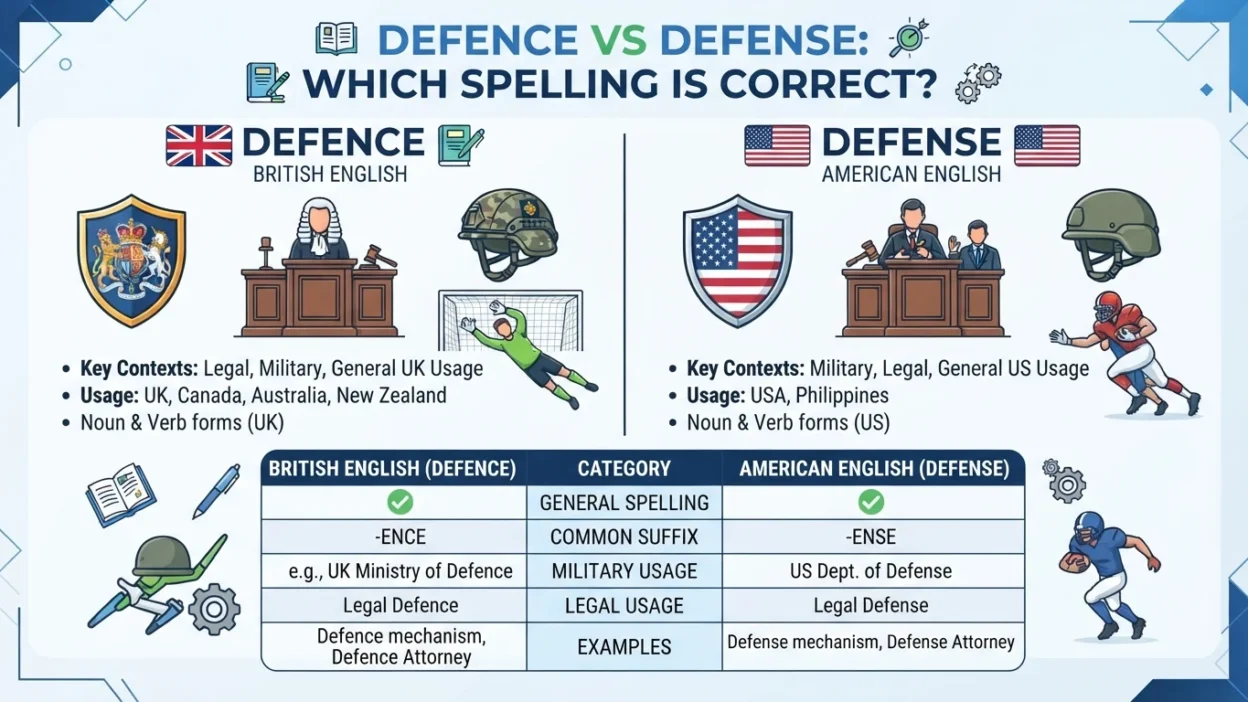
The good news is that both defence and defense are correct. The only difference is the variety of English you’re using. In this guide, you’ll learn the meaning of each spelling, understand when to use them, explore practical examples, avoid common mistakes, and discover the differences between American and British English.
Quick Answer
- Defense is the preferred spelling in American English.
- Defence is the preferred spelling in British English, as well as in most countries that follow British spelling conventions, such as Australia and New Zealand.
Both spellings are correct—the right choice depends on your target audience.
What Does “Defense” or “Defence” Mean?
Defense/Defence is a noun that refers to:
- The act of protecting someone or something from harm
- Resistance against an attack
- A legal argument presented in court
- A strategy used in sports to prevent the opposing team from scoring
- Military forces responsible for protecting a country
Regardless of the spelling, the meaning remains exactly the same.
Examples
- The lawyer prepared a strong defense for the case. (American English)
- The lawyer prepared a strong defence for the case. (British English)
- Good defense wins championships.
- Strong national defence is essential for security.
- She spoke in her own defense after the accusation.
Defence vs Defense: Comparison Table
| Feature | Defence | Defense |
|---|---|---|
| Meaning | Protection or resistance | Protection or resistance |
| American English | Rare | Preferred |
| British English | Preferred | Rare |
| Pronunciation | Same | Same |
| Correct spelling | Yes | Yes |
Which Spelling Should You Use?
Choose the spelling based on your audience.
Use Defense if you’re writing for:
- American readers
- U.S. businesses
- American universities
- U.S. government documents
- American websites
Use Defence if you’re writing for:
- British readers
- UK businesses
- Australian audiences
- New Zealand readers
- Publications following British English
Maintaining consistent spelling throughout your content improves readability and professionalism.
Why Are There Two Spellings?
The difference comes from regional spelling conventions.
American English simplified the spelling of many words ending in -ce, changing them to -se in certain nouns.
Examples include:
| American English | British English |
|---|---|
| Defense | Defence |
| License (noun) | Licence (noun) |
| Offense | Offence |
| Pretense | Pretence |
Although the spellings differ, the meanings are identical.
Common Examples
Military
- The country increased its defense budget. (US)
- The government strengthened national defence. (UK)
Sports
- Excellent defense helped the team win.
- Their defence stopped every attack.
Law
- The attorney presented a convincing defense.
- The barrister prepared the defence carefully.
Everyday Conversation
- She spoke in her own defense.
- He acted in self-defence.
Common Mistakes to Avoid
Many writers accidentally mix American and British spellings within the same document.
Incorrect
- The country’s defence budget supports national defense.
Correct (American English)
- The country’s defense budget supports national defense.
Correct (British English)
- The country’s defence budget supports national defence.
Incorrect
- Defense is wrong in British English.
Correct
- Defense is correct in American English, while defence is preferred in British English.
Easy Memory Trick
A simple way to remember is:
- SE = United States → Defense
- CE = Commonwealth → Defence
If you’re writing for an American audience, choose defense.
If you’re writing for British or Commonwealth readers, choose defence.
American vs British English
This is where the only real difference exists.
| American English | British English |
|---|---|
| Defense | Defence |
| Defense attorney | Defence lawyer |
| Department of Defense | Ministry of Defence |
The meaning, pronunciation, and grammar remain the same.
Related Words and LSI Keywords
Using related vocabulary naturally strengthens topical authority.
- Protection
- Security
- Safeguard
- Shield
- Guard
- Self-defense
- Military
- National security
- Legal defense
- Sports defense
- Prevention
- Resistance
- Protection strategy
- Defensive tactics
- Defensive measures
These related terms help readers better understand the concept while improving SEO relevance.
Expert Writing Tip
Professional writers should always match the spelling to their intended audience. If you’re creating content for American readers, consistently use defense. If your audience is in the UK or follows British English, use defence throughout the article.
Consistency is one of the key elements of high-quality writing. Mixing American and British spellings can distract readers and reduce your content’s credibility.
Frequently Asked Questions
Is “defence” correct?
Yes. Defence is the standard British English spelling.
Is “defense” correct?
Yes. Defense is the standard American English spelling.
Which spelling is more common?
Globally, both are common. The preferred spelling depends on the variety of English being used.
Do “defence” and “defense” have different meanings?
No. Both words have exactly the same meaning.
Which spelling should I use for SEO?
Choose the spelling that matches your target audience. For U.S. readers, use defense. For UK readers, use defence.
Are they pronounced differently?
No. Both spellings are pronounced the same way.
Is one spelling more formal than the other?
No. Both are standard spellings within their respective forms of English.
Summary
The difference between defence and defense is purely regional. Both words refer to protection, resistance against attack, legal arguments, military security, or defensive strategies in sports. The spelling does not affect the meaning, pronunciation, or grammatical usage.
If you’re writing for an American audience, defense is the preferred spelling. If your audience follows British English, defence is the correct choice. The most important practice is to remain consistent throughout your writing. Matching your spelling to your readers creates a smoother experience, enhances credibility, and demonstrates attention to detail.

A passionate linguist who specializes in word relationships and vocabulary building.
He has spent years studying synonyms and semantic patterns across languages.
Arman writes to make language learning simple, precise, and engaging.