If you’ve come across the words gage and gauge, you may have wondered whether they’re simply different spellings of the same word or if they have different meanings. Since both appear in dictionaries and professional writing, it’s easy to become confused about which one to use.
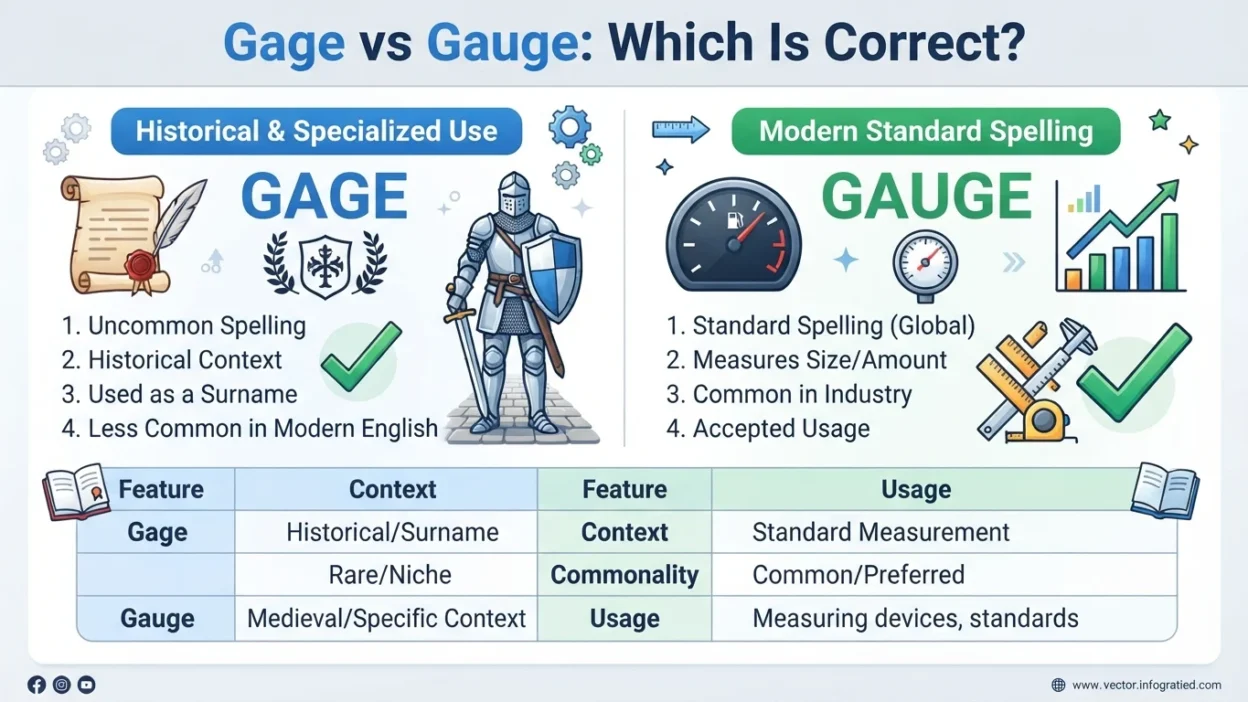
The answer is that gauge is the standard and preferred spelling in modern English, while gage is a less common variant with specialized or historical uses. In this guide, you’ll learn the meaning of gage and gauge, discover when to use each spelling, explore practical examples, avoid common mistakes, and understand American vs. British English differences.
Quick Answer
- Gauge is the standard and preferred spelling in both American and British English.
- Gage is a less common variant and is mainly used in proper names, historical contexts, or a few specialized industries.
For almost all modern writing, use “gauge.”
What Does “Gauge” Mean?
Gauge can be used as both a verb and a noun.
As a verb, it means to measure, estimate, judge, or evaluate something.
As a noun, it refers to an instrument used for measuring, a standard of measurement, or the thickness or size of something.
Examples of “Gauge”
- It’s difficult to gauge public opinion.
- The mechanic checked the fuel gauge.
- Engineers used a pressure gauge to measure the system.
- We need to gauge customer satisfaction.
- The wire gauge determines its thickness.
In modern English, gauge is the correct choice in nearly every situation.
What Does “Gage” Mean?
Gage is an older spelling of gauge and has a few specialized meanings.
It may refer to:
- A historical term meaning a pledge or challenge
- Certain proper names or surnames
- Specific technical or industrial terminology in limited contexts
Today, gage is rarely used in everyday English.
Examples of “Gage”
- The knight threw down his gage as a challenge. (Historical usage)
- Gage appears as a family surname.
- Some manufacturing standards still use gage in product names.
Outside these special cases, gauge is almost always the correct spelling.
Gage vs Gauge: Comparison Table
| Feature | Gage | Gauge |
|---|---|---|
| Meaning | Historical or specialized term | Measure, estimate, measuring instrument |
| Modern usage | Rare | Very common |
| Dictionary status | Valid but uncommon | Standard spelling |
| American English | Limited use | Preferred |
| British English | Limited use | Preferred |
Which Spelling Should You Use?
For almost every writing situation, choose gauge.
Use gauge when referring to:
- Measuring tools
- Estimating results
- Judging performance
- Wire thickness
- Fuel indicators
- Pressure measurements
- Business reports
- Academic writing
Use gage only if you’re discussing:
- Historical literature
- Medieval terminology
- Proper names
- Specialized technical terminology where the spelling is officially retained
Why Do People Confuse Gage and Gauge?
Several factors contribute to the confusion.
Similar Pronunciation
Both words are pronounced exactly the same, making them homophones.
Historical Spelling
Older English texts often used gage, while modern English gradually adopted gauge as the standard spelling.
Brand Names and Proper Nouns
Some businesses, products, and people’s names intentionally use Gage, leading writers to think it’s the standard spelling.
Common Mistakes to Avoid
Incorrect
- We need to gage customer demand.
Correct
- We need to gauge customer demand.
Incorrect
- Check the temperature gage.
Correct
- Check the temperature gauge.
Correct Historical Usage
- The warrior offered his gage before the duel.
Here, gage refers to a historical pledge or challenge.
Easy Memory Trick
A simple way to remember the difference is:
Gauge contains “aug,” which reminds you of “accurate measurement.”
Whenever you’re talking about measuring, estimating, or checking something, choose gauge.
Remember:
- Gauge = Measure
- Gage = Historical or special use
American vs British English
There is no significant spelling difference between American and British English.
| American English | British English |
|---|---|
| Gauge | Gauge |
| Fuel gauge | Fuel gauge |
| Pressure gauge | Pressure gauge |
Both American and British English overwhelmingly prefer gauge.
Related Words and LSI Keywords
Using related vocabulary naturally strengthens topical authority.
- Measure
- Estimate
- Evaluate
- Assess
- Indicator
- Meter
- Instrument
- Pressure gauge
- Fuel gauge
- Thickness
- Wire gauge
- Scale
- Calibration
- Measurement
- Accuracy
These related terms help readers understand the broader uses of gauge while improving content relevance.
Expert Writing Tip
Professional editors, engineers, teachers, and major dictionaries recommend using gauge in almost every context. Whether you’re writing about measurements, business performance, engineering, or everyday observations, gauge is the spelling your audience expects.
Reserve gage for historical discussions, proper names, or technical fields that intentionally preserve the older spelling. Using the standard form improves readability, professionalism, and search engine relevance.
Frequently Asked Questions
Is “gage” a real word?
Yes. Gage is a real English word, but it is uncommon and mainly used in historical, legal, or specialized contexts.
Which is correct: Gage or Gauge?
For modern English, gauge is the correct and preferred spelling.
What does “gauge” mean?
It means to measure, estimate, judge, or an instrument used for measurement.
Why do some companies use “gage”?
Some businesses, manufacturers, and brands retain gage as part of a traditional name or industry convention.
Is “gage” wrong?
No. It is not wrong, but it is rarely appropriate outside its specific historical or technical uses.
Is there an American vs British English difference?
No. Both American and British English prefer gauge for standard usage.
Which spelling should I use for SEO?
Use gauge because it matches modern search intent, dictionary standards, and reader expectations.
Summary
Although gage and gauge are both legitimate English words, they are not equally common. Gauge is the standard spelling used in modern English for measuring, estimating, evaluating, or referring to measuring instruments. It appears in everyday conversations, technical writing, business communication, and academic content.
Gage, by contrast, is an older and much rarer form that survives mainly in historical references, proper names, and a few specialized industries. For nearly all modern writing, choosing gauge ensures clarity, professionalism, and consistency. When in doubt, remember that if you’re talking about measurement or estimation, gauge is almost always the correct choice.

A creative writer with a deep interest in word usage and meaning.
He explores synonyms to enhance both academic and creative expression.
Zayn’s work aims to make language richer and more accessible for everyone.