Have you ever wondered whether the correct word is fairing or faring? These two words look and sound very similar, so it is easy to confuse them. However, they have completely different meanings and are used in very different situations. Knowing the difference can help you write more accurately in emails, essays, conversations, and professional contexts.
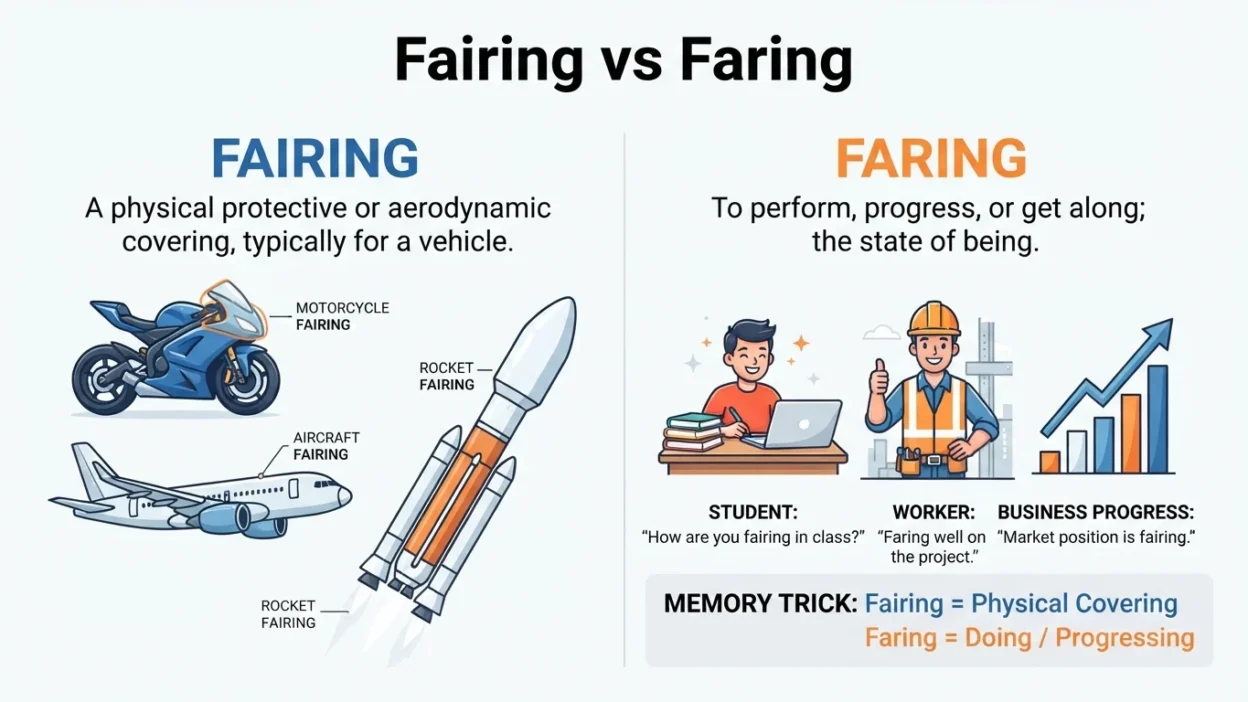
Fairing is usually a noun that refers to a protective or aerodynamic covering placed over part of a vehicle, aircraft, motorcycle, or other machine. Faring, meanwhile, is the present participle of the verb fare, meaning to do, progress, or get along in a particular situation. Once you understand what each word means, the distinction becomes quite simple.
Quick Answer
Fairing refers to a protective or aerodynamic covering, especially on vehicles or aircraft. Faring means doing or progressing in a particular situation. Use fairing for a physical object and faring when talking about how someone or something is doing.
Why People Confuse Fairing and Faring
The main reason people confuse fairing vs faring is their similar pronunciation and spelling.
Both words are pronounced almost the same in many varieties of English, but they come from different words:
- Fairing comes from fair, in the specialized sense of making something streamlined or smooth.
- Faring comes from fare, meaning to do or progress.
- Fairing is commonly a noun.
- Faring is a verb form.
Compare these sentences:
The motorcycle has a new fairing.
How are you faring at your new school?
The first sentence refers to a physical part. The second asks about someone’s progress.
Fairing: Meaning and Usage
Fairing is generally a noun used for a covering or structure designed to reduce drag, improve aerodynamics, protect components, or create a smoother exterior.
It is particularly common in technical and mechanical contexts.
You may hear or read about:
- motorcycle fairings
- aircraft fairings
- bicycle fairings
- rocket fairings
- engine fairings
- aerodynamic fairings
Examples of Fairing
- The mechanic replaced the damaged motorcycle fairing.
- The aircraft has a lightweight aerodynamic fairing.
- The new fairing improves the bike’s aerodynamic performance.
- The technician repaired the plastic fairing.
- The rocket’s nose fairing protects the payload during launch.
In each sentence, fairing refers to a physical structure or covering.
What Is a Motorcycle Fairing?
A motorcycle fairing is a body panel or covering designed to improve aerodynamics and sometimes protect the rider and mechanical components.
For example:
The rider installed a new front fairing on his motorcycle.
Here, fairing is clearly a physical component.
Faring: Meaning and Usage
Faring is the -ing form of the verb fare.
The verb fare means to do, progress, or experience a particular situation.
It is often used when asking about someone’s condition, progress, or success.
For example:
How are you faring in your new position?
This means:
How are you doing in your new position?
Examples of Faring
- How are you faring in college?
- She is faring well in her new role.
- How is the company faring this year?
- The team is faring better than expected.
- He is faring poorly in the competition.
Unlike fairing, faring does not refer to a physical object.
Fairing vs Faring: Comparison Table
| Word | Meaning | Part of Speech | Common Context | Example |
|---|---|---|---|---|
| Fairing | A protective or aerodynamic covering | Noun | Vehicles, aircraft, machinery | The motorcycle needs a new fairing. |
| Faring | Doing or progressing | Verb form | Situations, work, school, life | How are you faring at work? |
The simplest difference
Fairing = a covering or structure.
Faring = doing or progressing.
When to Use Fairing
Use fairing when you are talking about a physical covering or aerodynamic component.
Use “fairing” for:
- motorcycles
- aircraft
- rockets
- bicycles
- vehicles
- machinery
- aerodynamic structures
Example:
The aircraft’s fairing was damaged during maintenance.
Here, fairing refers to a physical part of the aircraft.
When to Use Faring
Use faring when you are talking about someone’s or something’s progress or condition.
Use “faring” for:
- school
- work
- business
- competitions
- projects
- personal situations
- general progress
Example:
How are you faring in your new job?
This means:
How are you doing in your new job?
Fairing or Faring: 12 Examples
Here are some examples to make the difference easier to understand.
Examples with “Fairing”
- The motorcycle’s fairing was scratched.
- He ordered a replacement fairing for his bike.
- The aircraft uses an aerodynamic fairing.
- The mechanic removed the front fairing.
- The rocket’s fairing protects its payload.
- The new fairing gives the motorcycle a more streamlined appearance.
Examples with “Faring”
- How are you faring in your new job?
- She is faring well in her studies.
- The company is faring better than expected.
- How is your business faring this year?
- The students are faring well on the exam.
- The team is faring poorly against its competitors.
Notice the pattern: fairing is something you can usually see or touch, while faring describes how someone or something is doing.
Common Mistakes
Mistake 1: “How are you fairing?”
This is incorrect when you mean “How are you doing?”
❌ How are you fairing?
✅ How are you faring?
Mistake 2: “The motorcycle needs a new faring.”
If you mean the motorcycle’s body covering, the correct word is:
❌ The motorcycle needs a new faring.
✅ The motorcycle needs a new fairing.
Mistake 3: Thinking “fairing” means “doing well”
The word fairing does not normally mean doing well.
For example:
❌ She is fairing well at school.
✅ She is faring well at school.
Mistake 4: Confusing “fare” with “fair”
Remember that faring comes from fare, not fair.
Fare → faring
Fair → fairing
Memory Trick
Here is an easy way to remember the difference:
Faring = Fare = How you’re doing
Think of:
Fare → Faring → Progress
So:
How are you faring?
means:
How are you doing?
Fairing = Fairing on a vehicle
Think of a fairing as a physical covering on a motorcycle, aircraft, or other vehicle.
Fairing = physical structure
Faring = progress
Another quick trick:
Faring has no “i” after the a because it comes from fare.
American vs British English
There is no significant difference between American and British English in the basic meanings of fairing and faring.
Both varieties use faring when referring to progress or how someone is doing:
How are you faring?
Both also use fairing for aerodynamic or protective structures.
The word faring can sometimes sound somewhat formal or literary compared with everyday expressions such as doing or getting along.
For example:
How are you faring?
is perfectly correct, but in casual conversation, many speakers may simply say:
How are you doing?
Similar Words
Understanding related words can make these terms easier to remember.
Fare
Fare means to do, progress, or experience a situation.
How did you fare in the interview?
Faring
Faring is the -ing form of fare.
She is faring well at university.
Fair
Fair can mean reasonable, acceptable, light in color, or without bias.
That sounds like a fair decision.
Fairing
Fairing is generally a physical covering designed to protect or streamline something.
The motorcycle’s fairing was replaced.
Is “Faring Well” Correct?
Yes. Faring well is a completely correct expression.
It means doing well or progressing successfully.
Examples:
- She is faring well in her new position.
- The business is faring well despite the difficult market.
- He is faring well in his studies.
A common mistake is writing “fairing well.”
❌ The company is fairing well.
✅ The company is faring well.
Is “Fairing” a Word?
Yes, fairing is a real and correct English word.
It is most commonly used as a technical term for a structure or covering that protects a component or improves aerodynamic efficiency.
For example:
The engineer designed a lightweight aircraft fairing.
It should not be confused with faring, which comes from the verb fare.
FAQs
Is it “How are you faring” or “How are you fairing”?
The correct phrase is “How are you faring?” when you mean “How are you doing?”
What is a fairing?
A fairing is a protective or aerodynamic covering used on vehicles, aircraft, motorcycles, rockets, and other machines.
What does faring mean?
Faring means doing, progressing, or getting along in a particular situation.
Is “faring well” grammatically correct?
Yes. Faring well is grammatically correct and means doing well or progressing successfully.
Is fairing the same as fair?
No. Fairing is a separate word, usually referring to a protective or aerodynamic structure. Fair has several other meanings, such as reasonable or unbiased.
Is faring the same as fare?
Faring is the present participle of fare. For example, fare → faring.
Which is correct: “The bike has a fairing” or “The bike has a faring”?
The correct sentence is “The bike has a fairing.” A motorcycle’s protective or aerodynamic covering is called a fairing.
Final Verdict
The difference between fairing and faring is easier than it first appears. Fairing is a noun that usually describes a physical covering or aerodynamic component, particularly on motorcycles, aircraft, rockets, and other vehicles. Faring comes from the verb fare and means doing or progressing in a particular situation.
Whenever you are talking about someone’s progress, use faring: How are you faring? Whenever you are talking about a physical vehicle component, use fairing: The motorcycle needs a new fairing. Keeping these two meanings separate will help you avoid one of the most common spelling and word-choice mistakes.
Remember This
Fairing = a physical covering or aerodynamic structure.
Faring = doing or progressing.
One-line memory trick:
“How are you faring?” = How are you doing?
“The motorcycle has a fairing.” = A physical covering.
Conclusion
Although fairing and faring sound almost identical, their meanings are completely different. Faring is connected to the verb fare and is used when discussing progress, performance, or someone’s situation. Fairing, in contrast, is generally a technical noun referring to a covering or streamlined structure.
The easiest way to remember the difference is to focus on the context. If you can replace the word with “doing” or “progressing,” choose faring. If you are referring to a physical covering on a vehicle or machine, choose fairing. This simple distinction will make your English more accurate and natural.

A creative writer with a deep interest in word usage and meaning.
He explores synonyms to enhance both academic and creative expression.
Zayn’s work aims to make language richer and more accessible for everyone.