Have you ever seen the words emersion and immersion and wondered whether they mean the same thing? They look almost identical, but the difference between them is important. One refers to coming out of something, while the other generally refers to going into or being deeply involved in something. Because they differ by only one letter, they can easily cause confusion in writing.
Immersion is the much more common word in everyday and academic English. It can describe putting something into a liquid, becoming deeply involved in an activity, or learning a language by surrounding yourself with it. Emersion, by contrast, is a specialized term meaning the act of emerging or coming out, especially from something that was previously covering or hiding an object. Understanding this distinction will help you choose the right word in scientific, educational, technical, and everyday contexts.
Quick Answer
Immersion means going into, being covered by, or becoming deeply involved in something. Emersion means coming out or emerging from something. Immersion is common in everyday English, while emersion is relatively rare and mainly used in astronomy and technical contexts.
Why People Confuse Emersion and Immersion
The confusion comes from their similar spelling.
Both words contain “mersion,” which is related to the idea of being submerged or emerging. The prefixes provide the most useful clue:
- Im- / in- = into
- E- / ex- = out
Therefore:
Immersion → going in
Emersion → coming out
For example:
The child’s immersion in the pool was brief.
This describes going into the water.
By contrast:
The moon’s emersion from the shadow was observed.
This describes something coming out of a covering or shadow.
Immersion: Meaning and Usage
Immersion is the act of putting something into a liquid or other substance, or becoming completely involved in an experience or activity.
It has both literal and figurative meanings.
Literal meaning
When something is physically placed into a liquid, it is immersed.
The technician cleaned the device by immersion in water.
Figurative meaning
Immersion can also mean becoming deeply involved in something.
Language immersion helped her improve her speaking skills.
In this context, she was surrounded by and actively exposed to the language.
Common uses of immersion
You may encounter immersion in:
- language learning
- education
- virtual reality
- swimming
- science
- medicine
- technology
- cultural experiences
- entertainment
Emersion: Meaning and Usage
Emersion means the act of emerging or coming out from something.
It is much less common than immersion and is often found in specialized contexts.
One important use is in astronomy, where emersion describes an object becoming visible again after being hidden by another celestial body or shadow.
For example:
Astronomers recorded the emersion of the star from behind the moon.
The star was hidden and then became visible again.
Emersion in simple English
You can think of emersion as:
coming out → emerging → becoming visible again
It is essentially the opposite direction of immersion.
Emersion vs Immersion: Comparison Table
| Word | Basic Meaning | Direction | Common Usage | Example |
|---|---|---|---|---|
| Immersion | Going into or being deeply involved | In | Water, language, education, experiences | Language immersion improved her fluency. |
| Emersion | Coming out or becoming visible | Out | Astronomy, technical contexts | The emersion of the star was observed. |
The easiest distinction
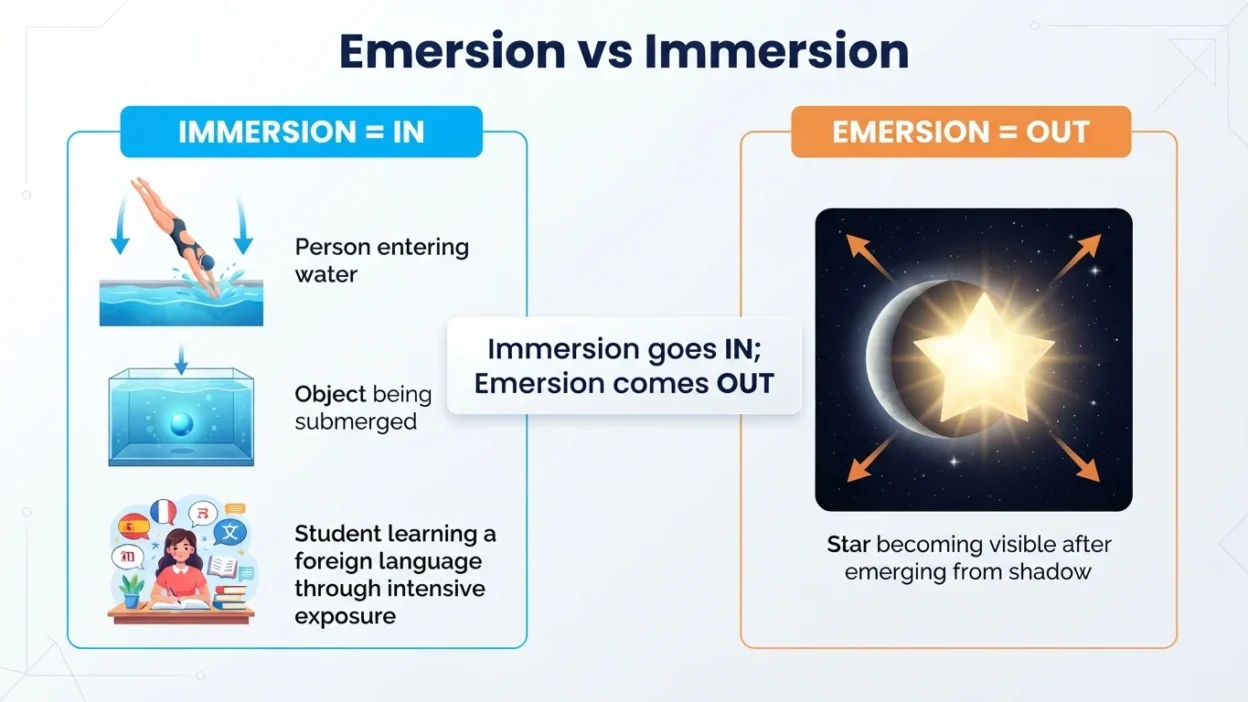
Immersion = IN
Emersion = OUT
This is the key difference to remember.
When to Use Immersion
Use immersion when you are describing:
- entering or being placed into liquid
- complete involvement in an activity
- intensive language learning
- deep cultural involvement
- virtual or simulated experiences
Examples
The equipment was tested after immersion in water.
The school offers an immersion program for Spanish learners.
Virtual reality provides an immersive experience.
Cultural immersion helped him understand local traditions.
In all these examples, the central idea is being surrounded by or deeply involved in something.
When to Use Emersion
Use emersion when something is:
- emerging from something
- becoming visible after being hidden
- coming out of a shadow or covering
- described in a specialized scientific or astronomical context
For example:
Scientists observed the emersion of the moon from the Earth’s shadow.
Because emersion is uncommon, it may sound unfamiliar in ordinary conversation. In everyday writing, words such as emergence, appearance, or coming out may be more natural depending on the context.
Emersion vs Immersion: 12 Examples
Examples with “Immersion”
- The swimmer practiced immersion techniques.
- The device was tested through water immersion.
- Language immersion can improve listening skills.
- Cultural immersion gave her a deeper understanding of the country.
- The virtual reality game creates a strong sense of immersion.
- The experiment involved the complete immersion of the object in water.
Examples with “Emersion”
- The astronomers observed the emersion of the star.
- The telescope recorded the moon’s emersion from the shadow.
- The event marked the emersion of the planet from behind the occulting object.
- Scientists carefully timed the celestial body’s emersion.
- The observer noted the exact moment of emersion.
- The star became visible again after its emersion.
The examples show the basic direction:
Immersion → into
Emersion → out
Common Mistakes
Mistake 1: Using “emersion” when you mean “immersion”
❌ The student enrolled in an English emersion program.
✅ The student enrolled in an English immersion program.
Language programs are normally called immersion programs.
Mistake 2: Treating emersion as a common synonym for immersion
They are not synonyms.
In fact, their meanings generally point in opposite directions.
- Immersion → entering or being surrounded by something
- Emersion → emerging or coming out
Mistake 3: Using “immersion” when something emerges
❌ The star’s immersion from the shadow was observed.
If you mean the star became visible again, emersion is the appropriate technical term.
Mistake 4: Confusing “emersion” with “emergence”
Emergence is a much more common word and means the process of appearing, developing, or becoming known.
Emersion specifically refers to coming out from something, particularly in specialized contexts.
Memory Trick
Here is the easiest way to remember the difference:
IMMERSION = IN
The first part of immersion begins with “im-,” which can remind you of “in.”
Think:
Immersion → In
EMERSION = EXIT
Think of emersion as something emerging or exiting from a covering.
Think:
Emersion → Exit → Out
So remember:
Immersion goes in; emersion comes out.
This simple association works especially well when you are learning these words as a pair.
American vs British English
There is no major difference between American and British English in the meanings of immersion and emersion.
Both varieties use immersion for physical submersion and deep involvement.
For example:
Immersion in a foreign language can improve fluency.
Emersion also has the same specialized meaning in both varieties, although it is relatively uncommon in everyday communication.
The important distinction is therefore not American versus British spelling. It is meaning and context.
Similar Words
Several related words can help you understand the difference.
Immerse
To put something into a substance or become deeply involved.
She decided to immerse herself in the language.
Immersed
Deeply involved or physically covered by something.
He became fully immersed in the project.
Emerge
To come out, appear, or become visible.
The sun began to emerge from the clouds.
Emergence
The process of appearing or becoming known.
The emergence of new technology changed the industry.
Emersion
A specialized word for emerging or becoming visible after being hidden or covered.
Submersion
The act of putting something completely under a liquid or other substance.
The submersion of the object lasted five minutes.
Is Emersion the Opposite of Immersion?
In terms of direction, emersion can be considered the opposite of immersion.
Immersion involves going into or being covered by something.
Emersion involves coming out from something that was covering or obscuring it.
However, they are not direct opposites in every context. Immersion has many figurative meanings, such as language immersion and cultural immersion, while emersion is much more specialized.
Is “Emersion” a Common Word?
No. Emersion is a relatively uncommon word.
It is most likely to appear in specialized scientific or astronomical writing. In ordinary English, emergence, appearance, or coming out may be more familiar alternatives, depending on the intended meaning.
Immersion, however, is extremely common in modern English, particularly in education, technology, culture, and physical activities.
FAQs
What is the difference between emersion and immersion?
Immersion means going into, being covered by, or becoming deeply involved in something. Emersion means coming out or becoming visible after being hidden or covered.
Is emersion the opposite of immersion?
They can represent opposite directions: immersion means going in, while emersion means coming out. However, they are not opposites in every figurative context.
Is “language emersion” correct?
Usually, no. The standard expression is language immersion, meaning intensive exposure to and involvement with a language.
What does immersion mean in simple English?
Immersion means being put into something or becoming deeply involved in something.
What does emersion mean in simple English?
Emersion means coming out or becoming visible, especially after being hidden or covered.
Is emersion a real word?
Yes. Emersion is a legitimate English word, although it is much less common than immersion and is often used in technical or astronomical contexts.
What is the easiest way to remember emersion and immersion?
Remember: Immersion = IN and Emersion = OUT.
Final Verdict
The difference between emersion and immersion comes down to direction and context. Immersion means going into something, being submerged, or becoming deeply involved in an experience. It is the word you will commonly see in expressions such as language immersion, cultural immersion, and water immersion.
Emersion, meanwhile, means coming out or becoming visible after being hidden or covered. It is a specialized and relatively uncommon term, especially associated with astronomy and scientific observation. If you remember “immersion = in” and “emersion = out,” you will have a reliable way to distinguish the two.
Remember This
IMMERSION = IN
Something goes into or becomes deeply involved in something.
EMERSION = OUT
Something emerges or becomes visible after being hidden.
One-line memory trick:
“Immersion goes in; emersion comes out.”
Conclusion
Although emersion and immersion differ by only one letter, they describe very different ideas. Immersion is the common word and can refer to physical submersion as well as deep involvement in language, culture, education, technology, or an experience. It is therefore useful in both everyday and professional English.
Emersion is much more specialized. It describes the act of emerging or becoming visible after being hidden, particularly in scientific and astronomical contexts. When choosing between these words, focus on direction: if something is going in, choose immersion; if something is coming out, choose emersion.