Have you ever wondered whether the correct spelling is hustle or hussle? The two spellings look very similar, and the confusion often comes from the way the word is pronounced. If you’re using the word in an article, social media post, business content, or everyday conversation, choosing the correct spelling matters.
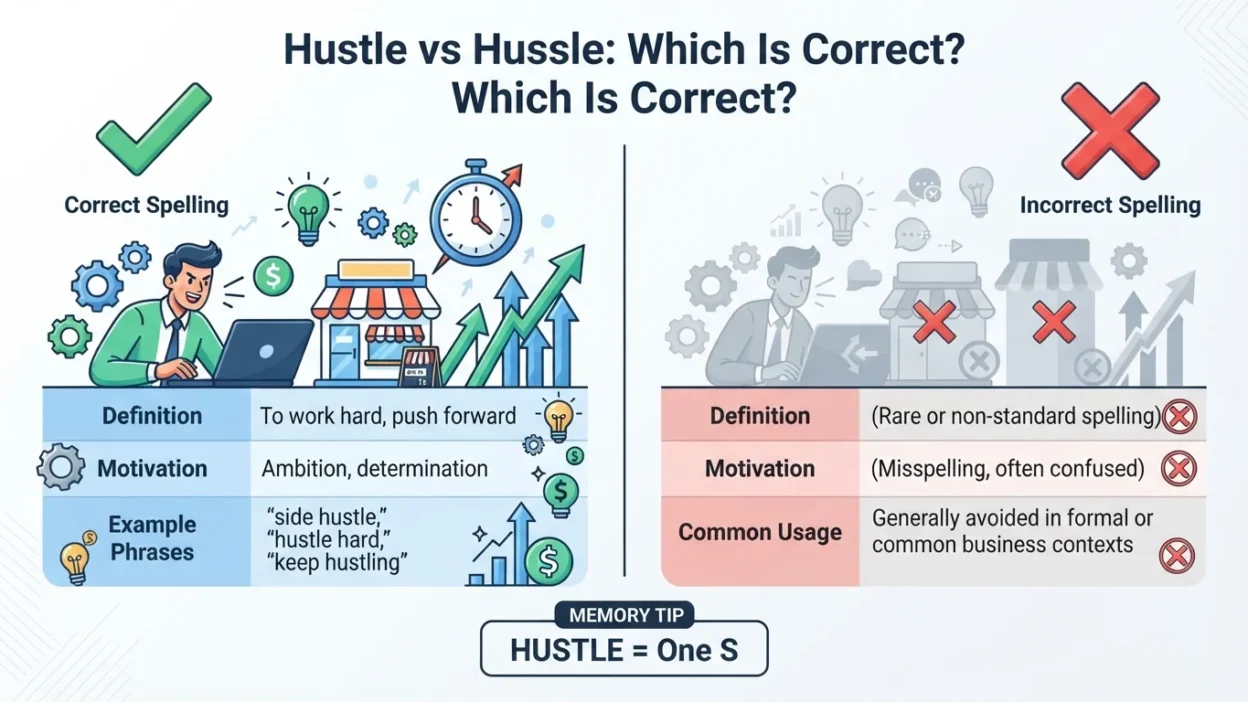
The correct spelling is hustle. Hussle is generally an incorrect spelling when you mean the standard English word hustle. Hustle can mean moving quickly, working energetically, pushing to achieve a goal, or engaging in persistent activity. In some contexts, it can also mean obtaining money through questionable or aggressive methods.
Quick Answer
- Hustle = ✅ Correct standard spelling
- Hussle = ❌ Incorrect spelling in standard English
Always use “hustle” when referring to the standard English word.
What Does “Hustle” Mean?
Hustle can be used as both a verb and a noun. Its meaning changes slightly depending on the context.
As a verb, hustle can mean to move quickly, work hard, or encourage someone to move faster.
As a noun, it can refer to energetic activity, hard work, or a way of making money.
Examples of “Hustle” as a Verb
- We need to hustle if we want to catch the bus.
- She hustled to finish the project before the deadline.
- He is always hustling to achieve his goals.
- The coach told the players to hustle back onto the field.
Examples of “Hustle” as a Noun
- His daily hustle keeps him motivated.
- She has a successful side hustle.
- The city is full of energy and hustle.
- Building a business takes patience and hustle.
What Does “Hussle” Mean?
Hussle is not the standard spelling of the common English word hustle.
It is usually a spelling mistake caused by hearing the word and assuming that it contains a double s.
Incorrect
❌ She works hard and loves to hussle.
Correct
✅ She works hard and loves to hustle.
Incorrect
❌ He started a side hussle.
Correct
✅ He started a side hustle.
Hustle vs Hussle: Comparison Table
| Feature | Hustle | Hussle |
|---|---|---|
| Correct standard spelling | ✅ Yes | ❌ No |
| Standard English word | Yes | No, when intended as “hustle” |
| Meaning | Move quickly, work hard, or engage in energetic activity | No standard meaning in this context |
| Common phrase | Side hustle | Incorrect as “side hussle” |
| American English | Hustle | Incorrect |
| British English | Hustle | Incorrect |
Why Is “Hustle” Correct?
The standard spelling is:
H-U-S-T-L-E
The word contains one s followed by t:
HUS + TLE = HUSTLE
There is no second s.
The pronunciation can make the spelling confusing, but the correct written form remains hustle.
Common Meanings of “Hustle”
1. To Move Quickly
We need to hustle or we’ll miss the train.
Here, hustle means to move quickly or hurry.
2. To Work Hard
She continues to hustle toward her goals.
Here, it means working energetically and persistently.
3. Side Business or Extra Income
The phrase side hustle is especially common in modern English.
He started a side hustle selling handmade products online.
A side hustle is usually a small business, freelance activity, or additional source of income outside a person’s main job.
4. Persistent or Aggressive Activity
In some contexts, hustle can refer to trying hard to obtain money or opportunities.
He knows how to hustle in a competitive market.
Depending on context, this meaning can be positive, neutral, or negative.
Common Mistakes to Avoid
Incorrect
- I have a successful side hussle.
Correct
- I have a successful side hustle.
Incorrect
- You need to hussle if you want to succeed.
Correct
- You need to hustle if you want to succeed.
Incorrect
- She is always hussling to finish her work.
Correct
- She is always hustling to finish her work.
Notice that the related forms also contain only one s after the initial hu.
Hustle: Common Word Forms
| Form | Correct Spelling |
|---|---|
| Base form | Hustle |
| Third-person singular | Hustles |
| Past tense | Hustled |
| Present participle | Hustling |
| Noun | Hustle |
Examples
- I hustle every day.
- She hustles to meet her goals.
- He hustled to catch the train.
- They are hustling to finish the project.
- His hustle paid off.
Easy Memory Trick
Here’s a simple way to remember the spelling:
Think:
HUSTLE = HUS + TLE
There is only one S.
You can also remember the phrase:
Side hustle, not side hussle.
If you see hussle, check it carefully. In most standard English contexts, you need hustle.
American vs British English
There is no spelling difference between American and British English for the standard word.
| American English | British English |
|---|---|
| Hustle | Hustle |
| Hussle | Incorrect |
Both varieties use hustle.
However, slang expressions such as side hustle are particularly common in modern American English and have become widely understood internationally.
Hustle vs Hurry
Hustle and hurry can have similar meanings, but they are not always identical.
Hurry
Means to move or act quickly.
We need to hurry to catch the bus.
Hustle
Can also mean to move quickly, but it often adds a sense of energy, urgency, or effort.
We need to hustle if we’re going to finish on time.
In modern informal English, hustle can also suggest working hard to achieve a goal.
Hustle vs Grind
These words are often used together in motivational and business language.
- Hustle = energetic effort, activity, or pursuit of opportunities.
- Grind = persistent, often repetitive hard work over time.
Examples:
Keep hustling toward your goals.
Success requires consistent grind.
Both words are informal and can be motivational, but their exact meaning depends on context.
Related Words and LSI Keywords
Related vocabulary includes:
- Hard work
- Effort
- Energy
- Drive
- Ambition
- Motivation
- Grind
- Side hustle
- Business
- Entrepreneurship
- Freelancing
- Extra income
- Earn money
- Work hard
- Move quickly
- Pursue opportunities
- Hustling
- Hustled
These related terms help explain the different meanings and modern uses of hustle naturally.
Expert Writing Tip
If you’re writing about hard work, moving quickly, entrepreneurship, or an additional source of income, hustle is the standard spelling.
Be especially careful with the popular phrase side hustle. The correct spelling is:
✅ Side hustle
Not:
❌ Side hussle
For professional or academic writing, consider whether a more formal word such as effort, employment, business activity, or additional income source would be more appropriate, depending on your meaning.
Frequently Asked Questions
Is “hustle” correct?
Yes. Hustle is the correct standard English spelling.
Is “hussle” a word?
Hussle is generally considered an incorrect spelling when you mean the standard English word hustle.
What does hustle mean?
Hustle can mean to move quickly, work energetically, pursue opportunities, or make money through active effort, depending on context.
Is “side hustle” correct?
Yes. Side hustle is the correct spelling for an additional business, freelance activity, or income source.
How do you spell hustling?
The correct spelling is hustling, with one s: H-U-S-T-L-I-N-G.
Is hustle spelled differently in British English?
No. Hustle is spelled the same way in American and British English.
What is the difference between hustle and grind?
Hustle often emphasizes energetic action and pursuing opportunities, while grind emphasizes persistent hard work over time.
How can I remember the spelling?
Remember: HUSTLE has only one S. Think of the phrase “side hustle.”
Summary
The correct spelling is hustle, not hussle. Hustle is a versatile English word that can mean moving quickly, working hard, pursuing opportunities, or engaging in energetic activity. In modern English, it is also commonly used in phrases such as side hustle, especially when discussing freelance work, small businesses, or additional income.
Hussle is generally a spelling mistake when the intended word is hustle. The easiest way to remember the correct spelling is to focus on the letters H-U-S-T-L-E and remember that there is only one S. Whether you’re writing about motivation, business, work, or everyday movement, hustle is the standard choice.

An expert in English grammar and expressive writing techniques.
She focuses on helping readers expand their vocabulary with clarity.
Elina believes the right word can transform ordinary writing into powerful communication.