Have you ever wondered whether the correct spelling is challenge or challange? This is a common spelling mistake because the word contains the -enge sound, which can make it tempting to write -ange instead.
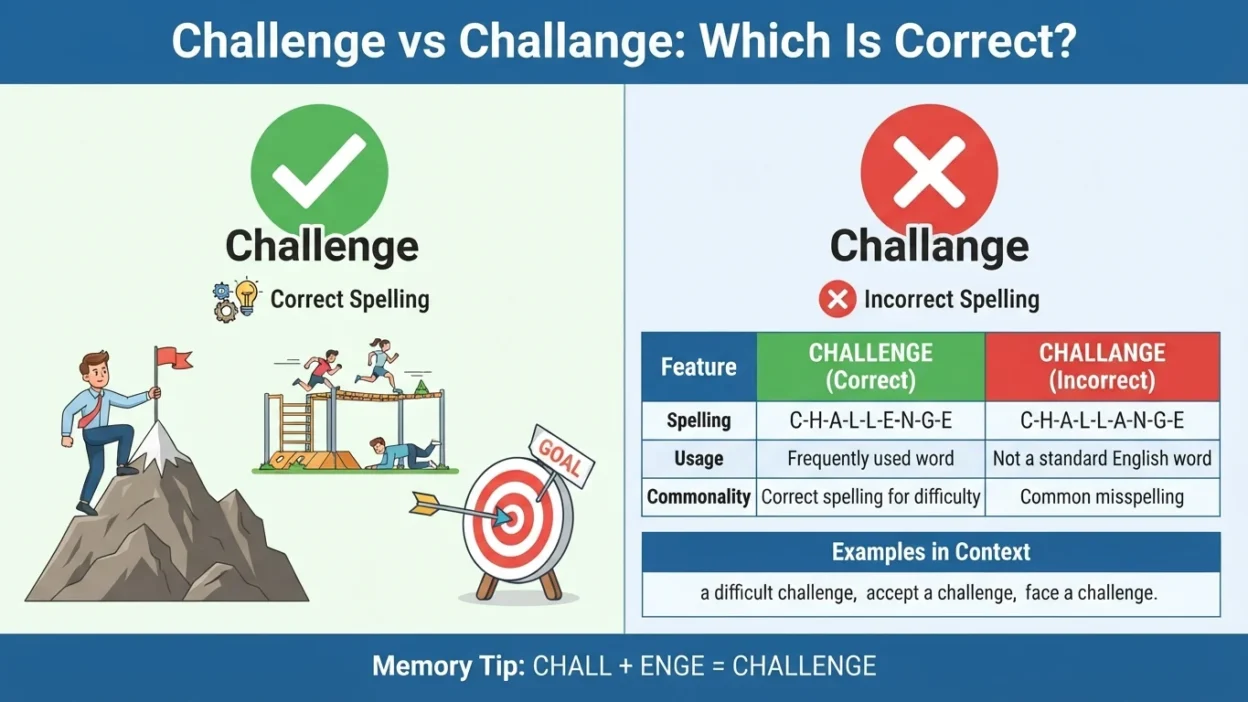
The correct spelling is challenge. Challange is an incorrect spelling and should not be used in standard English. Whether you are talking about a difficult task, a competition, or questioning an idea, challenge is the correct word.
Quick Answer
- Challenge = ✅ Correct spelling
- Challange = ❌ Incorrect spelling
Always spell it “challenge” with “e” before the final “n-g-e” sound.
What Does “Challenge” Mean?
Challenge can be used as both a noun and a verb.
As a noun, it means a difficult task, problem, or situation that requires effort or skill.
As a verb, it can mean to question something, invite someone to compete, or test someone’s ability.
Examples as a Noun
- Learning a new language can be a challenge.
- The project presented several challenges.
- Climbing the mountain was a difficult challenge.
- Finding a solution was a major challenge.
Examples as a Verb
- I challenge you to finish the task today.
- She challenged his explanation.
- The competition challenged the athletes.
- The lawyer challenged the evidence.
What Does “Challange” Mean?
Challange is not a standard English word. It is a common misspelling of challenge.
Incorrect
❌ This is a difficult challange.
Correct
✅ This is a difficult challenge.
Incorrect
❌ She challanged the decision.
Correct
✅ She challenged the decision.
Notice that the correct form uses -enge, not -ange.
Challenge vs Challange: Comparison Table
| Feature | Challenge | Challange |
|---|---|---|
| Correct spelling | ✅ Yes | ❌ No |
| Standard English word | Yes | No |
| Meaning | Difficult task, test, or act of questioning | No standard meaning |
| Noun | Challenge | Incorrect |
| Verb | Challenge | Incorrect |
| American English | Challenge | Incorrect |
| British English | Challenge | Incorrect |
Why Is “Challenge” Correct?
The standard spelling is:
C-H-A-L-L-E-N-G-E
The key part to remember is:
-ENGE
Not:
-ANGE
The word is related historically to French challenger, which entered English with the spelling that developed into modern challenge.
Common Uses of “Challenge”
A Difficult Task
Completing the project was a real challenge.
A Competition
He accepted the challenge to compete.
Questioning Something
The lawyer challenged the witness’s statement.
Testing Ability
The exercise challenged her physical strength.
Encouraging Growth
Difficult experiences can challenge us to improve.
Common Mistakes to Avoid
Incorrect
- Learning grammar is a challange.
Correct
- Learning grammar is a challenge.
Incorrect
- She challanged the decision.
Correct
- She challenged the decision.
Incorrect
- The team faced many challanges.
Correct
- The team faced many challenges.
The plural form is challenges, not challanges.
Challenge: Common Word Forms
Learning the related forms can make the spelling easier to remember.
| Form | Correct Spelling |
|---|---|
| Singular noun | Challenge |
| Plural noun | Challenges |
| Base verb | Challenge |
| Past tense | Challenged |
| Present participle | Challenging |
| Third-person singular | Challenges |
Examples
- This is a challenge.
- These are difficult challenges.
- I will challenge the decision.
- She challenged the result.
- The task is challenging.
- He challenges himself every day.
Challenge vs Challenging
A common related spelling question is challenge vs challenging.
The correct form is:
Challenge → Challenging
When adding -ing, the final e is removed:
Challenge → Challenging
Not:
❌ Challangeing
And not:
❌ Challenging with an extra “a.”
Easy Memory Trick
Here’s a simple trick:
Remember the phrase:
Challenge has “E”
You can think:
A challenge requires E-ffort.
The word challenge contains e after the double l:
chall + e + nge
So remember:
Challenge = E
Challange = ❌
American vs British English
There is no spelling difference between American and British English.
| American English | British English |
|---|---|
| Challenge | Challenge |
| Challange | Incorrect |
Both varieties use challenge with the same spelling and meaning.
Challenge vs Problem
Challenge and problem are related, but they can have slightly different tones.
Problem
A problem is something that needs to be solved or corrected.
We have a technical problem.
Challenge
A challenge is something difficult that requires effort and can sometimes provide an opportunity to learn or improve.
Learning the new software was a challenge.
Using challenge can sometimes sound more positive or constructive than problem.
Related Words and LSI Keywords
Related vocabulary includes:
- Difficulty
- Problem
- Obstacle
- Test
- Task
- Competition
- Struggle
- Opportunity
- Goal
- Attempt
- Challenging
- Challenged
- Challenges
- Overcome a challenge
- Face a challenge
- Accept a challenge
- Major challenge
- Difficult challenge
These related terms help explain the meaning and usage of challenge naturally.
Expert Writing Tip
If you’re unsure whether to write challenge or challange, remember that the correct spelling contains -enge.
A useful visual reminder is:
CHALL + ENGE = CHALLENGE
When proofreading your writing, look for the incorrect “challange” spelling and replace it with “challenge.”
This is especially important in academic essays, professional documents, resumes, websites, and formal communication.
Frequently Asked Questions
Is “challenge” correct?
Yes. Challenge is the correct standard English spelling.
Is “challange” a word?
No. Challange is an incorrect spelling of challenge.
How do you spell challenge?
The correct spelling is C-H-A-L-L-E-N-G-E: challenge.
What does challenge mean?
As a noun, challenge means a difficult task, problem, or situation. As a verb, it can mean to test, question, or invite someone to compete.
What is the plural of challenge?
The plural is challenges.
What is the past tense of challenge?
The past tense is challenged.
Is challenge spelled differently in British English?
No. Challenge is spelled the same way in American and British English.
How can I remember the spelling?
Remember that challenge contains E: chall + enge = challenge. Do not replace the e with a.
Summary
The correct spelling is challenge, not challange. Challenge can be a noun meaning a difficult task, problem, or test, and it can also be a verb meaning to question, test, or invite someone to compete. It is a common and useful word in academic, professional, personal, and everyday English.
Challange is simply a spelling mistake and should be avoided. The easiest way to remember the correct form is to focus on -enge: chall + enge = challenge. Whether you are writing about a difficult task, a competition, or a disagreement, always use challenge.

A creative writer with a deep interest in word usage and meaning.
He explores synonyms to enhance both academic and creative expression.
Zayn’s work aims to make language richer and more accessible for everyone.