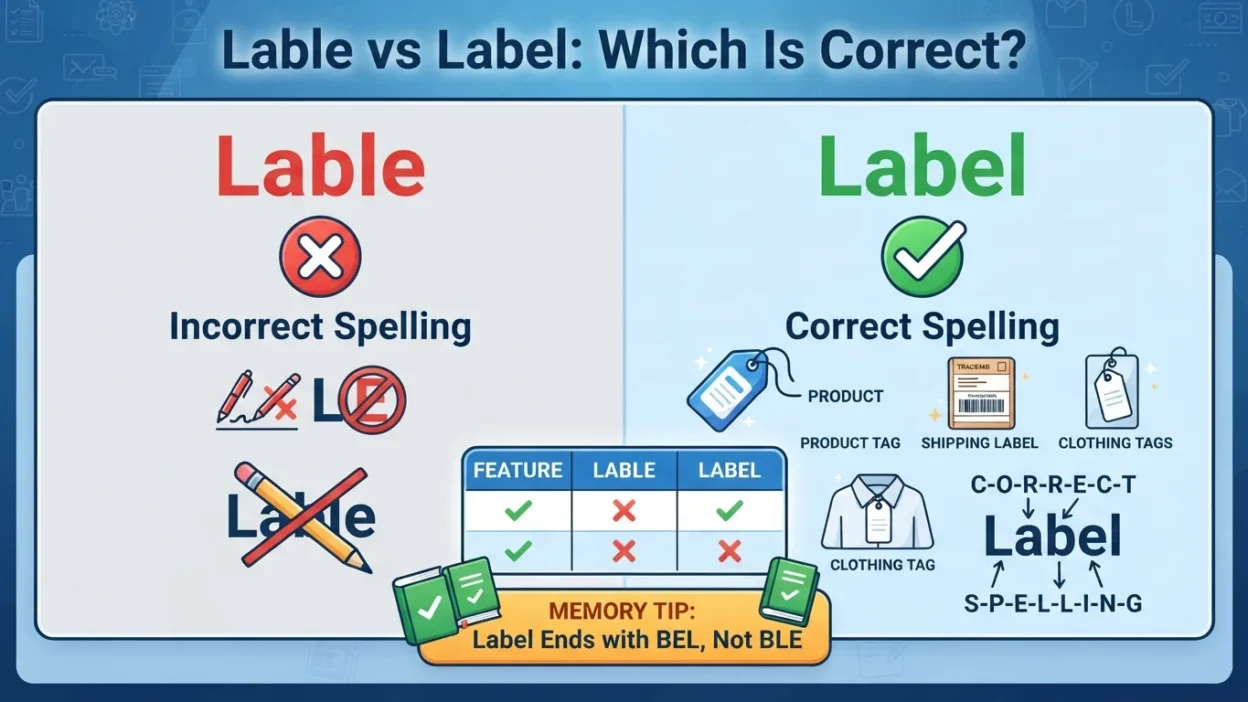
Have you ever typed lable and wondered why your spell checker flagged it as incorrect? You’re not alone. Label is one of the most commonly misspelled words in English because many people accidentally switch the positions of the letters e and l, resulting in the incorrect spelling lable.
The good news is that the rule is simple. Label is the correct spelling in both American and British English, while lable is a common misspelling. In this guide, you’ll learn the correct spelling, understand its meaning, see practical examples, avoid common mistakes, and discover an easy memory trick to remember it.
Quick Answer
- Label is the correct spelling in American and British English.
- Lable is an incorrect spelling and should never be used in formal or informal writing.
Always write “label,” not “lable.”
What Does “Label” Mean?
Label can be used as both a noun and a verb.
As a noun, it means a piece of paper, sticker, tag, or printed information attached to an object to identify or describe it.
As a verb, it means to attach a label to something or to describe or classify someone or something.
Examples of “Label”
- Read the label before using the medicine.
- The bottle has a warning label.
- Please label all the storage boxes.
- The teacher asked students to label the diagram.
- Don’t label people based on first impressions.
In each example, label is used correctly.
What Does “Lable” Mean?
Lable is not a correct English word. It is simply a spelling mistake caused by reversing the letters e and l.
Example
❌ Please read the lable carefully.
✅ Please read the label carefully.
Whether you’re writing about products, school assignments, or business documents, always use label.
Lable vs Label: Comparison Table
| Feature | Lable | Label |
|---|---|---|
| Correct spelling | ❌ No | ✅ Yes |
| Dictionary word | No | Yes |
| Meaning | None | Tag, identifier, or classify |
| American English | Incorrect | Correct |
| British English | Incorrect | Correct |
Why Is “Label” Correct?
The word label comes from older French and has been part of the English language for centuries. Standard dictionaries, grammar guides, and style manuals all recognize label as the correct spelling.
The incorrect spelling lable usually happens because people accidentally reverse the last two letters while typing or spelling from memory.
Common Uses of “Label”
Product Labels
- Check the food label for ingredients.
- The clothing label shows the washing instructions.
School and Education
- Students should label each part of the diagram.
- Remember to label your graphs clearly.
Business
- The company printed a new product label.
- Every package needs a shipping label.
Describing People
- Don’t label someone without knowing the facts.
- Society sometimes unfairly labels individuals.
Common Mistakes to Avoid
Many writers accidentally reverse the letters.
Incorrect
- The lable is missing.
Correct
- The label is missing.
Incorrect
- Please lable the folders.
Correct
- Please label the folders.
Incorrect
- Read the medicine lable.
Correct
- Read the medicine label.
Easy Memory Trick
Here’s a simple trick:
Think of the word table.
Both table and label end with -ble.
- Table
- Label
If you remember that table ends with ble, you’ll remember that label follows a similar letter pattern.
Another helpful reminder:
The word ends in “bel,” not “ble.”
American vs British English
There is no spelling difference between American and British English.
| American English | British English |
|---|---|
| Label | Label |
| Labeling* | Labelling* |
Note: The base word label is spelled the same in both varieties. However, when adding -ing, American English usually writes labeling, while British English commonly uses labelling with a double l.
Related Words and LSI Keywords
Using related vocabulary naturally improves topical authority and readability.
- Tag
- Sticker
- Identifier
- Mark
- Caption
- Product label
- Shipping label
- Name tag
- Packaging
- Classification
- Branding
- Marking
- Diagram label
- Product information
- Identification
These related terms strengthen SEO while helping readers understand different uses of label.
Expert Writing Tip
Professional writers, editors, teachers, and publishers always use label, as it is the only correct spelling recognized in standard English. Whether you’re writing about product packaging, diagrams, business documents, or social issues, using the correct spelling improves your credibility and ensures your writing looks polished.
If you’re unsure, remember that spell checkers and dictionaries will always recognize label, while lable will be marked as an error.
Frequently Asked Questions
Is “label” correct?
Yes. Label is the correct spelling in English.
Is “lable” a real word?
No. Lable is a common spelling mistake and is not recognized as a standard English word.
Which is correct: Lable or Label?
Label is the only correct spelling.
Can “label” be a verb?
Yes. Label can mean to attach a tag or to classify someone or something.
Is there a difference between American and British English?
The base word label is spelled the same in both American and British English. However, the verb form may differ slightly, with labeling (US) and labelling (UK).
Why do people misspell “label”?
Most people accidentally reverse the letters e and l, creating the incorrect spelling lable.
How can I remember the correct spelling?
Think of table. Since table ends in -ble, remember that label follows a similar letter pattern and never becomes lable.
Summary
The difference between Lable and Label is simple. Label is the only correct spelling and is used to refer to a tag, sticker, identifier, or the act of classifying something. It is the standard spelling in both American and British English and appears in education, business, healthcare, packaging, and everyday communication.
Lable, on the other hand, is a common misspelling caused by reversing the last two letters. By remembering that label is the correct dictionary spelling—and using simple memory tricks like comparing it to table—you can avoid this mistake and write with greater confidence and accuracy.

A creative writer with a deep interest in word usage and meaning.
He explores synonyms to enhance both academic and creative expression.
Zayn’s work aims to make language richer and more accessible for everyone.