Have you ever been unsure whether to write other than or other then? You’re not alone. Since than and then sound similar, many people accidentally confuse them. However, only one phrase is correct when you mean except, besides, or apart from.
The simple answer is that other than is the correct expression, while other then is almost always a grammar mistake. In this guide, you’ll learn the difference, understand the meanings of than and then, explore examples, avoid common mistakes, and discover an easy way to remember the correct phrase.
Quick Answer
- Other than is the correct phrase and means except, apart from, or besides.
- Other then is incorrect in standard English.
Whenever you mean “except” or “besides,” always use “other than.”
What Does “Other Than” Mean?
Other than is a common English phrase used to introduce an exception or an additional possibility.
It can mean:
- Except
- Apart from
- Besides
- Excluding
Examples of “Other Than”
- I don’t eat any meat other than chicken.
- Other than that mistake, your report is excellent.
- Does anyone other than Sarah know the answer?
- We have no choice other than to wait.
- Other than weekends, I’m usually available.
In each sentence, other than means except or apart from.
What Does “Other Then” Mean?
Other then is not a correct English phrase.
The confusion happens because then and than are homophones—they sound similar but have different meanings.
Example
❌ I don’t like any fruit other then apples.
✅ I don’t like any fruit other than apples.
Understanding “Than” vs “Then”
Knowing the difference between than and then makes this topic much easier.
Than
Than is used for:
- Comparisons
- Exceptions
- Choices
Examples:
- She is taller than me.
- I’d rather read than watch TV.
- No one other than Alex knew the answer.
Then
Then refers to:
- Time
- Sequence
- What happens next
Examples:
- Finish your homework, then go outside.
- We ate dinner and then watched a movie.
- Back then, life was different.
Because then relates to time, it does not belong in the phrase other than.
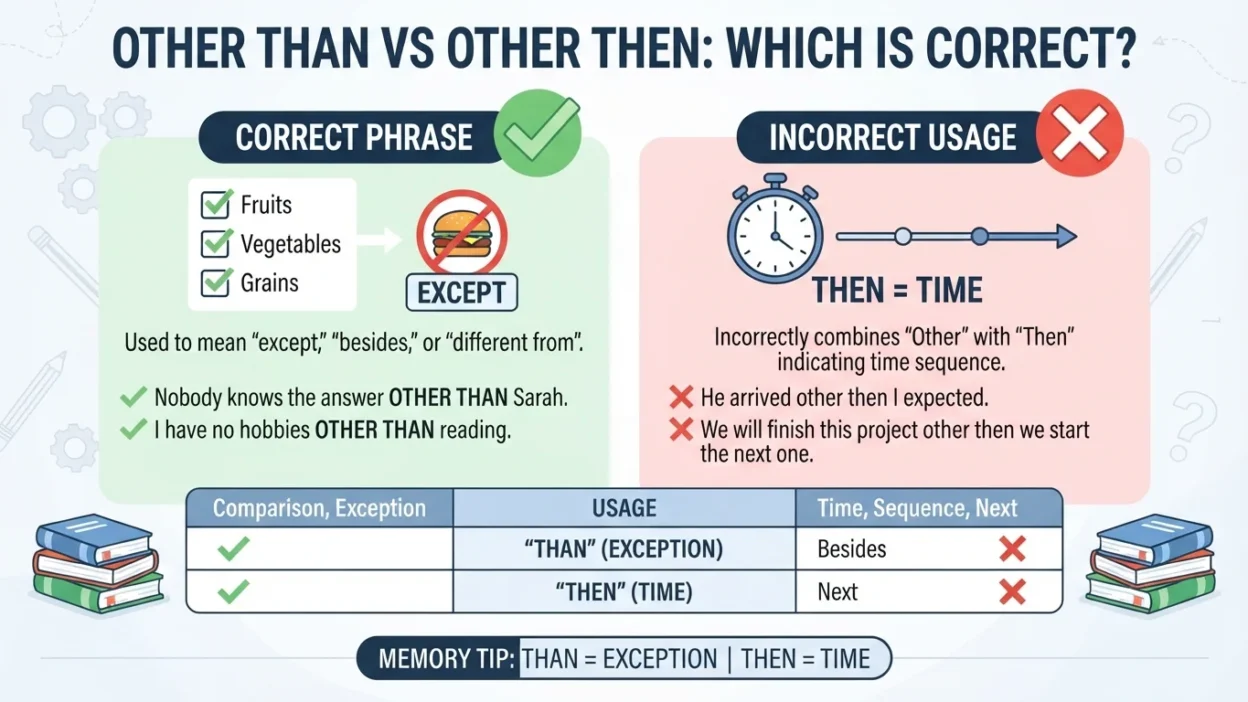
Other Than vs Other Then: Comparison Table
| Feature | Other Than | Other Then |
|---|---|---|
| Correct phrase | ✅ Yes | ❌ No |
| Meaning | Except, besides, apart from | Incorrect expression |
| Uses “than” correctly | Yes | No |
| Standard English | Yes | No |
The Main Difference
The easiest way to remember the difference is:
- Than = Comparison or Exception
- Then = Time or Sequence
Since other than introduces an exception, than is the correct word.
Compare these examples:
Correct
- Everyone other than Jack arrived on time.
- We had no option other than to cancel.
- Other than coffee, what would you like?
Incorrect
- Everyone other then Jack arrived on time.
- We had no option other then to cancel.
Which Phrase Should You Use?
Use other than when you mean:
- Except
- Apart from
- Besides
- Excluding
- With the exception of
Never use other then in these situations.
Common Mistakes to Avoid
Many writers accidentally replace than with then because they sound alike.
Incorrect
- I don’t know anyone other then you.
Correct
- I don’t know anyone other than you.
Incorrect
- Other then that, everything is fine.
Correct
- Other than that, everything is fine.
Incorrect
- We have no choice other then waiting.
Correct
- We have no choice other than waiting.
Easy Memory Trick
Here’s a simple trick:
Remember:
- Than = Comparison or Exception
- Then = Time
If you can replace the phrase with except, use other than.
Example:
- Everyone except Tom.
- Everyone other than Tom.
Since except works, other than is correct.
American vs British English
There is no difference between American and British English.
| American English | British English |
|---|---|
| Other than | Other than |
| Other then | Incorrect |
Both varieties of English use other than as the standard expression.
Related Words and LSI Keywords
Using related vocabulary naturally improves topical authority and readability.
- Except
- Besides
- Apart from
- Excluding
- With the exception of
- Rather than
- Comparison
- Grammar
- Than vs then
- English usage
- Common grammar mistakes
- Word choice
- Homophones
- Writing tips
- Correct English
These related terms strengthen SEO while helping readers understand the topic more clearly.
Expert Writing Tip
Professional writers, editors, and teachers recommend remembering the role of each word rather than memorizing the entire phrase. Since than is used for comparisons and exceptions, it naturally fits the expression other than. The word then relates to time, so it never belongs in this phrase.
Whenever you can replace other than with except, you know you’ve chosen the correct wording.
Frequently Asked Questions
Is “other than” correct?
Yes. Other than is the correct phrase and means except, apart from, or besides.
Is “other then” correct?
No. Other then is a grammar mistake in standard English.
Why do people confuse “than” and “then”?
Because they sound similar but have different meanings. Than is used for comparisons and exceptions, while then refers to time.
Can I replace “other than” with “except”?
Yes. In many sentences, except and other than have the same meaning.
Is there a difference between American and British English?
No. Both American and British English use other than.
How can I remember the correct phrase?
Remember: Than = Exception, Then = Time. If you mean except, always use other than.
Is “other than that” correct?
Yes. Other than that is a common expression meaning apart from that or except for that.
Summary
The difference between other than and other then is straightforward. Other than is the correct phrase used to mean except, apart from, or besides, making it the standard choice in both spoken and written English. Other then is incorrect because then refers to time or sequence, not exceptions.
A simple way to remember the rule is to think of than whenever you’re making a comparison or introducing an exception. If you can replace the phrase with except, other than is the correct choice. Using this rule will help you avoid a common grammar mistake and make your writing clearer and more professional.