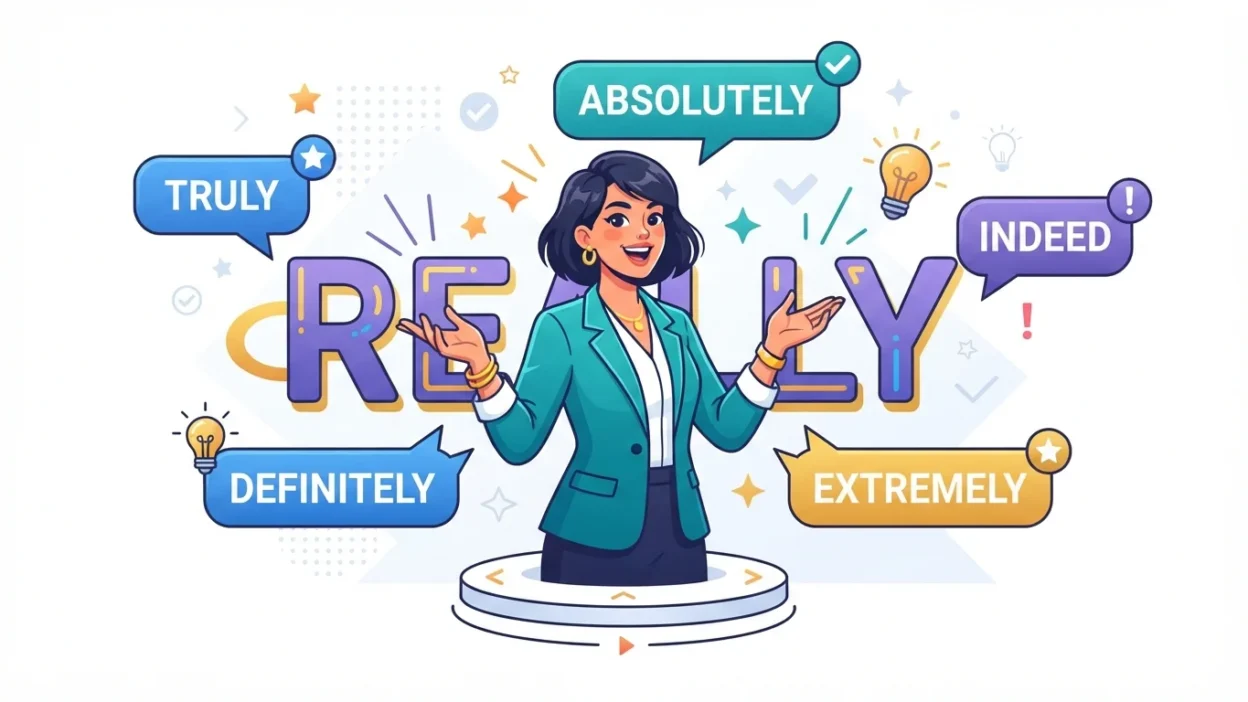
The word really is a common adverb used to emphasize truth, degree, intensity, or certainty. While it’s useful in everyday English, overusing it can make writing repetitive. Learning the synonyms of really helps you express emphasis more effectively in both formal and informal contexts.
Whether you’re writing an essay, email, blog, or social media post, these alternatives can make your language stronger and more varied.
What Does “Really” Mean?
Really can mean:
- Truly or genuinely
- Very or extremely
- In fact
- Actually
- Without doubt
Example Sentences
- I really enjoyed the movie.
- She’s really talented.
- Do you really believe that?
Usage Tip
Choose a synonym based on the context. Use truly or genuinely for sincerity, very or extremely for intensity, and actually or indeed for clarification.
30 Synonyms of Really (With Meanings, Examples & Usage)
1. Truly
Meaning: In a genuine or truthful way.
Example: I truly appreciate your help.
Best Usage Context: Formal and informal writing.
2. Genuinely
Meaning: Honestly and sincerely.
Example: She was genuinely happy to see us.
Best Usage Context: Personal and professional writing.
3. Actually
Meaning: In fact; contrary to expectation.
Example: He actually finished early.
Best Usage Context: Everyday conversation.
4. Indeed
Meaning: Used to emphasize a statement.
Example: It was indeed a remarkable achievement.
Best Usage Context: Formal writing.
5. Certainly
Meaning: Without doubt.
Example: She is certainly qualified.
Best Usage Context: Professional writing.
6. Definitely
Meaning: Without any doubt.
Example: I’ll definitely attend the meeting.
Best Usage Context: Everyday English.
7. Absolutely
Meaning: Completely or totally.
Example: That’s absolutely correct.
Best Usage Context: Strong emphasis.
8. Undoubtedly
Meaning: Beyond question.
Example: He is undoubtedly talented.
Best Usage Context: Formal writing.
9. Surely
Meaning: With confidence or certainty.
Example: Surely there’s another solution.
Best Usage Context: General writing.
10. Positively
Meaning: Without question.
Example: She was positively thrilled.
Best Usage Context: Descriptive writing.
11. Very
Meaning: To a high degree.
Example: The book is very interesting.
Best Usage Context: Everyday English.
12. Extremely
Meaning: To a very great degree.
Example: The weather is extremely cold.
Best Usage Context: Formal and informal writing.
13. Highly
Meaning: To a great extent.
Example: She is highly respected.
Best Usage Context: Professional writing.
14. Exceptionally
Meaning: To an unusually high degree.
Example: The food was exceptionally good.
Best Usage Context: Reviews and reports.
15. Remarkably
Meaning: In a notable way.
Example: He recovered remarkably quickly.
Best Usage Context: General writing.
16. Considerably
Meaning: By a significant amount.
Example: Sales increased considerably.
Best Usage Context: Business writing.
17. Greatly
Meaning: To a large extent.
Example: Your advice greatly helped me.
Best Usage Context: Formal writing.
18. Profoundly
Meaning: Deeply or intensely.
Example: She was profoundly affected.
Best Usage Context: Academic and literary writing.
19. Deeply
Meaning: With great intensity.
Example: I deeply regret the mistake.
Best Usage Context: Emotional contexts.
20. Seriously
Meaning: In a sincere or intense way.
Example: He seriously considered the offer.
Best Usage Context: General writing.
21. Honestly
Meaning: Truthfully.
Example: I honestly don’t know.
Best Usage Context: Casual conversations.
22. Frankly
Meaning: Speaking openly and honestly.
Example: Frankly, I disagree.
Best Usage Context: Opinions.
23. In Fact
Meaning: Used to introduce a true statement.
Example: In fact, she arrived early.
Best Usage Context: Formal writing.
24. To Be Honest
Meaning: Speaking truthfully.
Example: To be honest, I expected more.
Best Usage Context: Casual writing.
25. Unquestionably
Meaning: Beyond dispute.
Example: She is unquestionably talented.
Best Usage Context: Formal writing.
26. Completely
Meaning: Entirely.
Example: I completely understand.
Best Usage Context: General writing.
27. Totally
Meaning: Entirely or fully.
Example: I’m totally ready.
Best Usage Context: Informal conversations.
28. Entirely
Meaning: Fully or wholly.
Example: The decision was entirely reasonable.
Best Usage Context: Formal writing.
29. Quite
Meaning: To a noticeable degree.
Example: The movie was quite enjoyable.
Best Usage Context: British and general English.
30. Emphatically
Meaning: In a forceful or definite way.
Example: She emphatically denied the claim.
Best Usage Context: Formal and persuasive writing.
Comparison Table: When to Use Different Really Synonyms
| Context | Best Synonyms |
|---|---|
| Showing Truth | Truly, Genuinely, Honestly |
| Strong Emphasis | Absolutely, Definitely, Certainly |
| Degree or Intensity | Very, Extremely, Highly |
| Formal Writing | Indeed, Undoubtedly, Emphatically |
| Casual Conversation | Totally, Actually, To Be Honest |
How to Choose the Right Synonym
For Sincerity
Use:
- Truly
- Genuinely
- Honestly
For Strong Emphasis
Use:
- Absolutely
- Definitely
- Certainly
For Intensity
Use:
- Extremely
- Highly
- Exceptionally
For Formal Writing
Use:
- Indeed
- Undoubtedly
- Emphatically
Conclusion
Learning the synonyms of really helps you express emphasis, certainty, and intensity with greater precision. While really is useful in everyday English, alternatives such as truly, absolutely, extremely, indeed, and genuinely can make your writing more engaging and less repetitive.
Using the right synonym based on the context will improve both your spoken and written communication.