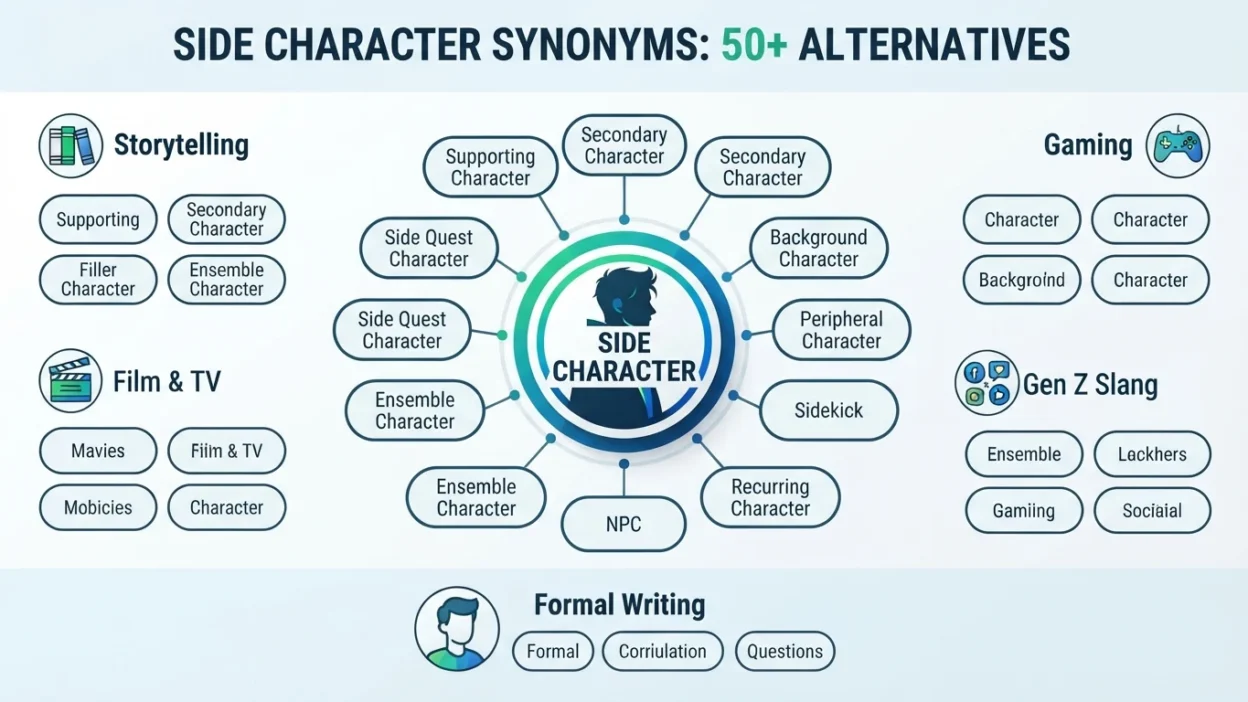
Looking for the best side character synonyms? Whether you’re writing about movies, novels, anime, television shows, video games, or internet culture, there are many ways to describe a character who is not the main focus of a story. The right word depends on the character’s importance, role, and relationship with the protagonist.
In storytelling, side character usually refers to someone who supports, interacts with, or exists alongside the main character without being the central figure. In modern slang, however, calling someone a side character can be humorous and may suggest that the person seems less important or behaves like an NPC. This guide covers both traditional storytelling terms and modern internet alternatives.
Quick Answer
The best side character synonyms include:
- Supporting character
- Secondary character
- Minor character
- Background character
- Peripheral character
- Supporting role
- Secondary role
- Tertiary character
- Bit character
- Recurring character
- Ensemble character
- Sidekick
- NPC
- Background NPC
- Extra
- Filler character
- Comic relief
- Side-player
- Backup character
- Non-playable character
For formal writing, supporting character and secondary character are usually the safest choices. For internet slang, NPC, NPC energy, background character, and sidekick are popular alternatives.
What Does “Side Character” Mean?
A side character is a character who plays a supporting or secondary role in a story rather than being the main protagonist.
Side characters can still be extremely important. They may help the protagonist, create conflict, provide information, add humor, develop the plot, or make the fictional world feel realistic.
For example:
Hermione is a major supporting character in the Harry Potter series.
A side character does not necessarily mean an unimportant character. Some supporting characters become just as memorable as the protagonist.
Best Side Character Synonyms
1. Supporting Character
Supporting character is one of the most accurate and widely accepted alternatives to side character.
Meaning: A character who helps develop the story without being the primary protagonist.
Example:
The detective’s partner is an important supporting character.
Best for: Literature, film, television, essays, and professional writing.
2. Secondary Character
A secondary character is a character who has less narrative focus than the main character.
Example:
The novel introduces several secondary characters throughout the story.
Best for: Literature, academic writing, and storytelling analysis.
3. Minor Character
A minor character has a relatively small role in the story.
Example:
The shopkeeper is a minor character who appears in only two chapters.
Best for: Characters with limited screen time or narrative importance.
4. Background Character
A background character usually exists in the setting without having a major role in the plot.
Example:
Several background characters appear in the busy city scene.
Best for: Movies, television, anime, games, and visual storytelling.
5. Peripheral Character
A peripheral character exists around the central story but is not directly at its core.
Example:
Several peripheral characters help create the atmosphere of the novel.
Best for: Formal and literary analysis.
6. Sidekick
A sidekick is a supporting character who regularly accompanies and assists the main character.
Example:
The hero’s loyal sidekick helps solve the mystery.
Best for: Adventure stories, superhero fiction, comedy, and casual conversation.
7. Tertiary Character
A tertiary character generally has an even smaller role than a primary or major supporting character.
Example:
The film includes several tertiary characters who appear briefly.
Best for: Detailed literary or narrative analysis.
8. Bit Character
A bit character has a very small role, often appearing briefly.
Example:
The actor played a bit character in the opening scene.
Best for: Film, television, theater, and entertainment discussions.
9. Recurring Character
A recurring character appears multiple times but is not necessarily the main character.
Example:
The show introduced a popular recurring character in its second season.
Best for: Television, series, anime, and long-form storytelling.
10. Ensemble Character
An ensemble character belongs to a larger group of important characters who share the story’s attention.
Example:
The series has an impressive ensemble cast.
Best for: Television, film, theater, and stories with multiple protagonists.
Side Character Synonyms for Literature
When writing a school assignment, essay, or literary analysis, use precise terms such as:
- Supporting character
- Secondary character
- Minor character
- Peripheral character
- Tertiary character
- Supporting role
- Secondary role
- Recurring character
- Narrative figure
- Supporting figure
Example
Instead of:
The author uses many side characters.
A stronger sentence is:
The author uses several supporting characters to develop the protagonist and advance the plot.
This sounds more precise and academic.
Side Character Synonyms for Movies and TV
For film and television, these terms are particularly useful:
- Supporting character
- Supporting role
- Secondary character
- Background character
- Recurring character
- Ensemble character
- Bit character
- Extra
- Supporting cast
- Background performer
Example
The series has a strong supporting cast that adds depth to the main storyline.
Side Character Synonyms for Anime
Anime communities commonly use both traditional storytelling vocabulary and internet slang.
Useful terms include:
- Supporting character
- Secondary character
- Side character
- Sidekick
- Background character
- Recurring character
- NPC
- Comic relief
- Rival
- Supporting cast
- Ensemble character
- Minor character
Some anime side characters can become fan favorites despite having less narrative focus than the protagonist.
Side Character Synonyms for Gaming
Gaming uses a different vocabulary because characters can be playable or non-playable.
Common alternatives include:
- NPC
- Non-playable character
- Supporting character
- Sidekick
- Background NPC
- Companion
- Follower
- Quest character
- Minor character
- Background player
- Filler character
- Side character
What Does NPC Mean?
NPC stands for non-player character or non-playable character, depending on the game and context.
In gaming, an NPC is a character controlled by the game’s software rather than by the player.
Online, however, NPC is sometimes used as slang to describe someone who seems predictable, passive, or lacking individuality.
Side Character Synonyms in Gen Z Slang
On social media, side character often has a humorous meaning.
Popular alternatives include:
- NPC
- NPC energy
- Background character
- Sidekick
- Extra
- Filler character
- Side-player
- Backup character
- Side quest character
- Main-character’s sidekick
- Main-character adjacent
- Supporting-cast energy
- Plot accessory
- Background energy
- Walking side quest
- Just here for the lore
Examples
Bro has serious NPC energy.
She’s giving background character vibes.
He’s basically the protagonist’s sidekick.
I’m just here for the lore.
Bro is a side quest character.
These phrases are informal and often humorous rather than literal.
Funny Side Character Alternatives
If you’re looking for funny or meme-style alternatives, try:
- NPC
- NPC energy
- Background NPC
- Extra
- Filler character
- Side quest character
- Walking side quest
- Plot accessory
- Main character’s plus-one
- Backup cast
- Comic relief
- Background energy
- Supporting-cast energy
- Just here for the lore
- Main-character adjacent
Example
He isn’t the main character; he’s the main character’s plus-one.
This type of language is best for memes, captions, group chats, and casual social media posts.
Side Character vs Supporting Character
These terms are often used interchangeably, but supporting character is usually more precise.
A side character is a broad, informal term for someone who is not the main character.
A supporting character has a specific narrative function and contributes to the story.
For example:
The protagonist’s friend is a side character.
This is casual.
The protagonist’s friend is a supporting character who helps drive the plot.
This is more precise.
Side Character vs Sidekick
A sidekick is a type of supporting character, but not every supporting character is a sidekick.
A sidekick usually has a close relationship with the protagonist and frequently assists them.
For example, a hero’s loyal companion may be a sidekick, while a teacher who appears occasionally is simply a supporting character.
Side Character vs NPC
These terms have different original meanings.
Side character is a storytelling term.
NPC is primarily a gaming term referring to a character controlled by the game rather than the player.
However, on social media, NPC can be used metaphorically to describe someone who seems like a background character.
Side Character vs Extra
An extra generally appears in the background and has little or no dialogue.
A side character usually has a more developed role.
For example:
- Extra: Person walking through a street scene.
- Background character: Person helping establish the setting.
- Supporting character: Person who interacts with the protagonist and advances the plot.
- Sidekick: Character who regularly assists the protagonist.
Side Character Synonyms: Comparison Table
| Synonym | Meaning | Tone | Best Context |
|---|---|---|---|
| Supporting character | Character who supports the main story | Neutral | Literature, film |
| Secondary character | Character with less focus than protagonist | Neutral | Writing |
| Minor character | Character with a small role | Neutral | Literature |
| Background character | Character in the background | Neutral | Film, anime |
| Peripheral character | Character outside the central story | Formal | Literary analysis |
| Tertiary character | Very minor character | Formal | Story analysis |
| Sidekick | Main character’s helper | Casual | Adventure, superheroes |
| Recurring character | Character who appears repeatedly | Neutral | TV, series |
| Bit character | Very small role | Neutral | Film, theater |
| NPC | Game-controlled character | Slang/gaming | Games, internet |
| Extra | Background performer | Casual | Film, TV |
| Comic relief | Character providing humor | Neutral | Comedy, fiction |
| Ensemble character | Member of a group cast | Neutral | Film, TV |
| Filler character | Character with limited narrative value | Informal | Anime, internet |
| Side quest character | Humorous minor figure | Slang | Gaming, memes |
How to Choose the Right Synonym
Choosing the right synonym depends on your context.
For Academic Writing
Use:
Supporting character, secondary character, minor character, or peripheral character.
For Movies and Television
Use:
Supporting role, supporting character, recurring character, ensemble character, or background character.
For Gaming
Use:
NPC, companion, quest character, follower, or non-playable character.
For Gen Z Slang
Use:
NPC energy, background character, sidekick energy, side quest character, or filler character.
For a Funny Caption
Use:
Just here for the lore, walking side quest, main-character’s plus-one, or certified NPC.
Common Mistakes When Using “Side Character”
Calling Every Non-Protagonist a Minor Character
Not every character who isn’t the protagonist is necessarily a minor character.
A supporting character can have a large and important role.
Using “NPC” in Formal Writing
NPC is appropriate when discussing gaming or informal internet culture. In formal literary analysis, supporting character or secondary character is usually better.
Confusing Sidekick With Side Character
A sidekick is specifically a helper or companion of the protagonist. A side character can have any supporting role.
Assuming Side Characters Are Unimportant
Some side characters have major influence on the plot, themes, and protagonist’s development. Being a side character does not automatically mean being insignificant.
American vs British English
Side character, supporting character, secondary character, and background character are understood in both American and British English.
In both varieties, supporting character is a particularly useful term for formal writing about literature, film, and television.
The slang use of NPC has also spread internationally through gaming and social media. However, expressions such as NPC energy or main-character energy are informal and should generally be reserved for casual contexts.
Related Words and LSI Keywords
Relevant terms related to side character synonyms include:
- Supporting character
- Main character
- Protagonist
- Antagonist
- Secondary character
- Minor character
- Background character
- Supporting role
- Sidekick
- NPC
- Non-playable character
- Recurring character
- Ensemble cast
- Character development
- Character arc
- Storytelling
- Narrative role
- Fictional character
- Main-character energy
- NPC energy
- Side quest
- Comic relief
- Background role
- Filler character
Frequently Asked Questions
What is the closest synonym for side character?
The closest general synonym is supporting character. Other options include secondary character, minor character, and background character.
What is a Gen Z synonym for side character?
Popular Gen Z alternatives include NPC, NPC energy, background character, side quest character, filler character, and sidekick energy.
Is a side character the same as a supporting character?
They can mean the same thing in casual conversation. However, supporting character is more precise when discussing a character’s narrative role.
What is an NPC?
NPC means non-player character or non-playable character. In gaming, it usually refers to a character controlled by the game rather than the player.
What is the difference between a side character and a sidekick?
A sidekick is a specific type of supporting character who regularly helps or accompanies the protagonist. A side character can have many different roles.
What is a minor character?
A minor character is a character with relatively little narrative importance, limited appearances, or a small role in the overall story.
What is a background character?
A background character usually appears in the setting without significantly affecting the main plot.
Can a side character be important?
Yes. A side character can be essential to character development, conflict, humor, world-building, or plot progression even if they are not the protagonist.
Summary
Side character is a broad term for a character who is not the central protagonist. Depending on the character’s role, more precise alternatives include supporting character, secondary character, minor character, background character, peripheral character, sidekick, and recurring character. In gaming and internet culture, terms such as NPC, NPC energy, side quest character, and filler character are popular informal alternatives.
The best synonym depends on your purpose. Use supporting character for formal storytelling discussions, minor character for a limited role, sidekick for a protagonist’s companion, and background character for someone who mainly establishes the setting. For casual or Gen Z communication, NPC, side quest character, and background character energy can add a humorous modern tone.
Actionable Takeaway
Choose your synonym based on the context:
- Formal storytelling: Supporting character
- Less important role: Minor character
- Story analysis: Secondary character
- Background role: Background character
- Hero’s helper: Sidekick
- Gaming: NPC
- Gen Z slang: NPC energy
- Funny: Side quest character
- Film/TV: Supporting role
- Large cast: Ensemble character
Using the most precise term helps your writing sound natural, clear, and appropriate for your audience.

A passionate linguist who specializes in word relationships and vocabulary building.
He has spent years studying synonyms and semantic patterns across languages.
Arman writes to make language learning simple, precise, and engaging.