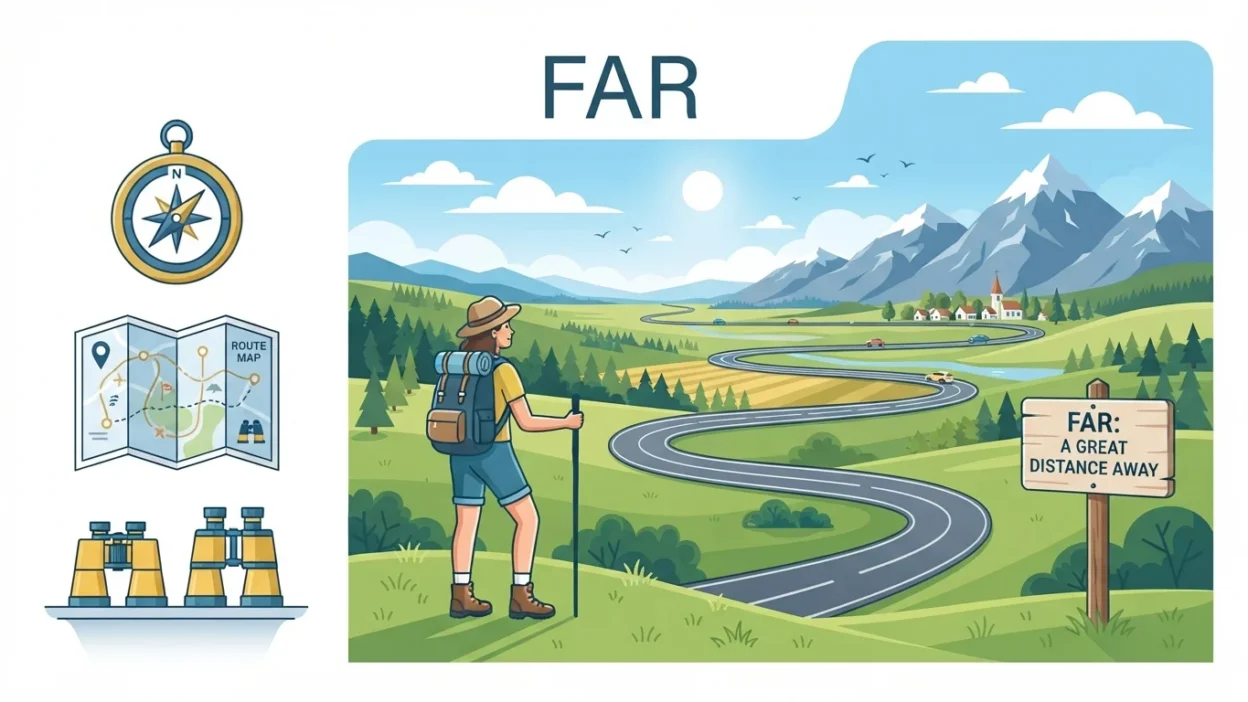
The word far is commonly used to describe a great distance in space, time, degree, or extent. It can refer to physical locations, future or past events, or a significant difference in amount or level. Learning the synonyms of far can help you write with greater variety and precision.
Whether you’re writing an essay, story, email, or blog post, these alternatives can improve your vocabulary and reduce repetition.
What Does “Far” Mean?
Far means:
- At a great distance
- Remote or distant in location
- A long time away in the past or future
- To a great extent or degree
Example Sentences
- The nearest town is far from here.
- We planned our vacation far in advance.
- Her skills are far better than mine.
Usage Tip
Choose a synonym based on the context. Use distant or remote for locations, much or considerably for degree, and beyond for distance or extent.
30 Synonyms of Far (With Meanings, Examples & Usage)
1. Distant
Meaning: Located a long way away.
Example: They lived in a distant village.
Best Usage Context: Places and geography.
2. Remote
Meaning: Far from populated areas.
Example: The cabin is in a remote forest.
Best Usage Context: Travel and nature.
3. Afar
Meaning: From a distance.
Example: We watched the fireworks from afar.
Best Usage Context: Literary writing.
4. Away
Meaning: At another place or distance.
Example: The station is miles away.
Best Usage Context: Everyday speech.
5. Beyond
Meaning: On the farther side of.
Example: The mountains lie beyond the valley.
Best Usage Context: General writing.
6. Removed
Meaning: Separated by distance or circumstance.
Example: The island is removed from the mainland.
Best Usage Context: Formal writing.
7. Isolated
Meaning: Far from others or difficult to reach.
Example: They lived in an isolated community.
Best Usage Context: Geography.
8. Outlying
Meaning: Situated far from the center.
Example: The outlying farms were affected.
Best Usage Context: Locations.
9. Peripheral
Meaning: Located on the edge or outskirts.
Example: They settled in a peripheral district.
Best Usage Context: Urban planning.
10. Extensive
Meaning: Covering a large area or degree.
Example: The damage was extensive.
Best Usage Context: Degree or size.
11. Much
Meaning: To a great degree.
Example: This option is much better.
Best Usage Context: Comparisons.
12. Considerably
Meaning: By a significant amount.
Example: Prices have risen considerably.
Best Usage Context: Formal writing.
13. Significantly
Meaning: To an important extent.
Example: The results improved significantly.
Best Usage Context: Academic writing.
14. Greatly
Meaning: To a large extent.
Example: She greatly appreciated the help.
Best Usage Context: General writing.
15. Substantially
Meaning: By a large amount.
Example: Profits increased substantially.
Best Usage Context: Business.
16. Widely
Meaning: Over a large area.
Example: The language is widely spoken.
Best Usage Context: Geography and communication.
17. Long
Meaning: A great distance or duration.
Example: It was a long journey.
Best Usage Context: Distance and time.
18. Deep
Meaning: Far inside or below.
Example: The treasure was buried deep underground.
Best Usage Context: Physical depth.
19. Outer
Meaning: Situated farther from the center.
Example: The outer suburbs are expanding.
Best Usage Context: Locations.
20. Extreme
Meaning: At the greatest limit.
Example: They traveled to the extreme north.
Best Usage Context: Geography.
21. Furthest
Meaning: At the greatest distance.
Example: She reached the furthest point.
Best Usage Context: Distance.
22. Farthest
Meaning: Most distant in space.
Example: Which city is the farthest away?
Best Usage Context: Everyday English.
23. Yonder
Meaning: At some distance.
Example: The cottage stood yonder.
Best Usage Context: Literary writing.
24. Off
Meaning: Away from a place.
Example: The trail runs off into the hills.
Best Usage Context: Informal writing.
25. Secluded
Meaning: Hidden and away from others.
Example: They found a secluded beach.
Best Usage Context: Travel.
26. Inaccessible
Meaning: Difficult to reach.
Example: The cave remained inaccessible.
Best Usage Context: Geography.
27. Unreachable
Meaning: Impossible or difficult to get to.
Example: The island became unreachable after the storm.
Best Usage Context: General writing.
28. Detached
Meaning: Separate or apart.
Example: The house stood detached from the others.
Best Usage Context: Property descriptions.
29. Apart
Meaning: Separated by distance.
Example: The two towns are miles apart.
Best Usage Context: Everyday speech.
30. Well Away
Meaning: At a safe or considerable distance.
Example: Keep well away from the edge.
Best Usage Context: Instructions and safety.
Comparison Table: When to Use Different Far Synonyms
| Context | Best Synonyms |
|---|---|
| Physical Distance | Distant, Remote, Afar |
| Time | Long, Distant, Beyond |
| Degree | Much, Considerably, Greatly |
| Geography | Isolated, Outlying, Secluded |
| Formal Writing | Significantly, Substantially, Peripheral |
How to Choose the Right Synonym
For Distance
Use:
- Distant
- Remote
- Afar
For Degree
Use:
- Much
- Greatly
- Considerably
For Locations
Use:
- Isolated
- Secluded
- Outlying
For Formal Writing
Use:
- Significantly
- Substantially
- Peripheral
Conclusion
Learning the synonyms of far allows you to describe distance, time, and degree more accurately. While far is a versatile word, alternatives such as distant, remote, considerably, beyond, and afar can make your writing more varied and precise.
Choosing the right synonym based on the context will improve readability and help you communicate your ideas more effectively.

An expert in English grammar and expressive writing techniques.
She focuses on helping readers expand their vocabulary with clarity.
Elina believes the right word can transform ordinary writing into powerful communication.