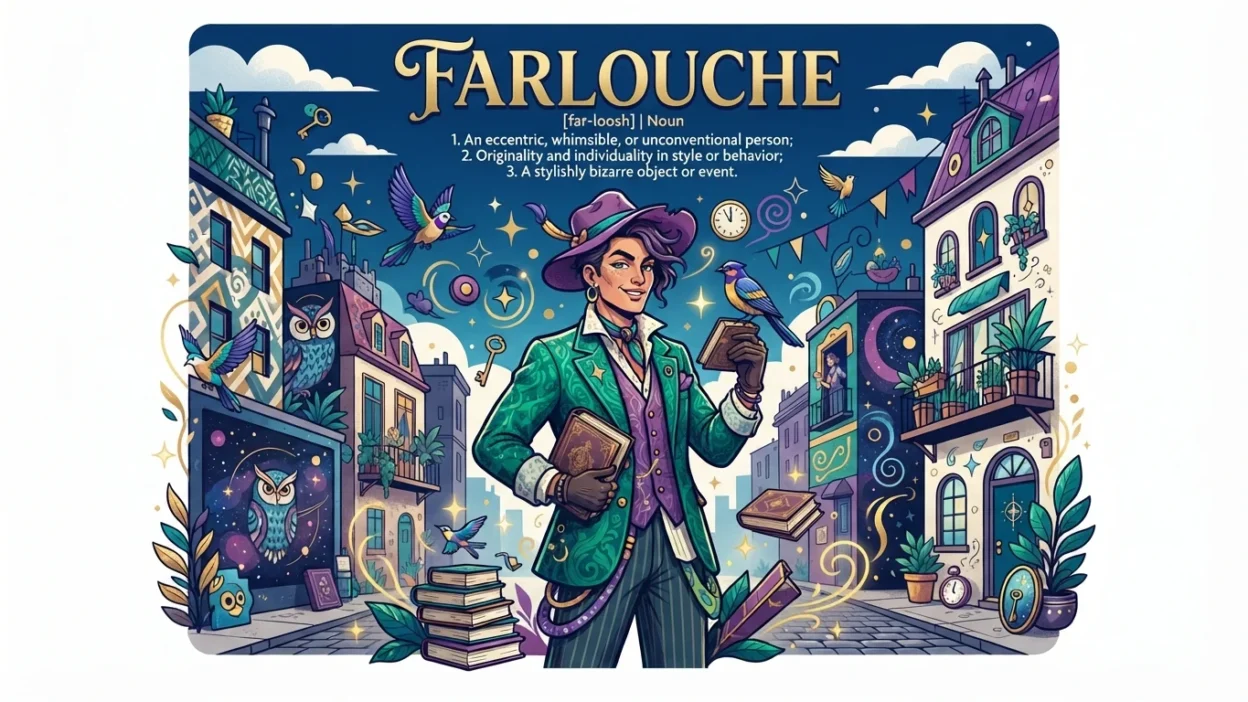
The word farlouche is an uncommon adjective of French origin. It describes someone or something that is eccentric, unconventional, strange, shy, reserved, or difficult to approach, depending on the context. It is most often used in literary or descriptive writing.
Learning the synonyms of farlouche can help you express ideas about unusual personalities, mysterious behavior, or unconventional styles more precisely.
What Does “Farlouche” Mean?
Farlouche can mean:
- Eccentric or unconventional
- Strange or odd
- Shy or reserved
- Aloof or difficult to approach
- Unpredictable or quirky
Example Sentences
- The artist was known for his farlouche personality.
- She gave a farlouche smile before walking away.
- The novel features a farlouche detective with unusual habits.
Usage Tip
Choose a synonym based on the intended meaning. Use eccentric or quirky for unusual behavior, and reserved or aloof for someone who keeps to themselves.
30 Synonyms of Farlouche (With Meanings, Examples & Usage)
1. Eccentric
Meaning: Unconventional or unusual.
Example: The eccentric inventor surprised everyone.
Best Usage Context: General writing.
2. Quirky
Meaning: Charmingly unusual.
Example: She has a quirky sense of humor.
Best Usage Context: Informal writing.
3. Unconventional
Meaning: Not following traditional norms.
Example: His unconventional methods worked well.
Best Usage Context: Professional and creative writing.
4. Odd
Meaning: Different from what is normal.
Example: That was an odd response.
Best Usage Context: Everyday English.
5. Strange
Meaning: Unusual or unexpected.
Example: They heard a strange noise.
Best Usage Context: General writing.
6. Peculiar
Meaning: Distinctively unusual.
Example: She had a peculiar habit of humming while working.
Best Usage Context: Descriptive writing.
7. Bizarre
Meaning: Extremely unusual.
Example: The sculpture had a bizarre appearance.
Best Usage Context: Creative writing.
8. Curious
Meaning: Odd or interestingly unusual.
Example: It was a curious coincidence.
Best Usage Context: Literary writing.
9. Outlandish
Meaning: Shockingly unconventional.
Example: He wore an outlandish costume.
Best Usage Context: Fashion and storytelling.
10. Offbeat
Meaning: Unusual in an appealing way.
Example: The café has an offbeat atmosphere.
Best Usage Context: Lifestyle writing.
11. Unorthodox
Meaning: Different from accepted practices.
Example: The coach used unorthodox tactics.
Best Usage Context: Business and education.
12. Idiosyncratic
Meaning: Characterized by unique personal traits.
Example: Her idiosyncratic writing style is recognizable.
Best Usage Context: Academic writing.
13. Aloof
Meaning: Emotionally distant or reserved.
Example: He seemed aloof at the party.
Best Usage Context: Personality descriptions.
14. Reserved
Meaning: Quiet and restrained.
Example: She is naturally reserved.
Best Usage Context: Everyday writing.
15. Withdrawn
Meaning: Keeping away from others.
Example: He became withdrawn after the incident.
Best Usage Context: Personal descriptions.
16. Shy
Meaning: Timid around others.
Example: The shy student avoided attention.
Best Usage Context: Everyday English.
17. Reticent
Meaning: Reluctant to speak.
Example: She remained reticent during the meeting.
Best Usage Context: Formal writing.
18. Introverted
Meaning: Focused inward rather than outward.
Example: He’s an introverted thinker.
Best Usage Context: Psychology and general writing.
19. Elusive
Meaning: Difficult to understand or find.
Example: The elusive writer rarely gave interviews.
Best Usage Context: Literature.
20. Mysterious
Meaning: Difficult to explain or understand.
Example: She had a mysterious charm.
Best Usage Context: Fiction.
21. Enigmatic
Meaning: Hard to interpret.
Example: The detective was enigmatic.
Best Usage Context: Literary writing.
22. Unpredictable
Meaning: Impossible to anticipate.
Example: His unpredictable behavior kept everyone guessing.
Best Usage Context: General writing.
23. Whimsical
Meaning: Playfully unusual.
Example: The garden had a whimsical design.
Best Usage Context: Creative writing.
24. Bohemian
Meaning: Living in an unconventional way.
Example: She embraced a bohemian lifestyle.
Best Usage Context: Arts and culture.
25. Nonconformist
Meaning: Someone who rejects social norms.
Example: The nonconformist challenged tradition.
Best Usage Context: Social commentary.
26. Independent
Meaning: Thinking or acting freely.
Example: He’s an independent thinker.
Best Usage Context: General writing.
27. Singular
Meaning: Exceptionally unique.
Example: She has a singular talent.
Best Usage Context: Formal writing.
28. Distinctive
Meaning: Clearly different from others.
Example: The building has a distinctive design.
Best Usage Context: Descriptive writing.
29. Original
Meaning: Fresh and unique.
Example: The artist developed an original style.
Best Usage Context: Creative fields.
30. Unusual
Meaning: Not common or ordinary.
Example: They noticed an unusual pattern.
Best Usage Context: General writing.
Comparison Table: When to Use Different Farlouche Synonyms
| Context | Best Synonyms |
|---|---|
| Unusual Personality | Eccentric, Quirky, Peculiar |
| Reserved Behavior | Aloof, Reserved, Reticent |
| Creative Writing | Enigmatic, Whimsical, Bohemian |
| Professional Writing | Unconventional, Unorthodox, Distinctive |
| Everyday Conversation | Odd, Strange, Unusual |
Conclusion
The synonyms of farlouche vary depending on the intended meaning. If you want to emphasize unusual behavior, use eccentric, quirky, or peculiar. If you’re describing someone who is quiet or hard to approach, aloof, reserved, or reticent are better choices. Selecting the right synonym will make your writing more precise and engaging.

A passionate linguist who specializes in word relationships and vocabulary building.
He has spent years studying synonyms and semantic patterns across languages.
Arman writes to make language learning simple, precise, and engaging.