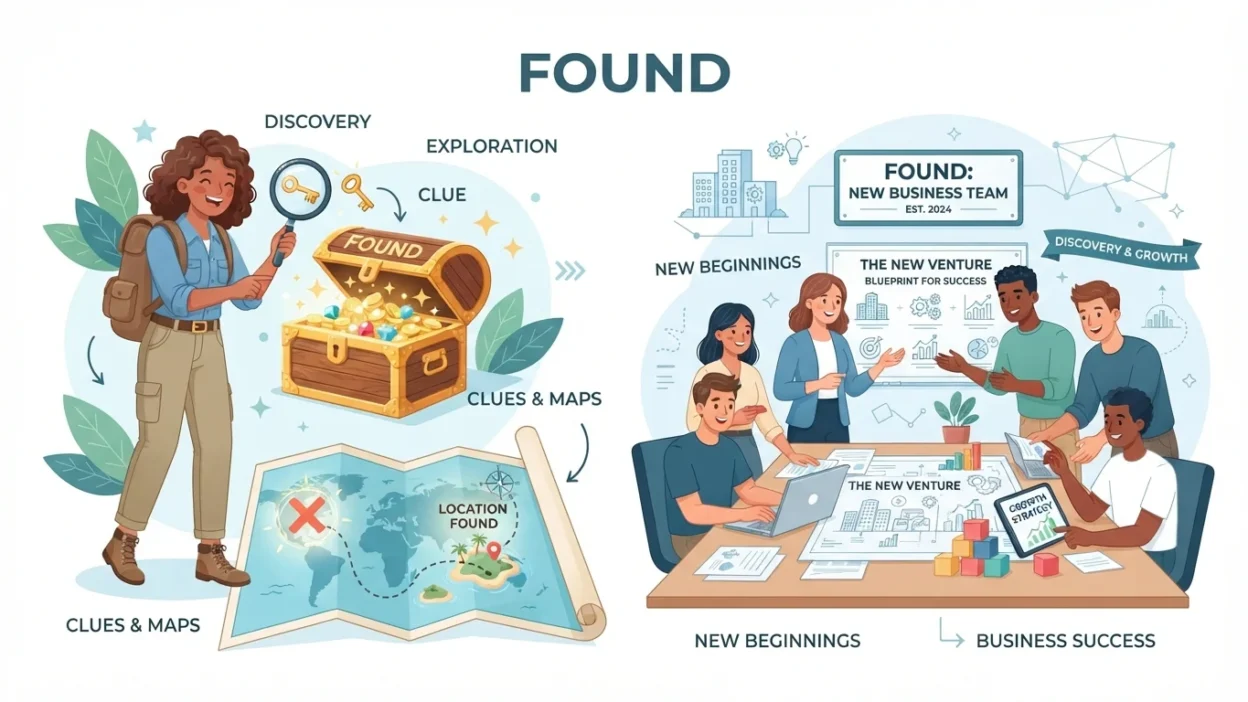
The word found is the past tense and past participle of find, meaning to discover, locate, or come across something. It can also refer to establishing or creating an organization, institution, or business. Learning the synonyms of found can help students, ESL learners, writers, and professionals express these meanings more accurately in different contexts.
Whether you’re writing an essay, report, novel, or business document, using alternatives to found can make your writing more varied and precise.
What Does “Found” Mean?
Found can mean:
- To discover or locate something
- To come across something unexpectedly
- To establish or create an organization, company, or institution
Example Sentences
- She found her missing keys under the couch.
- Scientists found evidence of ancient civilizations.
- They found a nonprofit organization to support local communities.
Usage Tip
Choose a synonym based on the intended meaning. Words like discover and locate replace found when it means to find, while establish and create replace it when it means to found an organization or institution.
30 Synonyms of Found (With Meanings, Examples & Usage)
1. Discover
Meaning: To find something for the first time.
Example: Researchers discovered a new species.
Best Usage Context: Science and general writing.
2. Locate
Meaning: To find the exact position of something.
Example: Police located the missing vehicle.
Best Usage Context: Everyday and professional writing.
3. Detect
Meaning: To notice or identify something.
Example: The scanner detected a problem.
Best Usage Context: Science and technology.
4. Identify
Meaning: To recognize or establish what something is.
Example: Experts identified the artifact.
Best Usage Context: Academic and professional writing.
5. Unearth
Meaning: To discover something hidden or buried.
Example: Archaeologists unearthed ancient pottery.
Best Usage Context: History and archaeology.
6. Come Across
Meaning: To find something unexpectedly.
Example: I came across an old photograph.
Best Usage Context: Informal conversations.
7. Encounter
Meaning: To meet or find unexpectedly.
Example: They encountered unexpected challenges.
Best Usage Context: General writing.
8. Spot
Meaning: To notice or see.
Example: She spotted a rare bird.
Best Usage Context: Everyday communication.
9. Notice
Meaning: To become aware of something.
Example: He noticed a mistake in the report.
Best Usage Context: General writing.
10. Observe
Meaning: To see or notice carefully.
Example: Scientists observed unusual behavior.
Best Usage Context: Academic writing.
11. Recover
Meaning: To find and regain something lost.
Example: The police recovered the stolen artwork.
Best Usage Context: Law enforcement and insurance.
12. Retrieve
Meaning: To get back something.
Example: She retrieved the files from storage.
Best Usage Context: Business and technology.
13. Track Down
Meaning: To find after a careful search.
Example: Detectives tracked down the suspect.
Best Usage Context: Investigations.
14. Pinpoint
Meaning: To identify the exact location or cause.
Example: Engineers pinpointed the fault.
Best Usage Context: Technical writing.
15. Reveal
Meaning: To make something known.
Example: The report revealed new information.
Best Usage Context: Journalism and research.
16. Expose
Meaning: To uncover something hidden.
Example: The investigation exposed corruption.
Best Usage Context: News and investigative writing.
17. Establish
Meaning: To create or found an organization.
Example: They established a scholarship fund.
Best Usage Context: Business and institutions.
18. Create
Meaning: To bring something into existence.
Example: She created a successful startup.
Best Usage Context: General writing.
19. Form
Meaning: To organize or establish.
Example: The members formed a committee.
Best Usage Context: Business and organizations.
20. Launch
Meaning: To officially start something.
Example: The company launched a new initiative.
Best Usage Context: Business and marketing.
21. Institute
Meaning: To establish officially.
Example: The government instituted new regulations.
Best Usage Context: Legal and official writing.
22. Organize
Meaning: To arrange or establish systematically.
Example: Volunteers organized a charity event.
Best Usage Context: General writing.
23. Set Up
Meaning: To establish or prepare.
Example: They set up a local business.
Best Usage Context: Everyday and business writing.
24. Initiate
Meaning: To begin or establish.
Example: The company initiated a training program.
Best Usage Context: Professional writing.
25. Pioneer
Meaning: To originate or introduce something new.
Example: She pioneered innovative teaching methods.
Best Usage Context: Innovation and history.
26. Build
Meaning: To create or develop.
Example: They built a successful organization.
Best Usage Context: Business and construction.
27. Develop
Meaning: To create and improve over time.
Example: The team developed a new software platform.
Best Usage Context: Technology and business.
28. Originate
Meaning: To begin or create.
Example: The idea originated in Europe.
Best Usage Context: Academic writing.
29. Construct
Meaning: To build or establish.
Example: The company constructed a research center.
Best Usage Context: Engineering and business.
30. Bring Into Existence
Meaning: To create or establish something.
Example: Their efforts brought a valuable community program into existence.
Best Usage Context: Formal writing.
Comparison Table: When to Use Different Found Synonyms
| Context | Best Synonyms |
|---|---|
| Discovering Something | Discover, Locate, Detect |
| Everyday Conversations | Find, Come Across, Spot |
| Research & Science | Identify, Observe, Unearth |
| Business & Organizations | Establish, Form, Launch |
| Formal Writing | Institute, Originate, Initiate |
How to Choose the Right Synonym
For Discovering Something
Use:
- Discover
- Locate
- Identify
For Everyday Use
Use:
- Come Across
- Spot
- Notice
For Business and Organizations
Use:
- Establish
- Form
- Launch
For Academic Writing
Use:
- Observe
- Reveal
- Originate
For Formal Contexts
Use:
- Institute
- Initiate
- Construct
Conclusion
Learning the synonyms of found helps you express the ideas of discovering, locating, or establishing something with greater accuracy. While found is a versatile word, alternatives such as discover, locate, identify, establish, and create are often better suited to specific contexts.
Choosing the right synonym improves clarity, enhances readability, and makes your writing more professional and engaging.