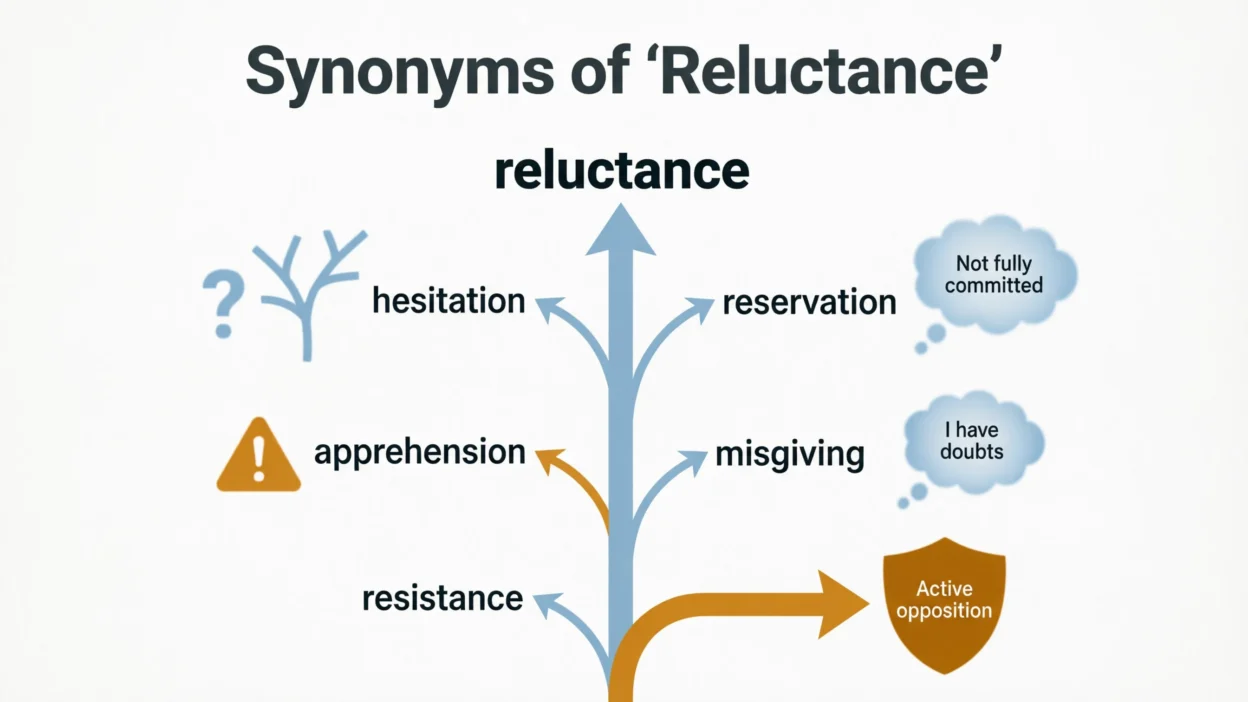
Reluctance refers to a feeling of hesitation, unwillingness, or resistance to doing something. It often arises from uncertainty, fear, doubt, or a lack of enthusiasm. Learning the synonyms of reluctance can help students, ESL learners, writers, and professionals express different shades of hesitation and unwillingness more accurately.
Whether you’re writing an essay, business report, novel, or everyday conversation, using alternatives to reluctance can make your writing richer and more precise.
What Does “Reluctance” Mean?
Reluctance means:
- Unwillingness to act
- Hesitation before making a decision
- Resistance to doing something
- Doubt or lack of eagerness
Example Sentences
- She showed reluctance to accept the promotion.
- His reluctance to answer the question raised concerns.
- There was some reluctance among employees to adopt the new policy.
Usage Tip
Use reluctance when describing someone who is hesitant, unwilling, or uncertain about taking action or making a decision.
1. Hesitation
Meaning: A pause caused by uncertainty or doubt.
Example: After a brief hesitation, she signed the agreement.
Best Usage Context: Everyday and formal writing.
2. Unwillingness
Meaning: A lack of desire to do something.
Example: His unwillingness to cooperate slowed the project.
Best Usage Context: General communication.
3. Resistance
Meaning: Opposition to change or action.
Example: The proposal faced resistance from the committee.
Best Usage Context: Business, politics, and social discussions.
4. Reservation
Meaning: Doubt or concern about something.
Example: She expressed reservations about the investment.
Best Usage Context: Formal and professional writing.
5. Apprehension
Meaning: Anxiety or fear about a future event.
Example: He approached the interview with apprehension.
Best Usage Context: Emotional and literary writing.
6. Misgiving
Meaning: A feeling of doubt or unease.
Example: Despite her misgivings, she accepted the offer.
Best Usage Context: Formal communication.
7. Doubt
Meaning: Uncertainty or lack of confidence.
Example: His doubt prevented him from making a decision.
Best Usage Context: General writing.
8. Indecision
Meaning: Difficulty choosing between options.
Example: Her indecision delayed the project.
Best Usage Context: Decision-making discussions.
9. Reticence
Meaning: Reluctance to speak or act.
Example: His reticence made negotiations difficult.
Best Usage Context: Academic and professional writing.
10. Diffidence
Meaning: Modest or shy hesitation.
Example: Her diffidence kept her from sharing ideas.
Best Usage Context: Literary writing.
11. Disinclination
Meaning: A preference not to do something.
Example: He showed a disinclination to travel.
Best Usage Context: Formal writing.
12. Aversion
Meaning: Strong dislike that causes unwillingness.
Example: She has an aversion to public speaking.
Best Usage Context: Personal preferences.
13. Caution
Meaning: Careful hesitation before acting.
Example: Investors acted with caution during the downturn.
Best Usage Context: Business and finance.
14. Wariness
Meaning: Careful distrust or suspicion.
Example: They viewed the proposal with wariness.
Best Usage Context: Professional and general discussions.
15. Skepticism
Meaning: Doubt about the truth or value of something.
Example: The announcement was met with skepticism.
Best Usage Context: Journalism and research.
16. Uncertainty
Meaning: Being unsure about what will happen.
Example: Economic uncertainty affected consumer spending.
Best Usage Context: Economics and business.
17. Timidity
Meaning: Lack of courage or confidence.
Example: His timidity prevented him from volunteering.
Best Usage Context: Personality descriptions.
18. Shyness
Meaning: Nervousness around other people.
Example: Her shyness created reluctance to speak.
Best Usage Context: Everyday communication.
19. Fear
Meaning: Concern about danger or failure.
Example: Fear fueled his reluctance.
Best Usage Context: Emotional discussions.
20. Anxiety
Meaning: Feelings of nervousness or worry.
Example: Anxiety caused her reluctance to travel.
Best Usage Context: Personal and emotional writing.
21. Inhibition
Meaning: A mental restraint on behavior.
Example: Social inhibition affected his confidence.
Best Usage Context: Psychology.
22. Vacillation
Meaning: Repeatedly changing one’s mind.
Example: Her vacillation delayed the final decision.
Best Usage Context: Formal writing.
23. Delay
Meaning: Waiting before taking action.
Example: Their delay reflected reluctance to proceed.
Best Usage Context: Business and project management.
24. Opposition
Meaning: Active resistance to an idea or action.
Example: The law faced strong public opposition.
Best Usage Context: Politics and business.
25. Reserve
Meaning: Emotional restraint or hesitation.
Example: He spoke with noticeable reserve.
Best Usage Context: Social interactions.
26. Second Thoughts
Meaning: Doubts after an initial decision.
Example: She had second thoughts about moving abroad.
Best Usage Context: Informal conversations.
27. Cold Feet
Meaning: Sudden fear or hesitation before an important event.
Example: He got cold feet before the presentation.
Best Usage Context: Informal speech.
28. Constraint
Meaning: A limitation causing hesitation or delay.
Example: Budget constraints increased reluctance to expand.
Best Usage Context: Business and economics.
29. Reluctancy
Meaning: Another noun form meaning unwillingness.
Example: His reluctancy was understandable.
Best Usage Context: Less common, formal writing.
30. Lack of Enthusiasm
Meaning: Little interest or eagerness.
Example: The team’s lack of enthusiasm was evident.
Best Usage Context: Workplace and education.
Comparison Table: When to Use Different Reluctance Synonyms
| ContextBest Synonyms | |
|---|---|
| Everyday Conversations | Hesitation, Doubt, Second Thoughts |
| Workplace & Business | Reservation, Resistance, Caution |
| Academic Writing | Reticence, Disinclination, Vacillation |
| Emotional Situations | Apprehension, Anxiety, Fear |
| Personality Traits | Diffidence, Timidity, Shyness |
How to Choose the Right Synonym
For Everyday Use
Use:
- Hesitation
- Doubt
- Second Thoughts
For Professional Writing
Use:
- Reservation
- Resistance
- Caution
For Academic Contexts
Use:
- Reticence
- Vacillation
- Disinclination
For Emotional Situations
Use:
- Apprehension
- Anxiety
- Fear
For Personality Descriptions
Use:
- Diffidence
- Timidity
- Shyness
Conclusion
Learning the synonyms of reluctance allows you to describe hesitation, uncertainty, and unwillingness with greater accuracy. While reluctance is widely used, alternatives such as hesitation, reservation, apprehension, misgiving, and reticence offer more specific meanings depending on the context.
Choosing the right synonym enhances clarity, improves readability, and makes your writing more engaging.

A passionate linguist who specializes in word relationships and vocabulary building.
He has spent years studying synonyms and semantic patterns across languages.
Arman writes to make language learning simple, precise, and engaging.