“That” is a versatile English word used as a pronoun, determiner, conjunction, or relative pronoun. Because its meaning changes depending on the sentence, there is no single synonym that works in every situation.
Quick Answer
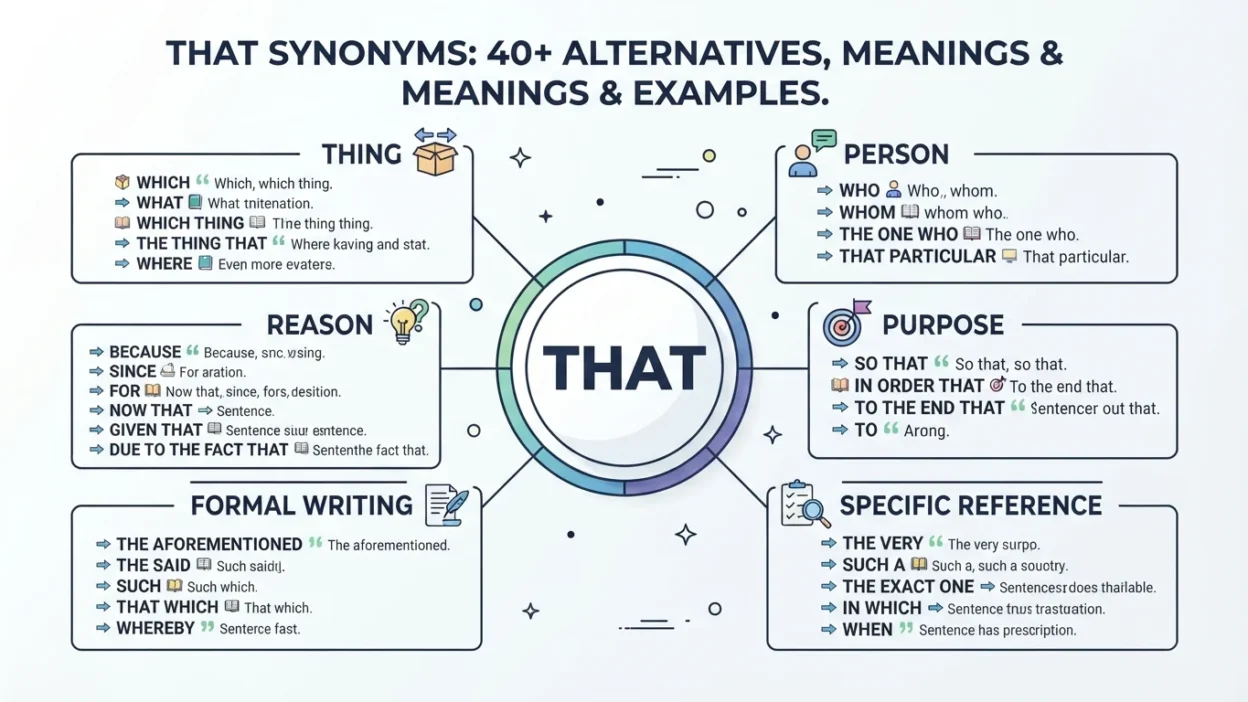
Depending on context, alternatives for that include:
- Which
- Who
- Whom
- What
- Such
- The
- Those
- It
- This
- That particular
- The one
- The fact that
- Because
- Since
- So
- In order that
- So that
- In which
- Where
- When
- As
- As stated
- The aforementioned
- The said
- The same
- Such a
- Such as
- To the extent that
- Insofar as
- Given that
- Considering that
What Does “That” Mean?
“That” has several different uses.
1. Pointing to Something
That car is expensive.
Here, that identifies a specific thing that is usually farther away from the speaker.
Possible alternatives:
- That particular
- The
- The one
That particular car is expensive.
“That” vs “This”
This usually refers to something closer.
That usually refers to something farther away or previously mentioned.
This book is mine.
That book belongs to Sarah.
“That” as a Relative Pronoun
“That” can introduce a clause describing a person or thing.
The book that I bought was expensive.
Possible alternatives include which or who, depending on the noun.
The book which I bought was expensive.
For people:
The woman that called me is my teacher.
The woman who called me is my teacher.
Important
Who is generally preferred when referring to people, especially in formal writing.
“That” for People
In some informal or restrictive relative clauses, that can refer to people.
The person that helped me was kind.
More natural in formal English:
The person who helped me was kind.
“That” as a Conjunction
“That” can introduce a clause.
I know that she is busy.
In many sentences, that can simply be omitted:
I know she is busy.
So an alternative is sometimes nothing rather than another word.
“That” Meaning “Because”
In certain constructions, that can be replaced by because or since if it expresses a reason.
I was surprised that he left early.
But:
I was surprised because he left early.
These sentences have slightly different meanings, so they are not always interchangeable.
“That” Meaning “So That”
When “that” introduces a purpose or result, so that can sometimes be used.
He spoke loudly that everyone could hear him.
More natural:
He spoke loudly so that everyone could hear him.
“That” Meaning “Which”
When “that” introduces a relative clause referring to a thing, which can often replace it.
The movie that we watched was excellent.
The movie which we watched was excellent.
“That” Meaning “Who”
When referring to a person:
The student that won the competition was excited.
The student who won the competition was excited.
“That” Meaning “Such”
“That” can sometimes appear in structures that emphasize degree.
It was that good.
Depending on the intended meaning, alternatives may include:
- So
- Very
- Extremely
- Such
For example:
It was so good.
“That” as a Determiner
“That” can identify a particular noun.
I don’t like that idea.
Possible alternatives:
- That particular idea
- The idea
- Such an idea
I don’t like that particular idea.
“That” vs “Those”
Use that for singular nouns and those for plural nouns.
That book is interesting.
Those books are interesting.
“That” vs “Such”
These words are sometimes confused.
That points to a specific person, thing, or idea.
I don’t want that book.
Such means “of this or that kind.”
I don’t want such a book.
Formal Alternatives to “That”
In formal writing, you may sometimes replace repeated uses of that with:
- Which
- Who
- The aforementioned
- The said
- Such
- The fact that
- In which
- Given that
- Considering that
Example
The policy that was introduced last year has changed.
More formal:
The policy which was introduced last year has changed.
Or:
The aforementioned policy has changed.
“That” Synonyms by Context
When “That” Refers to a Thing
Use:
- Which
- The one
- That particular
- Such
The phone that I bought is new.
The phone which I bought is new.
When “That” Refers to a Person
Use:
- Who
- Whom
The person that helped me was kind.
The person who helped me was kind.
When “That” Introduces an Idea
Often use:
- The fact that
- The idea that
- The statement that
- The belief that
I believe that he is honest.
I believe the fact that he is honest. ❌
Be careful: “the fact that” changes the grammatical structure and isn’t a universal replacement.
When “That” Shows Reason
Depending on the sentence:
- Because
- Since
- Given that
- Considering that
Given that it was raining, we stayed inside.
Since it was raining, we stayed inside.
When “That” Shows Purpose
Use:
- So that
- In order that
- With the aim that
She whispered so that nobody could hear.
“That” Synonyms Comparison Table
| Use of “That” | Possible Alternative | Example |
|---|---|---|
| Specific thing | That particular | That particular car |
| Relative clause | Which | The book which I bought |
| Person | Who | The person who called |
| Possibility/idea | The fact that | The fact that he left |
| Reason | Because/Since | Since it was late |
| Purpose | So that | So that we could hear |
| Formal reference | The aforementioned | The aforementioned issue |
| Type/kind | Such | Such a problem |
| Place relationship | In which | The room in which we met |
| Time relationship | When | The day when we met |
Frequently Asked Questions
What is the closest synonym for “that”?
There isn’t one universal synonym. Which, who, such, that particular, and the one may work depending on how “that” is being used.
Can “that” be replaced with “which”?
Yes, when that is functioning as a relative pronoun referring to a thing.
The book that I read.
The book which I read.
Can “that” be replaced with “who”?
Yes, when it refers to a person, although who is generally preferred.
The man who called me.
What is a formal synonym for “that”?
Depending on context, formal alternatives include which, the aforementioned, the said, given that, and in which.
Can “that” be removed from a sentence?
Often, yes.
I think that she is right.
I think she is right.
This is especially common in conversational English.
What is the opposite of “that”?
The closest contrasting demonstrative is usually this, especially when referring to something closer.
Conclusion
“That” cannot be replaced by one single synonym because it has several grammatical functions. When it refers to a thing, which may work. When it refers to a person, who is often better. When it points to something specific, that particular or the one may work. In formal writing, phrases such as the aforementioned can sometimes avoid repetition.
The key is to identify what “that” is doing in the sentence before choosing an alternative.
Actionable Takeaway
- Thing: Which
- Person: Who
- Specific thing: That particular
- Specific item: The one
- Formal reference: The aforementioned
- Reason: Because / Since
- Purpose: So that
- Relationship: In which
- Type: Such
- Time: When
- Often unnecessary: Omit “that”

A creative writer with a deep interest in word usage and meaning.
He explores synonyms to enhance both academic and creative expression.
Zayn’s work aims to make language richer and more accessible for everyone.