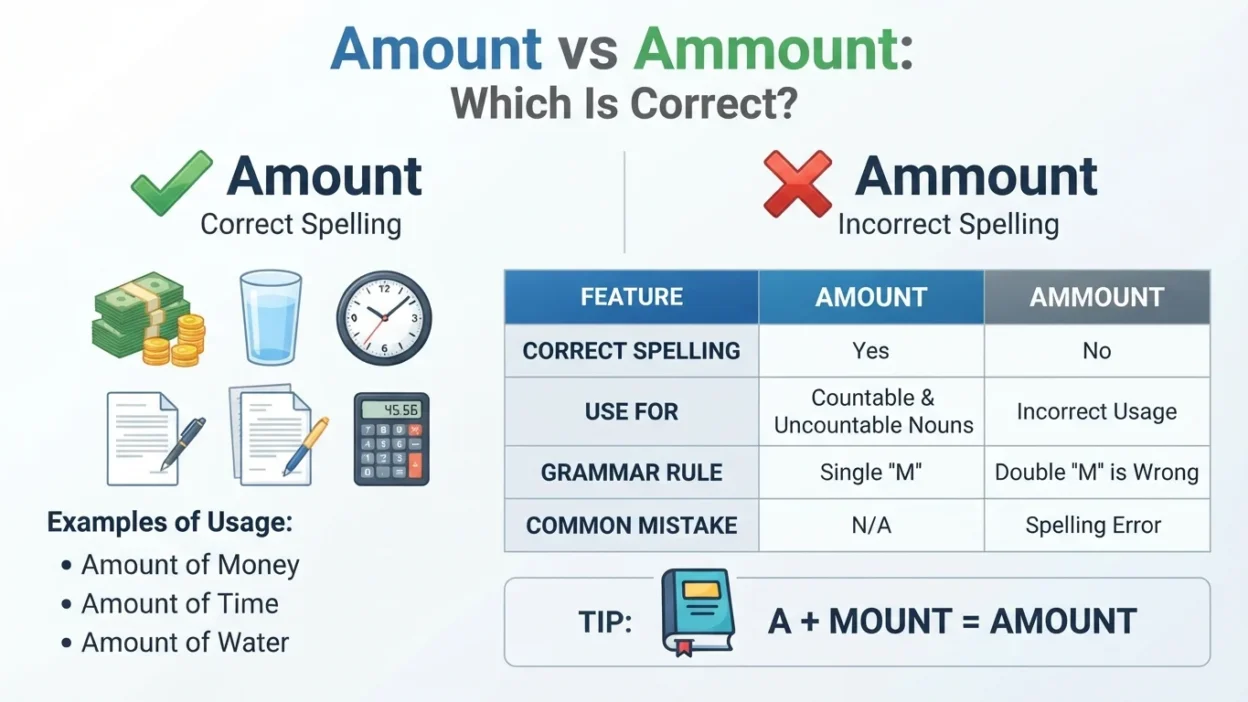
Have you ever wondered whether the correct spelling is amount or ammount? This is a common spelling mistake because the word may sound as if it contains a double m. However, only one spelling is correct.
The correct word is amount. Ammount is a misspelling and should not be used in standard English. Amount is commonly used when talking about the quantity or total of something, especially something that cannot usually be counted individually.
Quick Answer
- Amount = ✅ Correct spelling
- Ammount = ❌ Incorrect spelling
Always write “amount” with one “m.”
What Does “Amount” Mean?
Amount is a noun that refers to the quantity or total of something.
It is especially common with uncountable nouns, such as:
- Money
- Water
- Time
- Information
- Work
- Food
- Energy
- Traffic
Examples of “Amount”
- The amount of money in my account has increased.
- We need a small amount of water.
- She spent a large amount of time studying.
- The amount of information was overwhelming.
- He received a significant amount of support.
Amount can also be used as a verb meaning to add up to or to have a particular total.
The expenses amount to $500.
What Does “Ammount” Mean?
Ammount is not a standard English word. It is simply a common misspelling of amount.
The mistake usually happens because writers accidentally double the m.
Incorrect
❌ The ammount of money is too high.
Correct
✅ The amount of money is too high.
Remember: amount has only one “m.”
Amount vs Ammount: Comparison Table
| Feature | Amount | Ammount |
|---|---|---|
| Correct spelling | ✅ Yes | ❌ No |
| Standard English word | Yes | No |
| Meaning | Quantity or total | No standard meaning |
| Common usage | Money, time, water, information | Misspelling |
| American English | Amount | Incorrect |
| British English | Amount | Incorrect |
Why Is “Amount” Correct?
The standard spelling of the word is amount, with only one m.
The word comes through French from Latin roots and has been spelled amount in English for centuries.
There is no spelling rule that requires another m.
So remember:
A-M-O-U-N-T
Not:
A-M-M-O-U-N-T
Amount vs Number
One of the most important usage distinctions is between amount and number.
Use “Amount” for Uncountable Nouns
- An amount of money
- An amount of water
- An amount of time
- An amount of information
Use “Number” for Countable Nouns
- A number of students
- A number of books
- A number of people
- A number of cars
Compare
✅ A large amount of money was donated.
✅ A large number of people attended.
❌ A large amount of people attended. (Often avoided in formal standard English.)
This distinction is especially useful in academic and professional writing.
Common Uses of “Amount”
Money
- What amount should I pay?
- The total amount is $200.
Time
- A considerable amount of time was required.
- I spend a small amount of time exercising.
Information
- The report contains a large amount of information.
- We need more information, not necessarily a greater amount of data.
Work
- She completed a significant amount of work.
- The project requires a considerable amount of effort.
Common Mistakes to Avoid
Incorrect
- The ammount is incorrect.
Correct
- The amount is incorrect.
Incorrect
- Please enter the total ammount.
Correct
- Please enter the total amount.
Incorrect
- A large ammount of money was spent.
Correct
- A large amount of money was spent.
Easy Memory Trick
Here’s a simple way to remember the spelling:
Think:
AMOUNT = A + MOUNT
The word mount has only one m, so amount also has only one m.
Remember:
A + MOUNT = AMOUNT
Not:
❌ A + MMOUNT
American vs British English
There is no spelling difference between American and British English.
| American English | British English |
|---|---|
| Amount | Amount |
| Ammount | Incorrect |
Both varieties of English use amount with one m.
Amount vs Quantity
Amount and quantity are closely related, but their usage can vary depending on context.
- Amount often refers to a total or quantity, especially with uncountable things.
- Quantity is a more general term for how much of something there is.
Examples:
A large amount of money was invested.
The quantity of water was measured carefully.
Both can be correct, but amount is often the more natural choice in everyday English.
Related Words and LSI Keywords
Related terms include:
- Quantity
- Total
- Sum
- Volume
- Measure
- Number
- Plenty
- Little
- Much
- More
- Less
- Large amount
- Small amount
- Total amount
- Amount of money
- Amount of time
- Amount of information
These related terms help explain the meaning and usage of amount while keeping the content natural and useful.
Expert Writing Tip
If you’re unsure whether to write amount or ammount, remember that amount always has just one m. Also, pay attention to whether you’re discussing something countable or uncountable.
For example:
- Amount of money ✅
- Amount of time ✅
- Number of students ✅
- Number of books ✅
Using both the correct spelling and the correct noun choice will make your writing more precise and professional.
Frequently Asked Questions
Is “amount” correct?
Yes. Amount is the correct spelling.
Is “ammount” a real word?
No. Ammount is a misspelling of amount.
How do you spell amount?
The correct spelling is A-M-O-U-N-T: amount.
Does amount have one or two “m”s?
Amount has one “m.”
What is the difference between amount and number?
Use amount mainly with uncountable nouns, such as money or time. Use number with countable nouns, such as students or books.
Is “amount” spelled differently in British English?
No. Amount has the same spelling in American and British English.
What is a synonym for amount?
Depending on the context, synonyms include quantity, total, sum, volume, measure, and number.
How can I remember the correct spelling?
Think A + MOUNT = AMOUNT. Since mount has one m, amount has one m too.
Summary
The correct spelling is amount, not ammount. Amount refers to the quantity or total of something and is commonly used with uncountable nouns such as money, time, water, information, and effort. It is a standard word in both American and British English.
Ammount is simply a spelling mistake and should be avoided in academic, professional, and everyday writing. To remember the correct spelling, use the simple trick A + MOUNT = AMOUNT. Also remember the related grammar rule: use amount for uncountable nouns and number for countable nouns.

An expert in English grammar and expressive writing techniques.
She focuses on helping readers expand their vocabulary with clarity.
Elina believes the right word can transform ordinary writing into powerful communication.