Have you ever wondered whether the correct spelling is knaw or gnaw? These words can be confusing because the g in gnaw is silent, making the word sound somewhat different from how it looks.
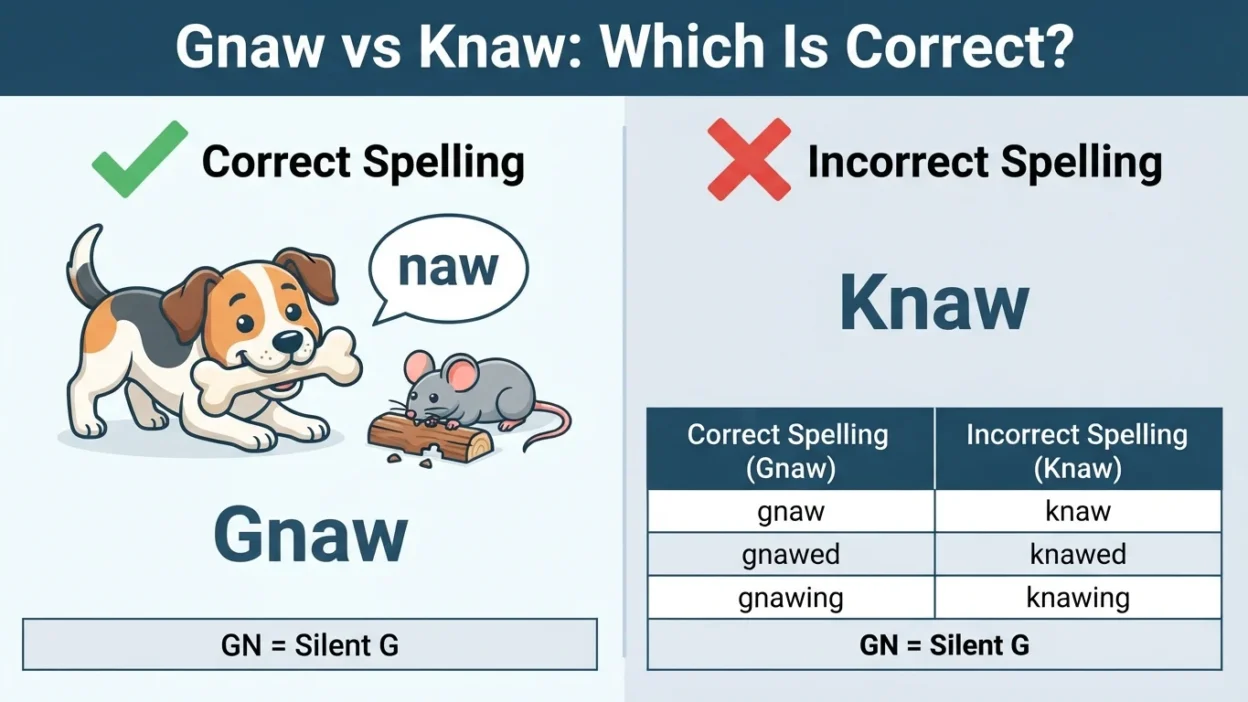
The correct spelling is gnaw. Knaw is a common misspelling and is not the standard spelling of the word. Gnaw means to bite or chew something repeatedly, especially with the teeth. It can also describe something that causes persistent worry or discomfort.
Quick Answer
- Gnaw = to bite or chew something repeatedly.
- Knaw = ❌ incorrect spelling.
Always write “gnaw,” not “knaw.”
What Does “Gnaw” Mean?
Gnaw is a verb that means to bite or chew something repeatedly, usually with the teeth.
It can also be used figuratively to describe a feeling, thought, or problem that continues to bother someone.
Examples of “Gnaw”
- The dog began to gnaw on the bone.
- The rabbit gnawed through the wooden box.
- The mouse gnawed a hole in the wall.
- Doubt continued to gnaw at him.
- The feeling of guilt gnawed at her.
So, gnaw can describe both physical chewing and persistent emotional discomfort.
What Does “Knaw” Mean?
Knaw is not the standard English spelling of the verb meaning “to chew or bite.”
It is usually a spelling mistake caused by the pronunciation of gnaw.
Incorrect
❌ The dog likes to knaw on bones.
Correct
✅ The dog likes to gnaw on bones.
If you mean “to chew or bite repeatedly,” use gnaw.
Gnaw vs Knaw: Comparison Table
| Feature | Gnaw | Knaw |
|---|---|---|
| Correct spelling | ✅ Yes | ❌ No |
| Standard English word | Yes | No |
| Meaning | Bite or chew repeatedly | No standard meaning |
| Pronunciation | “naw” | — |
| American English | Gnaw | Incorrect |
| British English | Gnaw | Incorrect |
Why Is “Gnaw” Correct?
The word gnaw comes from Old English gnagan, meaning to bite or chew.
The spelling has preserved the initial g, even though the g is silent in modern English.
This is similar to other English words beginning with gn-, such as:
- Gnat
- Gnome
- Gnash
- Gnaw
In these words, the initial g is silent.
How Do You Pronounce “Gnaw”?
Gnaw is pronounced approximately like:
“naw”
The g is silent.
Examples
- Gnaw → sounds like “naw”
- Gnat → sounds like “nat”
- Gnome → sounds like “nome”
The unusual pronunciation is one reason people sometimes spell gnaw incorrectly as knaw.
Common Uses of “Gnaw”
Physical Chewing
- The puppy gnawed on the toy.
- The squirrel gnawed through the branch.
- The rabbit gnawed on a carrot.
Emotional Meaning
Gnaw can also describe something that continuously troubles or worries someone.
- The question began to gnaw at him.
- Her regret gnawed at her.
- Doubts were gnawing at his confidence.
The phrase gnaw at is particularly common when discussing worry, guilt, doubt, or regret.
Common Mistakes to Avoid
Incorrect
- The mouse knawed through the wood.
Correct
- The mouse gnawed through the wood.
Notice that the past tense is gnawed, not knawed.
Incorrect
- His doubts began to knaw at him.
Correct
- His doubts began to gnaw at him.
Gnaw: Verb Forms
Knowing the different forms of the verb can help you avoid spelling mistakes.
| Form | Correct Word |
|---|---|
| Base form | Gnaw |
| Past tense | Gnawed |
| Past participle | Gnawed |
| Present participle | Gnawing |
| Third-person singular | Gnaws |
Examples
- Dogs gnaw bones.
- The dog gnawed the bone.
- The dog is gnawing the bone.
- The problem gnaws at her.
- The problem has gnawed at her for years.
Easy Memory Trick
Here’s a simple way to remember the spelling:
Think of the word gnat.
A gnat has a silent g, and so does gnaw.
Remember:
GN = silent G
So:
Gnaw = “naw”
Not:
❌ Knaw
American vs British English
There is no spelling difference between American and British English.
| American English | British English |
|---|---|
| Gnaw | Gnaw |
| Knaw | Incorrect |
Both varieties of English use gnaw with a silent g.
Gnaw vs Chew
Although gnaw and chew are related, they are not always exactly the same.
- Chew = to break food or another substance down by biting and grinding.
- Gnaw = to bite or chew repeatedly, often slowly or persistently.
For example:
The dog chewed its food.
But:
The dog gnawed on the bone.
Gnaw often suggests repeated biting over time.
Related Words and LSI Keywords
Related terms include:
- Bite
- Chew
- Nibble
- Gnawed
- Gnawing
- Gnaws
- Bite repeatedly
- Chew slowly
- Worry
- Trouble
- Anxiety
- Doubt
- Regret
- Gnaw at
- Gnaw away at
These related words provide useful context and help explain the different meanings of gnaw.
Expert Writing Tip
When you hear gnaw, don’t let the pronunciation trick you into writing knaw. English contains several words with a silent g, including gnaw, gnash, gnat, and gnome.
If you’re writing about repeated biting or chewing, use gnaw. If you’re describing persistent worry or regret, you can use the expression gnaw at.
Frequently Asked Questions
Is “gnaw” correct?
Yes. Gnaw is the correct spelling of the verb meaning to bite or chew repeatedly.
Is “knaw” a real word?
No. Knaw is generally a misspelling of gnaw and should not be used in standard English.
How is “gnaw” pronounced?
Gnaw is pronounced like “naw.” The initial g is silent.
What does “gnaw” mean?
It means to bite or chew something repeatedly. Figuratively, it can mean to continually trouble or worry someone.
What is the past tense of “gnaw”?
The past tense is gnawed.
Is there a difference between American and British English?
No. Both American and British English spell the word gnaw.
What is the difference between “gnaw” and “chew”?
Chew generally means to bite and grind something, while gnaw suggests repeated or persistent biting, often on something hard.
How can I remember the spelling?
Remember that gnaw has a silent g, just like gnat and gnome.
Summary
The correct spelling is gnaw, not knaw. Gnaw means to bite or chew something repeatedly, often slowly or persistently. It can also be used figuratively, as in “doubt gnawed at him,” to describe a feeling that continues to cause worry or discomfort.
Knaw is a common misspelling caused by the silent g in gnaw. The spelling is the same in American and British English. To remember it easily, think of other words beginning with gn-, such as gnat and gnome. The simple rule is: Gnaw has a silent G.

A passionate linguist who specializes in word relationships and vocabulary building.
He has spent years studying synonyms and semantic patterns across languages.
Arman writes to make language learning simple, precise, and engaging.