Have you ever wondered whether the correct spelling is of course or ofcourse? This is a common mistake because many English phrases are written as single words, but of course is different.
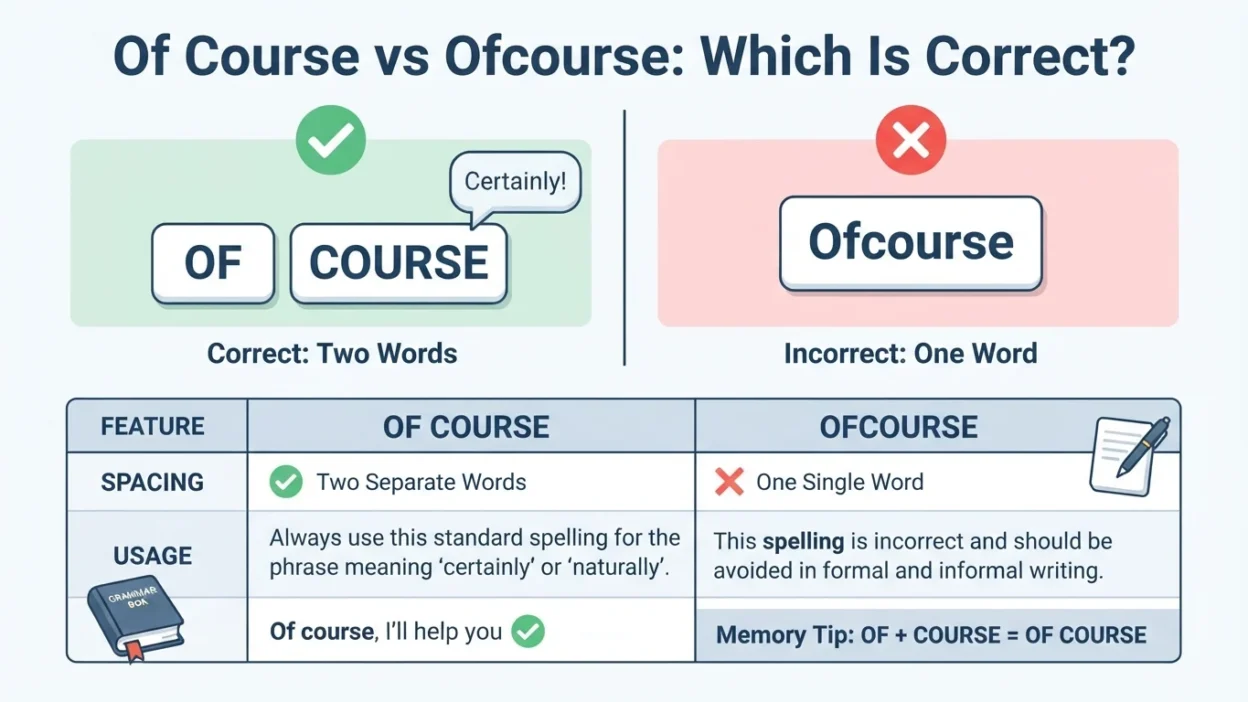
The correct form is of course, written as two separate words. Ofcourse is incorrect in standard English. The phrase is commonly used to mean certainly, naturally, or as expected. Learning this simple distinction can help make your writing clearer and more professional.
Quick Answer
- Of course = ✅ Correct
- Ofcourse = ❌ Incorrect
Always write “of course” as two words.
What Does “Of Course” Mean?
Of course is a common English phrase used to show that something is obvious, expected, agreed upon, or certain.
Depending on the context, it can mean:
- Certainly
- Naturally
- Obviously
- Without doubt
- Yes
- As expected
Examples of “Of Course”
- Of course, I’ll help you.
- She can of course join us.
- Of course I remember you.
- He will of course be invited.
- Of course, you’re right.
The exact meaning depends on the sentence and tone.
What Does “Ofcourse” Mean?
Ofcourse is not the standard spelling of the phrase.
Although people frequently write it as one word in text messages, social media posts, or informal online communication, standard English requires of course as two words.
Incorrect
❌ Ofcourse, I will help you.
Correct
✅ Of course, I will help you.
The same rule applies in formal, academic, professional, and edited writing.
Of Course vs Ofcourse: Comparison Table
| Feature | Of Course | Ofcourse |
|---|---|---|
| Correct spelling | ✅ Yes | ❌ No |
| Number of words | Two | One |
| Standard English | Yes | No |
| Formal writing | Correct | Incorrect |
| Meaning | Certainly / naturally | No standard separate form |
Why Is “Of Course” Correct?
Of course is a phrase made up of two separate words:
of + course = of course
Unlike compound words such as something or however, the words of and course remain separate.
There is no standard English spelling rule that combines them into ofcourse.
Remember:
Of course = two words
Common Uses of “Of Course”
To Show Agreement
- Of course, I agree with you.
- Of course, that’s a good idea.
- “Can I come with you?” “Of course!”
To Show Certainty
- She will of course succeed.
- We can of course discuss the issue later.
To Show Something Is Expected
- Of course, the team was excited about the victory.
- He was of course disappointed by the result.
To Politely Accept a Request
“Could you help me?”
“Of course!“
This is one of the most common uses of the phrase.
Common Mistakes to Avoid
Incorrect
- Ofcourse I can help you.
Correct
- Of course, I can help you.
Incorrect
- Thank you, ofcourse!
Correct
- Thank you, of course!
Incorrect
- Ofcourse she knows the answer.
Correct
- Of course she knows the answer.
Punctuation With “Of Course”
When of course appears at the beginning of a sentence as an introductory phrase, it is often followed by a comma.
Of course, I’ll be there.
When it appears naturally within a sentence, punctuation depends on the sentence structure.
She will of course be there.
He is, of course, welcome to join us.
When of course is used as a short response, an exclamation mark may be appropriate depending on the tone.
Of course!
Easy Memory Trick
Here’s a simple trick:
Think of the phrase as two ordinary words:
OF + COURSE = OF COURSE
You wouldn’t combine them when speaking, so don’t combine them when writing.
Remember:
Of course = 2 words
Ofcourse = 0 standard usage
American vs British English
There is no spelling difference between American and British English.
| American English | British English |
|---|---|
| Of course | Of course |
| Ofcourse | Incorrect |
Both varieties of English always use of course as two words.
Of Course vs Sure
Of course and sure can sometimes express agreement, but they are not always interchangeable.
Of Course
Often sounds more confident, natural, or emphatic.
“Can you help me?”
“Of course!“
Sure
Can be more casual.
“Can you help me?”
“Sure!“
Both can be appropriate depending on the context and tone.
Of Course vs Certainly
Certainly is another word that can sometimes replace of course.
- Of course, I can help.
- Certainly, I can help.
However, of course often sounds warmer and more conversational, while certainly can sound more formal or emphatic.
Related Words and LSI Keywords
Related vocabulary and phrases include:
- Certainly
- Naturally
- Obviously
- Definitely
- Surely
- Without doubt
- Of course not
- Of course yes
- Certainly yes
- As expected
- Naturally enough
- Absolutely
- Surely
These related expressions help explain the meaning and usage of of course naturally.
Expert Writing Tip
When writing emails, essays, articles, assignments, or professional messages, always write of course as two words.
The mistake ofcourse is especially common in quick online writing because people often type phrases the way they sound. However, edited and professional English follows the standard spelling of course.
A simple proofreading trick is to search your document for “ofcourse.” If you find it, change it to “of course.”
Frequently Asked Questions
Is “of course” correct?
Yes. Of course is the correct standard English form.
Is “ofcourse” a word?
No. Ofcourse is not the standard spelling. The correct form is of course, written as two words.
Should “of course” be one word or two?
It should always be written as two words: of course.
What does “of course” mean?
It can mean certainly, naturally, obviously, or without doubt, depending on the context.
Is “of course” formal or informal?
Of course can be used in both casual and formal writing. Its appropriateness depends on the sentence and context.
Is “of course” the same in American and British English?
Yes. Both American and British English spell it of course.
Can I use “of course” at the beginning of a sentence?
Yes. For example: “Of course, I’ll help you.”
How can I remember the spelling?
Remember the simple formula: OF + COURSE = OF COURSE. Always keep the two words separate.
Summary
The correct spelling is of course, not ofcourse. Of course is a common English phrase meaning certainly, naturally, obviously, or as expected. It can be used to agree with someone, express certainty, accept a request, or describe something that is expected.
Ofcourse is a common spelling mistake and should be avoided in standard English. Whether you’re writing an email, school assignment, blog post, business document, or social media caption, remember the simple rule: “of course” is always two words.

A passionate linguist who specializes in word relationships and vocabulary building.
He has spent years studying synonyms and semantic patterns across languages.
Arman writes to make language learning simple, precise, and engaging.