The words cartel and mafia are often used interchangeably in movies, news reports, and everyday conversations about organized crime. While both can refer to powerful criminal organizations, they do not mean exactly the same thing. Their structures, origins, activities, and ways of operating can differ significantly.
Understanding the difference between cartel vs mafia is useful for English learners, writers, journalists, and anyone who wants to use these terms accurately. A cartel generally refers to an organization or agreement designed to control a particular illegal or illicit market, especially drug trafficking, while mafia traditionally refers to a structured criminal organization with a broader network of activities and a strong internal hierarchy. However, real-world organizations can overlap, so context matters.
Quick Answer
A cartel is generally an organized group that controls or coordinates an illicit market, especially drug trafficking. A mafia is traditionally a structured criminal organization built around hierarchy, loyalty, and long-term criminal operations. The two terms can overlap, but they are not exact synonyms.
Why People Confuse Cartel and Mafia
People often confuse cartel and mafia because both describe forms of organized crime.
Both may involve:
- Illegal businesses
- Criminal networks
- Violence or intimidation
- Money laundering
- Corruption
- Territorial control
- Smuggling
- Extortion
Popular culture also frequently uses the words loosely. Films and television shows may call almost any powerful criminal organization a “mafia” or “cartel.”
The important difference is that the terms emphasize different characteristics.
A cartel is often associated with market control and coordination, particularly in illegal drug markets.
A mafia is more strongly associated with a long-standing criminal organization, hierarchy, family or group loyalty, and diversified criminal activities.
What Does “Cartel” Mean?
A cartel is a group of independent organizations or individuals that cooperate to control or influence a market.
The word has legitimate economic uses as well. For example, businesses can theoretically form a cartel by agreeing on prices or production levels, although such arrangements are illegal under competition laws in many jurisdictions.
In discussions of organized crime, however, cartel commonly refers to a criminal organization involved in controlling an illicit market.
Simple Meaning
Cartel = an organized group that coordinates or controls an illicit market or business.
Drug-trafficking organizations are among the most commonly described as cartels.
Examples
- Authorities investigated a suspected drug cartel.
- The organization was accused of controlling parts of the illegal drug trade.
- Several groups reportedly competed for control of the trafficking route.
The term can therefore emphasize business, supply chains, territory, and market control.
What Does “Mafia” Mean?
Mafia traditionally refers to a type of organized criminal group associated historically with Sicily and Italy, particularly the Sicilian Mafia.
In modern English, however, mafia is also used more broadly for powerful, organized criminal groups.
A mafia-style organization may have:
- A hierarchy
- Internal rules
- Loyalty networks
- Leadership structures
- Territorial influence
- Long-term criminal operations
Its activities may extend beyond one particular illegal market.
Simple Meaning
Mafia = a structured criminal organization, traditionally associated with hierarchical and long-term organized crime.
Depending on context, the word can also be used informally to describe a powerful secretive group controlling a particular activity, although that usage may be metaphorical rather than a literal reference to organized crime.
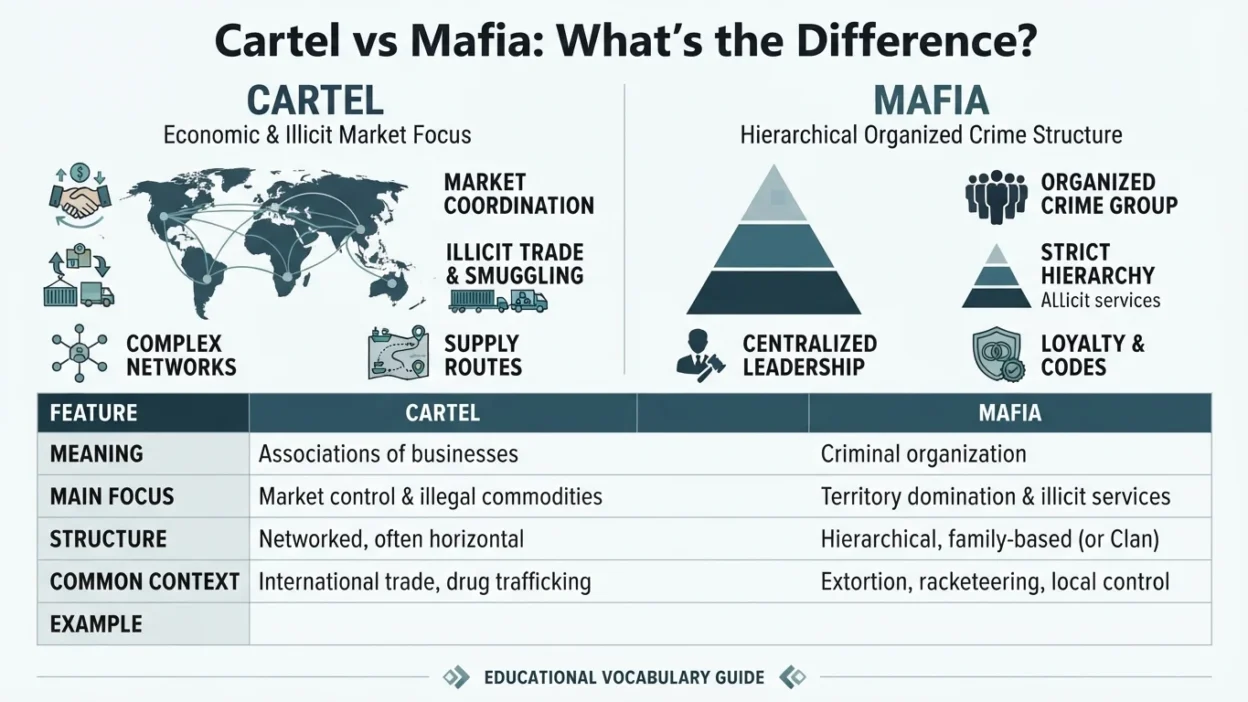
Cartel vs Mafia: Comparison Table
| Feature | Cartel | Mafia |
|---|---|---|
| Basic idea | Group coordinating or controlling a market | Structured criminal organization |
| Common association | Drug trafficking and illicit markets | Organized crime networks |
| Main emphasis | Market control and coordination | Organization, hierarchy, loyalty |
| Structure | Can involve alliances between groups | Often hierarchical |
| Activities | Frequently centered around particular illicit markets | Can involve several criminal activities |
| Historical association | Modern criminal-market usage varies | Strong historical connection to Sicily and Italy |
| Meaning outside crime | Can describe business agreements | Can be used metaphorically for powerful groups |
| Example phrase | Drug cartel | Mafia organization |
When to Use “Cartel”
Use cartel when the context involves an organized group coordinating or controlling a market, especially an illicit one.
Common combinations
- drug cartel
- cocaine cartel
- criminal cartel
- trafficking cartel
- cartel leader
- cartel network
- cartel operations
For example:
Authorities announced an investigation into an alleged drug cartel.
Here, cartel emphasizes the organization’s role in the illegal market.
Important Note
Not every criminal organization should automatically be called a cartel. The term is particularly useful when market coordination, trafficking, supply, or territorial control is central to the description.
When to Use “Mafia”
Use mafia when referring to a recognized mafia-type criminal organization or, depending on context, a broader organized crime network with a hierarchical structure.
Common expressions include:
- the Italian Mafia
- the Sicilian Mafia
- Mafia family
- Mafia boss
- Mafia organization
- organized Mafia crime
For example:
The novel follows a fictional Mafia family involved in organized crime.
Here, Mafia describes the broader criminal organization rather than one particular product market.
Cartel vs Mafia: Key Differences
1. Market vs organization
A cartel often highlights control or coordination of a market.
A mafia generally highlights the criminal organization itself.
2. Narrower vs broader focus
A cartel may be strongly associated with one particular illicit business, such as drug trafficking.
A mafia organization can operate across several criminal activities.
3. Structure
Mafia organizations are often portrayed or described as having established hierarchies, leadership roles, and internal relationships.
Cartels can have complex structures too, but the term itself does not necessarily imply one specific organizational model.
4. Historical meaning
Mafia has a specific historical association with organized crime in Sicily and Italy.
Cartel has a broader history as a term for coordinated economic groups and is now widely used for certain criminal organizations.
Examples of “Cartel”
- Authorities investigated an alleged drug cartel.
- The documentary examines the history of a powerful cartel.
- Police seized property allegedly connected to the cartel.
- The report discusses competition between rival cartels.
- The organization was accused of controlling an important trafficking route.
- Investigators traced the money to an alleged criminal cartel.
Examples of “Mafia”
- The movie tells the story of a fictional Mafia family.
- The journalist investigated the history of the Sicilian Mafia.
- The novel features a powerful Mafia boss.
- Authorities conducted an investigation into alleged Mafia activity.
- The documentary explores the history of organized crime and the Mafia.
- The fictional character tries to leave the Mafia organization.
Common Mistakes
Mistake 1: Treating cartel and mafia as perfect synonyms
Although both can refer to organized criminal groups, they emphasize different things.
Cartel often emphasizes market coordination or control.
Mafia generally emphasizes a structured criminal organization.
Mistake 2: Assuming every drug-trafficking group is a cartel
The word cartel is common in descriptions of major drug-trafficking organizations, but not every group involved in drug trafficking necessarily fits the term.
Context and the organization’s actual structure matter.
Mistake 3: Using “Mafia” for every organized criminal group
Mafia has a specific historical meaning and is also used more broadly in modern English. It should not automatically be applied to every criminal organization.
Mistake 4: Confusing the criminal meaning of “cartel” with its economic meaning
Cartel can describe an agreement among businesses to coordinate prices, production, or market behavior.
So the surrounding context matters.
Memory Trick
Use this simple association:
CARTEL → CONTROL
Think:
Cartel = Control of a market
Especially when talking about an illicit market.
MAFIA → ORGANIZATION
Think:
Mafia = Organized criminal network
This is not a strict definition of every real-world organization, but it is a useful English-learning shortcut.
American vs British English
The words cartel and mafia are used in both American and British English.
There is no major American-versus-British spelling difference:
- American English: cartel
- British English: cartel
And:
- American English: mafia
- British English: mafia
The main differences you may encounter are related to context and frequency, rather than spelling.
In news and crime reporting, drug cartel is especially common in American English contexts, while Mafia is often used when discussing historical Italian or Sicilian organized crime.
Similar Words
Several words can overlap with cartel and mafia, but they have different shades of meaning.
Organized crime
A broad term for criminal activity carried out by structured groups or networks.
Syndicate
A group of people or organizations working together for a shared purpose. In crime reporting, criminal syndicate can refer to an organized criminal network.
Gang
A group involved in organized or criminal activity. Gang can refer to groups that are less formal or hierarchical than organizations described as mafias.
Crime family
A term frequently associated with Mafia-style organizations, particularly in fictional and historical contexts.
Criminal network
A broad term for interconnected individuals or groups involved in criminal activity.
Underworld
An informal term referring collectively to the world of organized or serious criminal activity.
Final Verdict
The difference between cartel vs mafia mainly comes down to what the word emphasizes.
Cartel generally focuses on a group coordinating or controlling a market, particularly an illicit market such as drug trafficking. Mafia traditionally refers to a structured criminal organization and has strong historical connections to Sicilian and Italian organized crime.
They can overlap in real-world descriptions, and neither word should automatically be applied to every criminal organization. When writing about a specific group, it is better to use the term that accurately reflects the group’s documented structure and activities.
Frequently Asked Questions
Is a cartel the same as a mafia?
No. The terms can overlap, but they are not exact synonyms. Cartel generally emphasizes market coordination or control, while mafia refers more broadly to a structured criminal organization.
What is the main difference between cartel and mafia?
A cartel is commonly associated with controlling or coordinating an illicit market, while a mafia is associated with an organized criminal structure, hierarchy, and long-term criminal activity.
Is a cartel always involved in drugs?
No. Cartel has a broader meaning and can refer to coordinated groups in legitimate or illicit markets. However, drug cartel is one of the most common criminal uses of the term.
Is Mafia always a criminal organization?
Traditionally, Mafia refers to organized crime. However, lowercase mafia can sometimes be used metaphorically to describe a powerful or secretive group.
Which word is more general: cartel or mafia?
Neither is universally more general. Cartel emphasizes coordinated market activity, while mafia emphasizes a type of organized criminal structure.
Can a cartel and mafia work together?
Yes, in real-world organized crime, different criminal organizations can cooperate, compete, form alliances, or conduct transactions. The exact relationship depends on the specific groups and circumstances.
Is “Mafia” capitalized?
Mafia is commonly capitalized when referring to the specific historical organization or tradition associated with Sicily. Lowercase mafia may be used for a generic or metaphorical meaning, depending on the style and context.
Conclusion
Cartel vs mafia is a useful distinction to understand because these words describe different aspects of organized crime. A cartel is commonly associated with controlling or coordinating an illicit market, while a mafia is traditionally understood as a structured criminal organization with hierarchy, loyalty networks, and broader criminal operations.
For accurate English usage, don’t choose between the words simply because they both sound like terms for powerful criminals. Look at what the sentence is emphasizing. If the focus is market coordination or illicit trade, cartel may be the appropriate term. If the focus is a structured criminal organization or Mafia tradition, mafia may be more appropriate.
Remember This
Cartel → market control or coordination
Mafia → structured organized-crime network
Easy memory trick:
Cartel = CONTROL
Mafia = ORGANIZATION

An expert in English grammar and expressive writing techniques.
She focuses on helping readers expand their vocabulary with clarity.
Elina believes the right word can transform ordinary writing into powerful communication.