Choosing between “my father and I” and “my father and me” can be confusing because both phrases are correct in English—but they are used in different grammatical positions. The key is not the word father but whether the phrase is acting as the subject or the object of the sentence.
For example, you would say, “My father and I went to the market,” because the two people are performing the action. But you would say, “She invited my father and me,” because the two people are receiving the action. Once you understand this simple subject-versus-object rule, choosing between “my father and I” and “my father and me” becomes much easier.
Quick Answer
“My father and I” is correct when the phrase is the subject of a sentence.
“My father and me” is correct when the phrase is the object of a verb or preposition.
Easy rule: Remove “my father and” from the sentence. If I sounds correct, use my father and I. If me sounds correct, use my father and me.
Why Do People Confuse “My Father and I” and “My Father and Me”?
The confusion usually happens because I and me are both first-person pronouns, but they have different grammatical jobs.
- I is a subject pronoun.
- Me is an object pronoun.
When another person is mentioned alongside you, such as my father, my sister, or my friend, the same rule still applies.
Compare these sentences:
- My father and I went shopping. ✅
- The teacher spoke to my father and me. ✅
In the first sentence, the father and the speaker perform the action. In the second sentence, the teacher is performing the action toward them.
When to Use “My Father and I”
Use “my father and I” when the phrase is the subject of the sentence.
The subject is the person or people performing the action.
Examples
- My father and I went to the restaurant.
- My father and I watched a movie.
- My father and I visited our relatives.
- My father and I are planning a trip.
- My father and I worked on the project together.
- My father and I enjoyed the evening.
- My father and I decided to stay home.
- My father and I talked about the problem.
- My father and I traveled to Lahore.
- My father and I learned something new today.
In each example, my father and I are doing the action.
A Simple Test
Remove “my father and” from the sentence.
My father and I went to the store.
Remove “my father and”:
I went to the store. ✅
That sounds correct, so “my father and I” is correct.
When to Use “My Father and Me”
Use “my father and me” when the phrase is the object of a verb or preposition.
The object receives the action or follows a preposition such as to, for, with, from, between, about, or by.
Examples
- She invited my father and me to dinner.
- The teacher spoke to my father and me.
- They gave my father and me some useful advice.
- He took a photograph of my father and me.
- The gift was for my father and me.
- She traveled with my father and me.
- The decision affected my father and me.
- They asked my father and me to wait.
- The story was about my father and me.
- The doctor spoke with my father and me.
Again, remove “my father and”:
She invited my father and me.
Becomes:
She invited me. ✅
You would not normally say:
She invited I. ❌
Therefore, “my father and me” is correct.
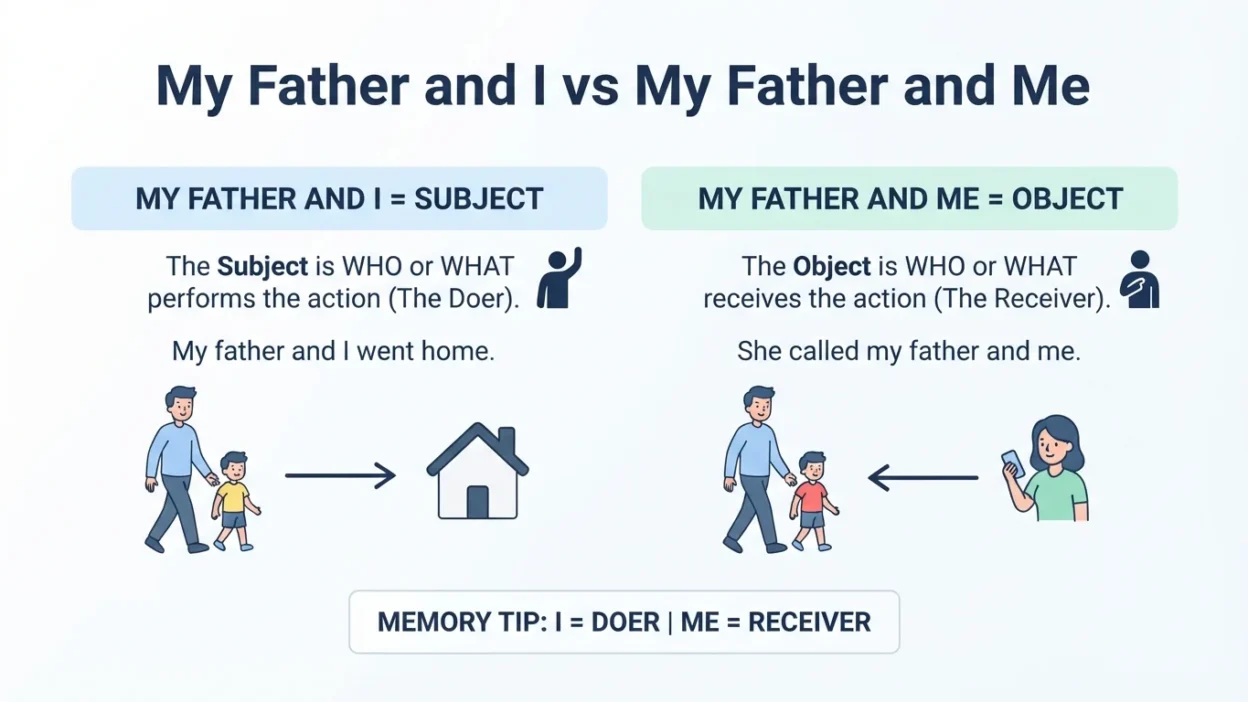
My Father and I vs My Father and Me: Comparison Table
| Phrase | Grammatical Role | When to Use | Example |
|---|---|---|---|
| My father and I | Subject | When performing the action | My father and I went home. |
| My father and me | Object | When receiving the action | She called my father and me. |
| My father and I | Subject | Before a verb | My father and I enjoyed dinner. |
| My father and me | Object | After a preposition | She sat with my father and me. |
My Father and I or My Father and Me: The Easy Test
One of the best grammar tricks is to temporarily remove the other person.
Example 1
My father and I went shopping.
Remove “my father and”:
I went shopping. ✅
So:
My father and I went shopping. ✅
Example 2
She called my father and me.
Remove “my father and”:
She called me. ✅
So:
She called my father and me. ✅
Example 3
My father and I enjoyed the concert.
→ I enjoyed the concert. ✅
Therefore:
→ My father and I enjoyed the concert. ✅
Example 4
The teacher helped my father and me.
→ The teacher helped me. ✅
Therefore:
→ The teacher helped my father and me. ✅
This test works for many similar constructions.
10+ Examples of “My Father and I”
Use my father and I when you and your father are the subjects.
- My father and I went fishing.
- My father and I cooked dinner.
- My father and I visited the museum.
- My father and I discussed the issue.
- My father and I watched the game.
- My father and I bought a new car.
- My father and I are very close.
- My father and I traveled together.
- My father and I built the table.
- My father and I cleaned the house.
- My father and I decided to leave early.
- My father and I enjoyed the beautiful weather.
10+ Examples of “My Father and Me”
Use my father and me when you and your father are objects.
- She invited my father and me.
- He helped my father and me.
- They called my father and me.
- The teacher spoke with my father and me.
- The gift was for my father and me.
- She took a picture of my father and me.
- They asked my father and me a question.
- The decision affected my father and me.
- He told my father and me the news.
- She traveled with my father and me.
- The story reminded my father and me of our childhood.
- Everyone congratulated my father and me.
Common Mistakes
Mistake 1: Using “I” as an object
Incorrect:
She invited my father and I. ❌
Correct:
She invited my father and me. ✅
Why? Me is the object of invited.
Mistake 2: Using “me” as the subject
Incorrect:
My father and me went to the store. ❌
Correct:
My father and I went to the store. ✅
Why? My father and I are the subjects performing the action.
Mistake 3: Thinking “I” is always more formal
Some speakers have been taught that I sounds more educated or formal than me. This can lead to sentences such as:
The manager spoke to my father and I. ❌
Using I here does not make the sentence more formal. It simply makes the grammar incorrect in standard English.
The correct sentence is:
The manager spoke to my father and me. ✅
Mistake 4: Choosing based on what sounds polite
English speakers sometimes use “my father and I” because it can sound more polite or formal.
However, grammar depends on the function of the pronoun, not politeness.
A Quick Memory Trick
Remember:
I = doer
Me = receiver
If you and your father do the action:
My father and I
If you and your father receive the action:
My father and me
Another useful trick:
I → subject
Me → object
Compare
My father and I went to the park.
→ We did the action.
She called my father and me.
→ We received the action.
What About “Between My Father and I”?
This is a very common mistake.
The standard grammatical form is:
Between my father and me ✅
Not:
Between my father and I ❌
Why? Between is a preposition, and the pronoun following it should be in the object form.
Compare:
- between you and me ✅
- between him and me ✅
- between my father and me ✅
A useful rule is:
Preposition + object pronoun
Therefore:
between my father and me
What About “My Father and I’s”?
Another common issue occurs when people want to show possession.
Instead of:
My father and I’s house ❌
Rewrite the sentence to make the possession clear:
My father’s and my house
The house belonging to my father and me
However, the most natural wording often depends on the exact sentence. Rephrasing can make the sentence much smoother.
American vs British English
There is no major difference between American and British English regarding the basic grammatical distinction between “my father and I” and “my father and me.”
Both varieties use:
- My father and I as a subject.
- My father and me as an object.
For example:
American English:
My father and I went to London.
British English:
My father and I went to London.
Likewise:
American English:
She spoke to my father and me.
British English:
She spoke to my father and me.
The grammatical rule is essentially the same.
Similar Pronoun Examples
The same rule applies to other combinations.
My mother and I / My mother and me
- My mother and I went shopping. ✅
- She invited my mother and me. ✅
My brother and I / My brother and me
- My brother and I played football. ✅
- The coach spoke to my brother and me. ✅
My friend and I / My friend and me
- My friend and I went to the cinema. ✅
- She called my friend and me. ✅
My sister and I / My sister and me
- My sister and I cooked dinner. ✅
- He helped my sister and me. ✅
The rule never changes: subject → I; object → me.
Frequently Asked Questions
Is “my father and I” correct?
Yes. “My father and I” is correct when the phrase functions as the subject of a sentence.
Example:
My father and I went to the market.
Is “my father and me” correct?
Yes. “My father and me” is correct when the phrase functions as an object.
Example:
She invited my father and me.
Which is correct: “my father and I went” or “my father and me went”?
“My father and I went” is correct because the phrase is the subject performing the action.
Which is correct: “between my father and I” or “between my father and me”?
“Between my father and me” is correct because between is a preposition and requires an object pronoun.
Can I say “my father and me” at the beginning of a sentence?
Usually not when the phrase is the subject.
Say:
My father and I went home. ✅
Not:
My father and me went home. ❌
Is “my father and I” more formal than “my father and me”?
Not necessarily. Both are correct in their appropriate grammatical positions. The choice depends on whether the pronoun is a subject or an object.
How can I quickly choose between I and me?
Remove the other person from the sentence.
If I works, use my father and I.
If me works, use my father and me.
Final Verdict
Both “my father and I” and “my father and me” are grammatically correct. The important difference is their role in the sentence.
Use “my father and I” when you and your father are performing the action: “My father and I went shopping.” Use “my father and me” when you and your father receive the action or follow a preposition: “She invited my father and me.”
The easiest way to remember the difference is to remove “my father and.” If the remaining sentence needs I, choose “my father and I.” If it needs me, choose “my father and me.” This simple test will help you avoid one of the most common pronoun mistakes in English.
Conclusion
The choice between “my father and I” and “my father and me” depends entirely on grammar, not on which phrase sounds more formal. I is a subject pronoun, while me is an object pronoun. Once you identify the role of the phrase, the correct choice becomes straightforward.
So remember: My father and I went to the store, but She called my father and me. When in doubt, remove “my father and” and test the sentence with I or me alone.
Remember This
My father and I = subject / doer
My father and I went home.
My father and me = object / receiver
She called my father and me.
Memory trick: I = doer, me = receiver.

A creative writer with a deep interest in word usage and meaning.
He explores synonyms to enhance both academic and creative expression.
Zayn’s work aims to make language richer and more accessible for everyone.