Have you ever wondered whether the correct word is vendor or vender? These two words look almost identical, but their usage and meanings are different. The confusion is especially common when talking about a person or business that sells products or services.
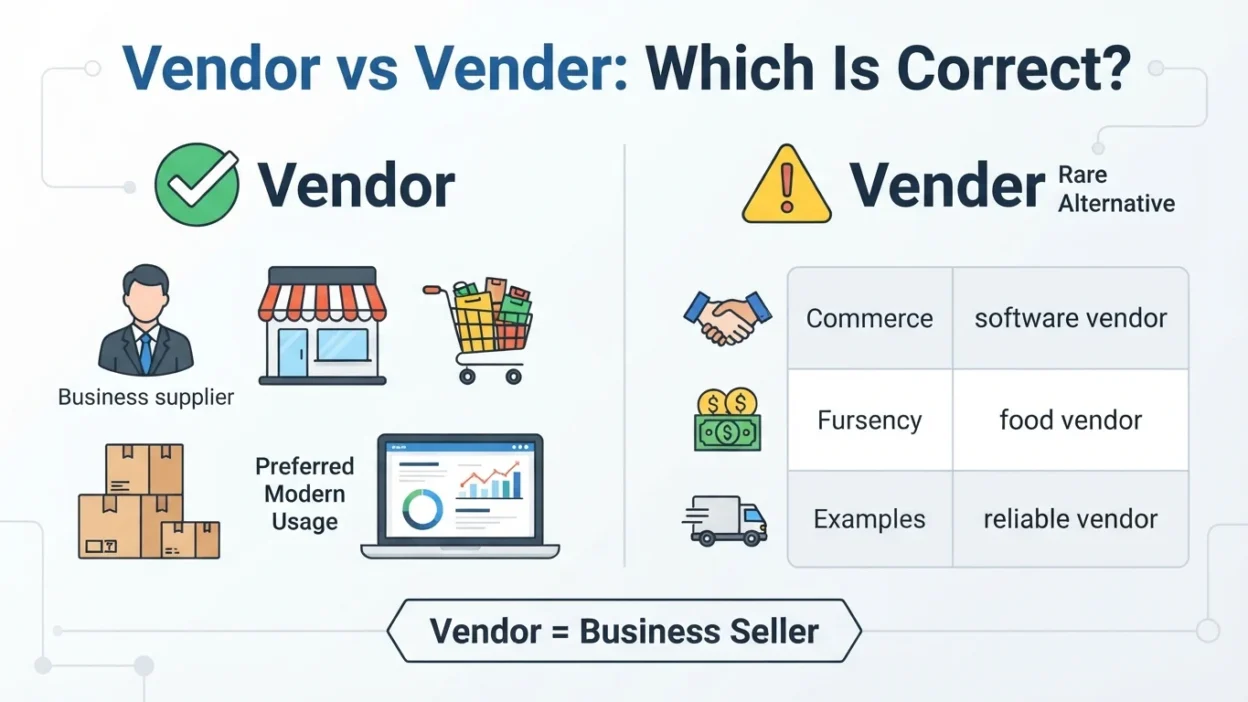
The good news is that vendor is the standard and far more common spelling for a seller or supplier. Vender is also a legitimate English word, but it is uncommon and is generally used only in certain contexts. Understanding the difference will help you choose the right word in business, shopping, and professional writing.
Quick Answer
- Vendor = a person or company that sells goods or services. ✅
- Vender = a person who sells something, but this spelling is uncommon. ✅
For most business and everyday writing, use “vendor.”
What Does “Vendor” Mean?
A vendor is a person, business, or organization that sells goods or services.
The word is widely used in:
- Business
- Retail
- E-commerce
- Technology
- Procurement
- Supply chains
- Events
- Real estate
- Professional services
Examples of “Vendor”
- We need to find a reliable vendor for office supplies.
- The company works with several software vendors.
- A street vendor was selling fresh fruit.
- The event hired a food vendor.
- The retailer changed its main vendor.
In business English, vendor is the standard choice.
What Does “Vender” Mean?
Vender is a legitimate but less common noun meaning a person who sells something.
It has essentially the same basic meaning as vendor, but it is much less frequent in modern English.
Examples
- The vender offered several handmade products.
- The market had several independent venders.
These sentences are grammatically possible, but vendor would usually sound more natural.
Important Note
Don’t confuse vender with the verb vend.
- Vend = to sell.
- Vender = a person who sells.
- Vendor = a person or company that sells goods or services.
Vendor vs Vender: Comparison Table
| Feature | Vendor | Vender |
|---|---|---|
| Meaning | Person or company that sells | Person who sells |
| Correct word? | ✅ Yes | ✅ Yes, but uncommon |
| Modern usage | Very common | Rare |
| Business writing | Preferred | Usually avoided |
| Retail | Common | Uncommon |
| Technology | Very common | Rare |
| American English | Common | Rare |
| British English | Common | Rare |
The Main Difference
The main difference is frequency and preferred usage, rather than a major difference in meaning.
Vendor
Vendor is the normal word used in modern English.
The company selected a new software vendor.
Vender
Vender is an alternative spelling that exists but is rarely used.
The vender sold handmade goods.
In most situations, replacing vender with vendor will make the sentence sound more natural.
Vendor in Business English
Vendor is particularly important in business and professional contexts.
Common expressions include:
- Vendor management
- Vendor agreement
- Vendor contract
- Vendor selection
- Vendor relationship
- Vendor payment
- Vendor list
- Approved vendor
- Third-party vendor
- Software vendor
- Service vendor
- Preferred vendor
Examples
- The procurement team reviewed the vendor agreement.
- We need an approved vendor for the project.
- The company is evaluating several software vendors.
- Good vendor management can reduce costs.
In these contexts, vendor is overwhelmingly preferred.
Vendor vs Seller
Vendor and seller are closely related, but there can be a slight difference in tone and context.
Seller
A seller is simply someone who sells something.
The seller accepted my offer.
Vendor
A vendor often suggests a business, supplier, or commercial provider.
The company became our main vendor.
Both words can be correct, but vendor is especially common in business and procurement language.
Common Mistakes to Avoid
Less Common
- We need a new vender for our software.
Preferred
- We need a new vendor for our software.
Less Common
- The food vender arrived at the event.
Preferred
- The food vendor arrived at the event.
Less Common
- Contact the product vender for support.
Preferred
- Contact the product vendor for support.
Easy Memory Trick
Here’s a simple way to remember:
Vendor = Very common
Both words start with V, but you can associate vendor with very common business vocabulary.
Another trick:
Vendor = Business seller
When you’re talking about a company, supplier, retailer, or service provider, vendor is almost always the best choice.
American vs British English
Both vendor and vender can be found in English varieties, but vendor is much more common.
| American English | British English |
|---|---|
| Vendor | Vendor |
| Vender | Rare |
There is no major difference in meaning between American and British English. Vendor is the preferred modern form in both.
Related Words and LSI Keywords
Related vocabulary includes:
- Seller
- Supplier
- Merchant
- Retailer
- Provider
- Distributor
- Dealer
- Wholesaler
- Business
- Company
- Service provider
- Supplier relationship
- Vendor management
- Vendor contract
- Procurement
- E-commerce
These terms help explain the broader meaning of vendor and its use in commercial and professional settings.
Expert Writing Tip
If you’re writing a business email, report, contract, website, or professional document, vendor is the safest and most natural choice.
Although vender is technically a valid word, its rarity can make it look like a spelling mistake. Using vendor avoids confusion and follows modern professional usage.
For example:
We are looking for a reliable vendor.
This sounds natural and professional.
Frequently Asked Questions
Is “vendor” correct?
Yes. Vendor is the standard and widely used word for a person or company that sells goods or services.
Is “vender” a real word?
Yes. Vender is a legitimate but uncommon spelling meaning a person who sells something.
Which is more common: vendor or vender?
Vendor is much more common, especially in business, retail, technology, and professional writing.
Should I use “vendor” in business writing?
Yes. Vendor is the preferred form in most business and professional contexts.
Is there a difference between vendor and seller?
Both refer to someone who sells something, but vendor is especially common for businesses, suppliers, and commercial providers.
Is “vendor” the same in American and British English?
Yes. Vendor is widely used in both American and British English.
Is “vender” incorrect?
Not necessarily. Vender is a recognized word, but it is uncommon. Vendor is usually the better choice.
How can I remember the preferred spelling?
Think Vendor = business seller. If you’re discussing a supplier, company, retailer, or service provider, use vendor.
Summary
The words vendor and vender are both technically valid, but they are not equally common. Vendor is the standard and overwhelmingly preferred term for a person, business, or organization that sells goods or services. It is especially common in business, technology, retail, procurement, and professional communication.
Vender can also mean a person who sells something, but it is relatively rare in modern English and may look like a spelling mistake to many readers. For clear, natural, and professional writing, vendor is almost always the better choice.