Choosing between Courtesy and Curtesy can be confusing because the words look similar and sound alike. However, they have completely different meanings and are used in different contexts. While courtesy is a common word in everyday English, curtesy is a rare legal term that most people never use.
If you’re wondering which spelling is correct for polite behavior or respectful actions, this guide will explain the difference with simple definitions, examples, common mistakes, and helpful tips.
Quick Answer
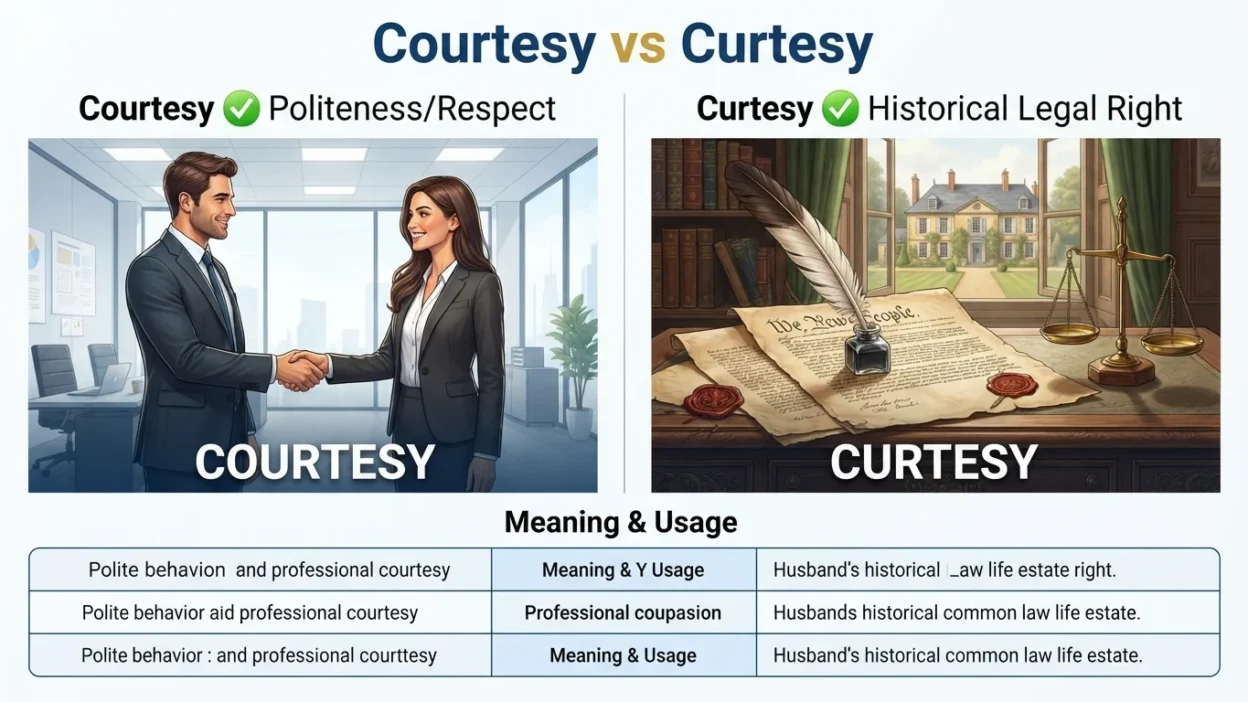
- Courtesy is the correct word when referring to politeness, respect, or a kind gesture.
- Curtesy is an old legal term referring to a husband’s historical right to inherit his deceased wife’s property under certain conditions.
In modern English, you’ll almost always use “courtesy.”
What Does “Courtesy” Mean?
Courtesy is a noun that means polite behavior, respect, kindness, or consideration toward others. It can also refer to something given freely as a gesture of goodwill.
Examples of Courtesy
- She thanked everyone with great courtesy.
- Showing courtesy to customers improves their experience.
- Please extend the common courtesy of arriving on time.
- The complimentary tickets were provided as a courtesy.
What Does “Curtesy” Mean?
Curtesy is a historical legal term in English common law. It referred to a husband’s right to use or inherit his deceased wife’s property if certain legal conditions were met.
Today, this term is obsolete in most legal systems and is rarely used outside historical or legal discussions.
Examples of Curtesy
- The textbook explained the doctrine of curtesy in medieval English law.
- Modern inheritance laws have largely replaced curtesy.
Courtesy vs Curtesy: Comparison Table
| Feature | Courtesy | Curtesy |
|---|---|---|
| Meaning | Politeness, respect, kindness | Historical legal inheritance right |
| Modern usage | Very common | Very rare |
| Context | Everyday English, business, communication | Legal history |
| Part of speech | Noun | Noun |
| Should you use it daily? | Yes | No, unless discussing legal history |
Key Differences
The easiest way to remember the difference is:
- Courtesy = Good manners and respect.
- Curtesy = An old legal concept.
If you’re writing about politeness, customer service, etiquette, or kindness, courtesy is always the correct choice.
Common Mistakes
Incorrect
- Thank you for your curtesy.
Correct
- Thank you for your courtesy.
Incorrect
- The hotel showed great curtesy to its guests.
Correct
- The hotel showed great courtesy to its guests.
Correct Legal Usage
- The professor discussed the historical doctrine of curtesy.
Memory Trick
Remember:
- Courtesy contains “court.” Good manners help you behave respectfully in society.
- Curtesy belongs to old legal history, not everyday conversation.
Whenever you mean politeness or kindness, choose courtesy.
American vs British English
There is no spelling difference between American and British English.
| American English | British English |
|---|---|
| Courtesy | Courtesy |
| Curtesy (legal term) | Curtesy (legal term) |
Both varieties of English use courtesy for polite behavior, while curtesy remains a historical legal term.
Related Words (LSI Keywords)
Using related vocabulary naturally improves understanding and topical relevance.
- Politeness
- Respect
- Good manners
- Etiquette
- Kindness
- Civility
- Consideration
- Professionalism
- Hospitality
- Respectful behavior
- Thoughtfulness
- Common courtesy
Frequently Asked Questions
Is “curtesy” a spelling mistake?
Not always. It is a real English word, but it is a rare legal term. Most people who write curtesy actually mean courtesy.
Which is correct: Courtesy or Curtesy?
For everyday English, courtesy is the correct word.
What does courtesy mean?
It means politeness, respect, kindness, and considerate behavior toward others.
What does curtesy mean?
It refers to a historical legal right of a husband to inherit or use his deceased wife’s property under old English common law.
Is curtesy still used today?
It is rarely used and mainly appears in historical or legal discussions.
Are courtesy and curtesy pronounced the same?
Yes. They are generally pronounced the same, which is why they are often confused.
Summary
Although Courtesy and Curtesy look and sound similar, they have entirely different meanings. Courtesy is the standard word used to describe politeness, respect, kindness, and considerate behavior. It appears regularly in everyday conversations, workplaces, customer service, and professional writing.
Curtesy, on the other hand, is a historical legal term that is rarely encountered outside legal history. If you’re writing about manners, etiquette, or respectful behavior, always choose courtesy. Using the correct word enhances clarity, demonstrates strong language skills, and ensures your writing communicates exactly what you intend.

A passionate linguist who specializes in word relationships and vocabulary building.
He has spent years studying synonyms and semantic patterns across languages.
Arman writes to make language learning simple, precise, and engaging.