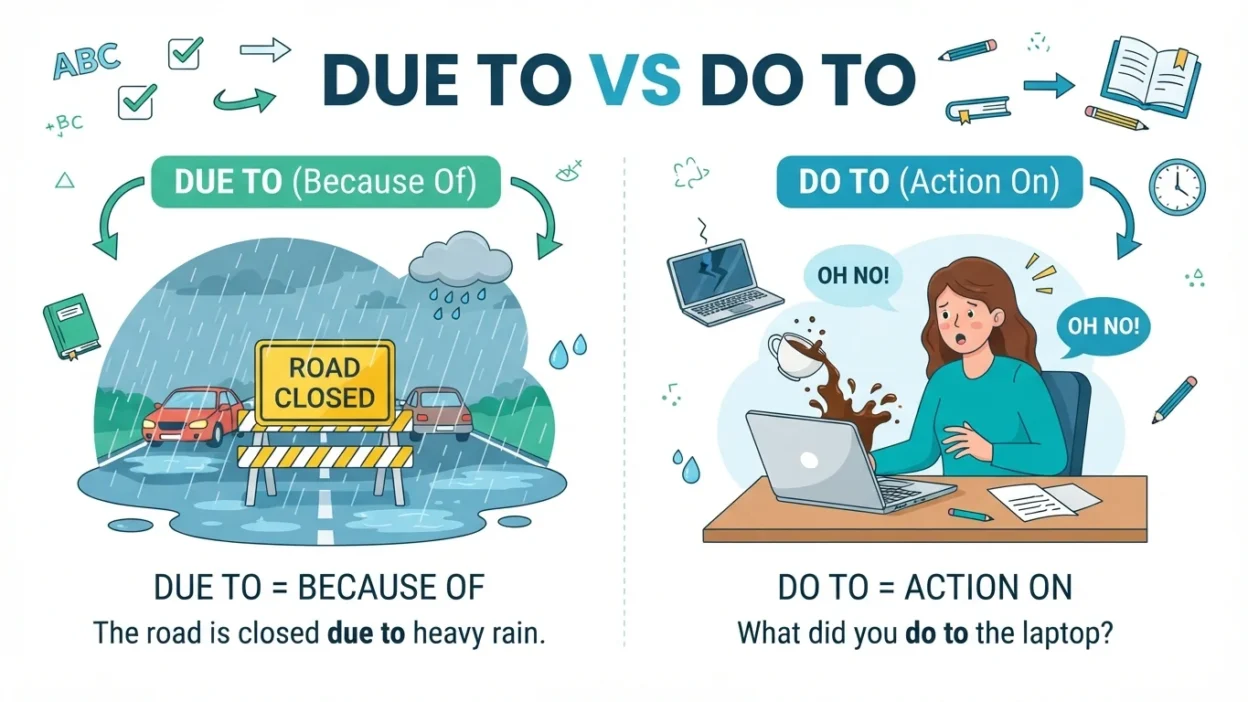
Many English learners and native speakers occasionally confuse Due To and Do To because they sound identical when spoken. However, these two phrases have completely different meanings and grammatical functions. Using the wrong one can make your writing look unprofessional or even change the meaning of your sentence.
If you’ve ever wondered whether to write due to or do to, this comprehensive guide will help you understand the difference. You’ll learn the meaning of each phrase, see practical examples, discover common mistakes to avoid, and pick up simple memory tricks so you can choose the correct phrase with confidence.
Quick Answer
- Due to means because of or caused by. It is the correct phrase in most situations.
- Do to means perform an action to someone or something. It is much less common because do is simply the verb do followed by the preposition to.
In everyday writing, you’ll almost always need “due to.”
What Does “Due To” Mean?
Due to is a prepositional phrase that means because of, as a result of, or caused by. It explains the reason something happened.
It commonly appears in formal writing, business communication, academic papers, and everyday conversations.
Examples of “Due To”
- The meeting was canceled due to bad weather.
- Flights were delayed due to heavy fog.
- She missed school due to illness.
- The road is closed due to construction.
- Sales increased due to strong customer demand.
In all of these examples, due to explains the cause of the situation.
What Does “Do To” Mean?
Do to is not a fixed phrase. Instead, it combines the verb do with the preposition to, meaning perform an action toward someone or something.
Although grammatically correct, it appears much less frequently than due to.
Examples of “Do To”
- Please don’t do that to your brother.
- What did they do to the old building?
- I would never do that to a friend.
- What have you done to my computer?
Notice that do to always involves an action performed on someone or something.
Due To vs Do To: Comparison Table
| Feature | Due To | Do To |
|---|---|---|
| Meaning | Because of | Perform an action to |
| Part of speech | Prepositional phrase | Verb + preposition |
| Common usage | Very common | Less common |
| Indicates | Cause or reason | Action toward someone or something |
| Example | Due to rain | Do that to me |
Key Differences
The easiest way to tell them apart is to ask yourself:
Are you explaining a reason?
- If yes, use due to.
Are you describing an action someone performs?
- If yes, use do to.
For example:
- The event was canceled due to rain. ✅
- What did you do to my phone? ✅
Common Mistakes
Many writers accidentally replace due to with do to because both phrases sound the same.
Incorrect
- The game was postponed do to rain.
Correct
- The game was postponed due to rain.
Incorrect
- She stayed home do to illness.
Correct
- She stayed home due to illness.
Correct
- What did you do to the cake?
Here, do to is correct because it refers to an action.
Memory Trick
Here’s an easy way to remember the difference:
- Due to = Because of. If you can replace due to with because of and the sentence still makes sense, it’s the correct choice.
- Do to = Perform an action. Think of the verb do as an action word.
Example:
- The picnic was canceled because of the rain.
- The picnic was canceled due to the rain. ✅
But:
- What did you because of my car? ❌
- What did you do to my car? ✅
American vs British English
There is no spelling difference between American English and British English.
| American English | British English |
|---|---|
| Due to | Due to |
| Do to | Do to |
Both varieties of English use these expressions in the same way.
Related Words and LSI Keywords
To build a strong understanding of the topic, it’s helpful to know related terms and phrases.
- Because of
- Owing to
- As a result of
- Thanks to
- Caused by
- Reason for
- Result of
- Perform
- Action
- Affect
- Influence
- Responsibility
These related words naturally fit discussions about due to and improve topical understanding.
Expert Usage Tip
Many style guides recommend using due to carefully in formal writing because it traditionally modifies nouns, while because of often modifies verbs. However, in modern English, due to is widely accepted in most contexts, especially when it clearly expresses the reason for something.
The phrase do to should only be used when referring to an action someone performs. If you’re explaining why something happened, due to is almost always the correct choice.
Frequently Asked Questions
Is “do to” ever correct?
Yes. It is correct when do is the main verb and to introduces the object of the action.
Which is correct: Due To or Do To?
For expressing a reason or cause, due to is correct.
Can I replace “due to” with “because of”?
In most cases, yes. If the sentence still makes sense, due to is likely the right choice.
Why do people confuse these phrases?
They are pronounced the same in everyday speech, making them easy to mix up when writing.
Is “due to” formal English?
Yes. It is commonly used in formal, academic, business, and everyday writing.
Is there a spelling difference in British and American English?
No. Both American and British English use due to and do to with the same spelling and meanings.
Which phrase is more common?
Due to is far more common because people frequently explain reasons or causes in both speech and writing.
Summary
Understanding the difference between Due To and Do To is simple once you know their roles. Due to means because of or caused by, making it the correct choice when explaining the reason for an event or situation. It is one of the most commonly used phrases in modern English and appears in everything from news articles to professional emails.
Do to, on the other hand, is simply the verb do followed by to, meaning to perform an action toward someone or something. While it is grammatically correct, it is much less common than due to. Whenever you’re unsure, ask yourself whether you’re explaining a cause or describing an action. This quick check will help you choose the right phrase every time.