If you’ve ever typed persue instead of pursue, you’re not alone. This is one of the most common spelling mistakes in English because both words look similar and sound almost the same. However, only one of them is correct in modern English.
In this guide, you’ll learn the difference between Persue and Pursue, their meanings, examples, common mistakes, spelling tips, American vs. British English differences, and frequently asked questions. By the end, you’ll know exactly which spelling to use in every situation.
Quick Answer
- Pursue is the correct spelling in both American and British English.
- Persue is an incorrect spelling and is considered a misspelling of pursue.
Always use “pursue” in your writing.
What Does “Pursue” Mean?
Pursue is a verb that means to follow, chase, continue working toward, or strive to achieve something. It can refer to physical actions, goals, dreams, careers, education, or opportunities.
It is commonly used in everyday conversations, academic writing, business communication, and professional settings.
Examples of “Pursue”
- She plans to pursue a career in medicine.
- They decided to pursue higher education abroad.
- The police continued to pursue the suspect.
- Never stop pursuing your dreams.
- The company will pursue new business opportunities.
In every modern context, pursue is the correct spelling.
What Does “Persue” Mean?
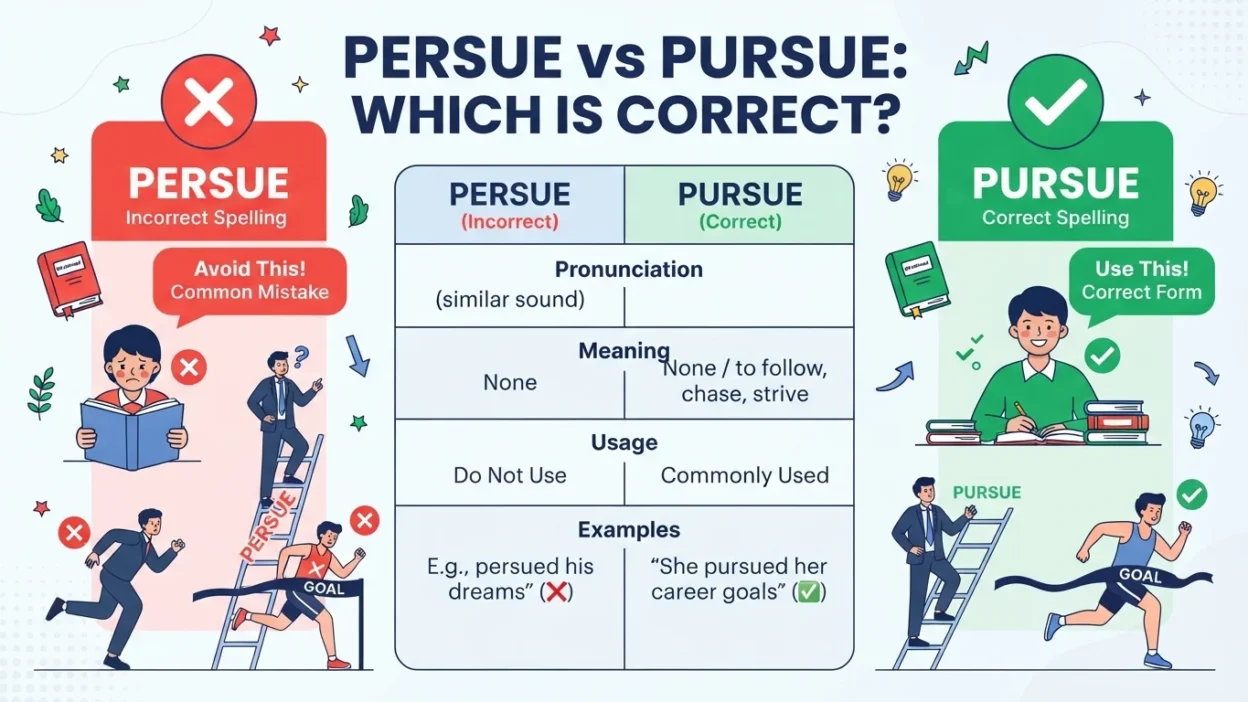
Persue has no recognized meaning in standard English. It is simply a spelling mistake made when people intend to write pursue.
Many writers accidentally replace the u with an e, especially when typing quickly or relying on pronunciation instead of correct spelling.
Example
❌ She wants to persue a law degree.
✅ She wants to pursue a law degree.
Persue vs Pursue: Comparison Table
| Feature | Persue | Pursue |
|---|---|---|
| Meaning | No meaning | To follow, chase, or work toward something |
| Correct spelling | ❌ No | ✅ Yes |
| Dictionary word | No | Yes |
| Everyday English | Never | Very common |
| American English | Incorrect | Correct |
| British English | Incorrect | Correct |
Why Do People Misspell “Pursue”?
There are several reasons why this spelling mistake is so common.
Similar Pronunciation
The pronunciation of pursue can make some people think the word starts with per- instead of pur-.
Typing Errors
When typing quickly, it’s easy to swap letters accidentally.
Unfamiliar Spelling Pattern
English contains many words beginning with per-, such as perform and perhaps, leading some writers to assume persue is correct.
Common Examples Using “Pursue”
Here are some everyday examples.
Education
- He wants to pursue a master’s degree.
- Many students pursue scholarships.
Career
- She decided to pursue a career in engineering.
- They continue to pursue professional growth.
Goals
- Always pursue your passions.
- We should pursue excellence every day.
Law Enforcement
- Officers pursued the suspect through the city.
- Police may pursue fleeing vehicles under certain conditions.
Common Mistakes to Avoid
Incorrect
- I want to persue my dreams.
Correct
- I want to pursue my dreams.
Incorrect
- They are persuing new opportunities.
Correct
- They are pursuing new opportunities.
Incorrect
- She persued a degree in science.
Correct
- She pursued a degree in science.
Easy Memory Trick
A simple way to remember the correct spelling is:
PURsue your PURpose.
Both PURsue and PURpose begin with PUR, making the correct spelling easier to remember.
Another tip:
Think of pursue as running toward a goal. Your goal starts with PUR, not PER.
American vs British English
There is no spelling difference between American and British English.
| American English | British English |
|---|---|
| Pursue | Pursue |
| Pursuing | Pursuing |
| Pursued | Pursued |
Both varieties of English use pursue with identical spelling and meaning.
Related Words and LSI Keywords
Including related terms naturally strengthens topical authority.
- Chase
- Follow
- Seek
- Strive
- Aim for
- Work toward
- Achieve
- Continue
- Goal
- Ambition
- Career path
- Opportunity
- Dream
- Aspiration
- Mission
These related phrases help readers understand the broader meaning of pursue while improving content relevance.
Expert Writing Tip
Professional editors, teachers, and dictionaries unanimously recognize pursue as the only correct spelling. If you accidentally write persue, spell-check software will usually flag it as an error.
For academic papers, resumes, business emails, and SEO content, always proofread your writing to ensure you’ve used pursue, not persue. Correct spelling enhances credibility and improves the reader’s experience.
Frequently Asked Questions
Is “persue” a real word?
No. Persue is not a standard English word. It is a common misspelling of pursue.
Which is correct: Persue or Pursue?
Pursue is the only correct spelling.
What does “pursue” mean?
It means to follow, chase, continue, or work toward achieving a goal or objective.
Why do people write “persue”?
Most people spell it incorrectly because of pronunciation or simple typing mistakes.
Is “pursue” used in both American and British English?
Yes. The spelling pursue is the same in both American and British English.
What is the past tense of pursue?
The past tense is pursued.
How do I remember the correct spelling?
Remember the phrase: “PURsue your PURpose.” Both words begin with PUR.
Summary
The difference between Persue and Pursue is simple. Pursue is the correct spelling and means to follow, chase, or strive toward a goal. It is widely used in everyday conversations, education, careers, business, and professional writing. Persue, on the other hand, is simply a misspelling and should be avoided.
Whenever you’re writing about achieving dreams, following opportunities, or continuing toward success, always choose pursue. Using the correct spelling improves clarity, strengthens your credibility, and ensures your writing reflects standard English conventions.