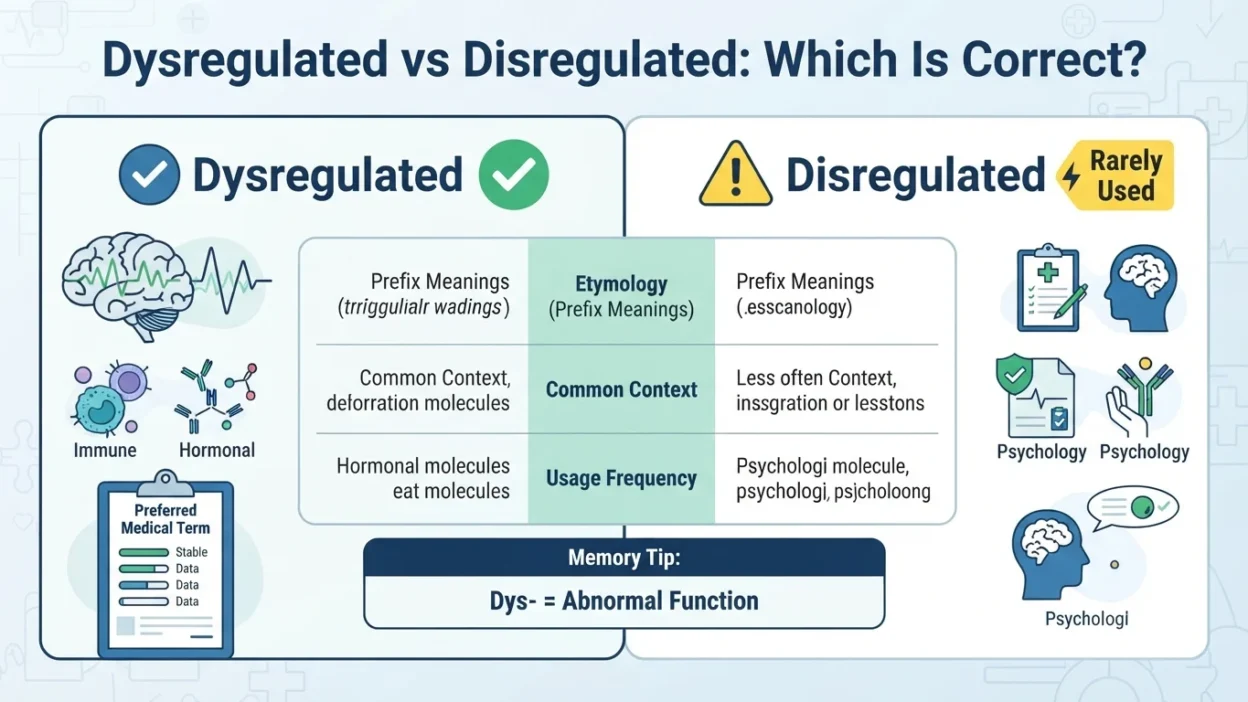
Have you ever come across the words dysregulated and disregulated and wondered which one is correct? Since both terms appear to describe something that is “not regulated properly,” they can easily be confused. However, they are not equally common, and one is strongly preferred in modern English.
The simple answer is that dysregulated is the standard and widely accepted term, especially in medicine, psychology, biology, and neuroscience. Disregulated exists but is much less common and is rarely preferred in professional or academic writing. In this guide, you’ll learn the difference, understand when to use each word, see practical examples, and avoid common mistakes.
Quick Answer
- Dysregulated is the preferred and widely accepted term, especially in scientific and medical contexts.
- Disregulated is a rare alternative and is generally avoided unless required by a specific source or context.
In most cases, choose “dysregulated.”
What Does “Dysregulated” Mean?
Dysregulated means that a system, process, emotion, or function is not working or being regulated normally. The prefix dys- means abnormal, impaired, or faulty.
The word is commonly used in:
- Medicine
- Psychology
- Psychiatry
- Neuroscience
- Biology
- Healthcare research
Examples of “Dysregulated”
- The patient has a dysregulated immune system.
- Emotional dysregulation is common in several mental health conditions.
- Researchers studied dysregulated hormone levels.
- A dysregulated stress response can affect overall health.
- The disease causes dysregulated cell growth.
In these examples, dysregulated describes a function that is impaired or abnormal.
What Does “Disregulated” Mean?
Disregulated means not properly regulated or poorly controlled, but it is rarely used in modern English.
While dictionaries recognize the word, it is far less common than dysregulated, especially in scientific and medical writing.
Examples of “Disregulated”
- The process became disregulated after the policy change.
- Some older publications use disregulated, but modern research usually prefers dysregulated.
In professional writing, dysregulated is almost always the better choice.
Dysregulated vs Disregulated: Comparison Table
| Feature | Dysregulated | Disregulated |
|---|---|---|
| Correct English | ✅ Yes | ✅ Yes (rare) |
| Common usage | Very common | Rare |
| Medical terminology | Preferred | Rarely used |
| Psychology | Preferred | Uncommon |
| Academic writing | Recommended | Usually avoided |
The Main Difference
The main difference is usage, not meaning.
- Dysregulated emphasizes abnormal or impaired regulation and is the accepted term in medicine and psychology.
- Disregulated simply suggests regulation has been disrupted, but it is uncommon and often replaced by dysregulated.
For example:
- The child displayed dysregulated emotional responses. ✅
- The child displayed disregulated emotional responses. (Grammatically possible but uncommon.)
Why Is “Dysregulated” Preferred?
The prefix dys- is widely used in medical and scientific terminology to describe abnormal functioning.
Examples include:
- Dysfunction
- Dyslexia
- Dysplasia
- Dysphagia
- Dysregulation
Because of this pattern, dysregulated sounds natural and precise to healthcare professionals and researchers.
Common Uses of “Dysregulated”
Psychology
- Dysregulated emotions
- Emotional dysregulation
- Behavioral dysregulation
Medicine
- Dysregulated immune response
- Dysregulated blood sugar
- Dysregulated hormone production
Biology
- Dysregulated gene expression
- Dysregulated cell signaling
- Dysregulated metabolism
Common Mistakes to Avoid
Many writers assume disregulated is the standard form because of other words beginning with dis-.
Less Preferred
- The patient has a disregulated nervous system.
Preferred
- The patient has a dysregulated nervous system.
Less Preferred
- Researchers studied disregulated hormones.
Preferred
- Researchers studied dysregulated hormones.
Easy Memory Trick
Here’s a simple trick:
Think of familiar medical words:
- Dysfunction
- Dyslexia
- Dysphagia
- Dysregulation
Since they all begin with dys-, you’ll remember that dysregulated is the standard medical term.
Remember:
Dys- = Abnormal Function
American vs British English
There is no significant difference between American and British English.
| American English | British English |
|---|---|
| Dysregulated | Dysregulated |
| Disregulated | Rare |
| Preferred term | Dysregulated |
Both varieties overwhelmingly prefer dysregulated, particularly in healthcare and scientific writing.
Related Words and LSI Keywords
Using related vocabulary naturally improves topical authority and readability.
- Dysregulation
- Emotional dysregulation
- Dysfunction
- Impaired regulation
- Hormonal imbalance
- Immune response
- Nervous system
- Gene expression
- Mental health
- Neurology
- Psychology
- Biological regulation
- Homeostasis
- Cellular function
- Medical terminology
These related terms improve SEO while helping readers understand the broader context of the word.
Expert Writing Tip
If you’re writing about health, psychology, biology, or medicine, always choose dysregulated unless you’re directly quoting a source that uses disregulated. The term dysregulated is the accepted standard in modern scientific literature and is instantly recognized by healthcare professionals.
Using the preferred terminology also improves the accuracy and credibility of your writing.
Frequently Asked Questions
Is “dysregulated” correct?
Yes. Dysregulated is the standard and widely accepted term in medicine, psychology, and biology.
Is “disregulated” a real word?
Yes. Disregulated is a recognized word, but it is much less common and rarely preferred in modern professional writing.
Which is better: Dysregulated or Disregulated?
In nearly all situations, dysregulated is the better and more widely accepted choice.
Why is “dysregulated” more common?
Because the prefix dys- specifically refers to abnormal or impaired function and is commonly used in medical terminology.
Is there a difference between American and British English?
No. Both American and British English generally prefer dysregulated.
Where is “dysregulated” most commonly used?
It is frequently used in psychology, psychiatry, neuroscience, medicine, and biological research.
How can I remember the correct word?
Think of dysfunction and dyslexia. Since both use the dys- prefix, dysregulated is the natural choice.
Summary
The difference between dysregulated and disregulated is mainly one of usage and preference. Dysregulated is the standard term in medicine, psychology, neuroscience, and biology because it accurately describes an abnormal or impaired regulatory process. It is the form used in research papers, medical textbooks, and professional communication.
Although disregulated is a recognized word, it is uncommon and rarely preferred in modern English. For almost all academic, scientific, and healthcare writing, dysregulated is the clearer, more accurate, and more widely accepted choice.

A creative writer with a deep interest in word usage and meaning.
He explores synonyms to enhance both academic and creative expression.
Zayn’s work aims to make language richer and more accessible for everyone.