Have you ever confused tacet and tacit? These words look and sound similar, but they have completely different meanings and are used in very different contexts. Knowing the distinction can help you avoid an embarrassing spelling or vocabulary mistake.
The key difference is simple: tacit means something that is understood or implied without being directly stated, while tacet is a musical term meaning “it is silent” or that a musician does not play during a particular section. In this guide, you’ll learn their meanings, examples, usage rules, common mistakes, and an easy memory trick.
Quick Answer
- Tacit = understood or implied without being directly expressed.
- Tacet = a musical direction telling a performer to remain silent or not play.
Both words are correct, but they have completely different meanings.
What Does “Tacit” Mean?
Tacit is an adjective meaning understood, accepted, or implied without being openly expressed or stated.
It is commonly used in formal, academic, legal, business, and everyday English.
Examples of “Tacit”
- They reached a tacit agreement without discussing the issue.
- His silence was a tacit approval of the plan.
- There was a tacit understanding between the two teams.
- She gave her tacit consent by remaining silent.
- The employees had a tacit expectation that everyone would arrive on time.
Common Expressions With “Tacit”
Some common phrases include:
- Tacit agreement
- Tacit approval
- Tacit consent
- Tacit understanding
- Tacit acceptance
- Tacit assumption
- Tacit knowledge
What Does “Tacet” Mean?
Tacet is a musical term derived from Latin. It means “it is silent” or “he/she/it is silent.”
A composer or conductor may use tacet in a musical score to tell a particular musician or section to remain silent for an entire movement or designated passage.
Examples of “Tacet”
- The score indicates tacet for the violin section.
- The trumpet part is marked tacet during the second movement.
- The percussionist remains silent when the score says tacet.
- The conductor explained that the brass section is tacet in this passage.
Unlike tacit, tacet is primarily associated with music.
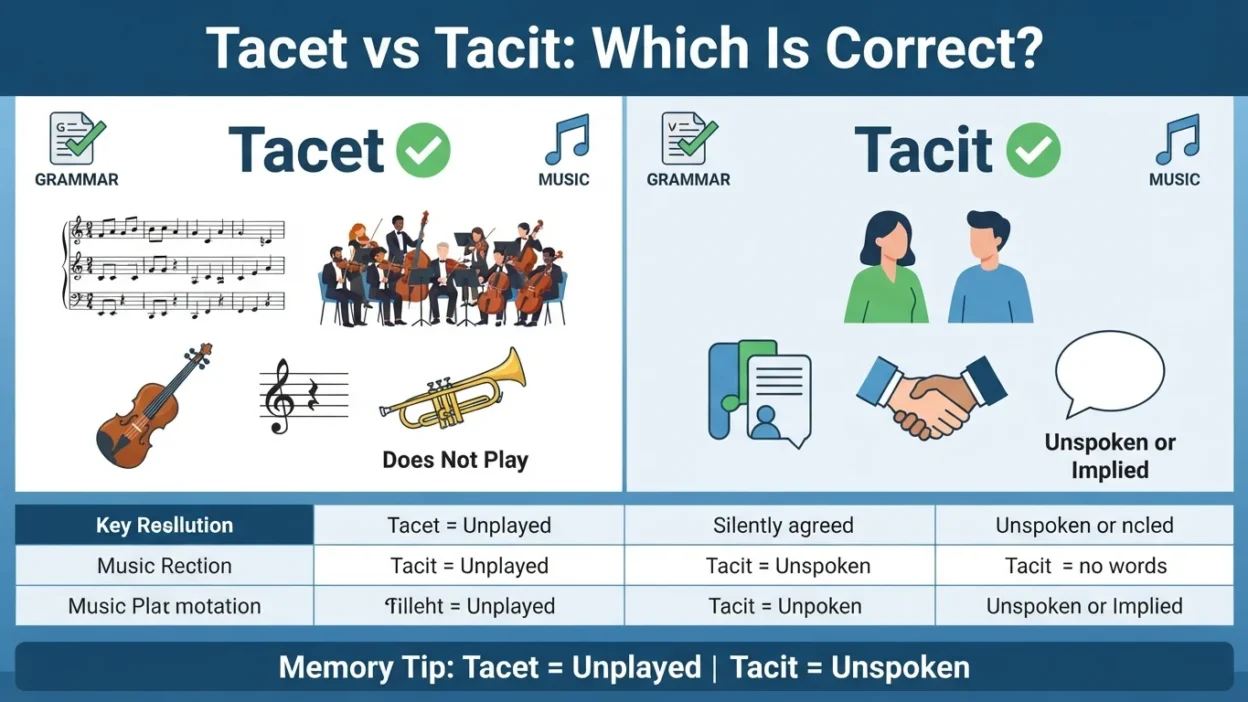
Tacet vs Tacit: Comparison Table
| Feature | Tacet | Tacit |
|---|---|---|
| Meaning | Remain silent / does not play | Implied or understood |
| Part of speech | Musical direction | Adjective |
| Common field | Music | General, academic, legal, business |
| Origin | Latin | Latin |
| Example | The flute is tacet. | They had a tacit agreement. |
The Main Difference
The easiest way to understand the difference is to connect each word with its context.
Tacit is about something unspoken but understood.
They had a tacit agreement.
Nobody directly stated the agreement, but both sides understood it.
Tacet is about silence in music.
The flute section is marked tacet.
This means the flute players do not play during that section.
Tacit vs Tacet in Simple English
Think of them this way:
- Tacit = Unspoken
- Tacet = Unplayed
This distinction makes the two words much easier to remember.
Example
Tacit:
We had a tacit understanding.
Meaning: We understood each other without saying it directly.
Tacet:
The piano is tacet.
Meaning: The piano does not play.
Common Mistakes to Avoid
Because the words differ by only one letter, they are easy to mix up.
Incorrect
- They reached a tacet agreement.
Correct
- They reached a tacit agreement.
Incorrect
- The violin section is tacit during the movement.
Correct
- The violin section is tacet during the movement.
Incorrect
- The contract contained a tacet understanding.
Correct
- The contract contained a tacit understanding.
Easy Memory Trick
Here’s a simple way to remember the difference:
Tacit = Talk is absent
Something is tacit when it is understood without being spoken.
Tacet = Take silence
In music, tacet tells a performer to remain silent.
Remember:
Tacit = Unspoken
Tacet = Unplayed
American vs British English
There is no meaningful spelling difference between American and British English for these words.
| American English | British English |
|---|---|
| Tacit | Tacit |
| Tacet | Tacet |
Both varieties use tacit for something implied or unspoken and tacet as a musical direction.
Related Words and LSI Keywords
Using related vocabulary naturally improves topical relevance and readability.
Related to “Tacit”
- Unspoken
- Implied
- Implicit
- Understood
- Unstated
- Silent agreement
- Unexpressed
- Assumed
- Indirect
- Tacit approval
Related to “Tacet”
- Musical notation
- Music score
- Silence
- Rest
- Orchestra
- Instrument
- Movement
- Musical direction
- Performer
- Conductor
These related terms help clarify the different contexts in which each word is used.
Expert Writing Tip
If you’re writing about agreements, assumptions, approval, or knowledge, you probably need tacit. If you’re reading or writing a musical score, tacet is likely the correct term.
A useful test is to ask: Is something unspoken, or is someone not playing?
- Unspoken → tacit
- Not playing → tacet
This simple distinction can help you choose the right word quickly and accurately.
Frequently Asked Questions
Is “tacit” correct?
Yes. Tacit is a standard English adjective meaning understood or implied without being directly stated.
Is “tacet” a real word?
Yes. Tacet is a legitimate musical term used in scores to indicate that a musician or section should remain silent.
What is the difference between tacit and tacet?
Tacit means unspoken or implied, while tacet is a musical instruction meaning that a performer does not play.
Is “tacit agreement” correct?
Yes. Tacit agreement is a common expression meaning an agreement that is understood without being explicitly stated.
Is “tacet agreement” correct?
No. Tacet agreement is incorrect. The correct phrase is tacit agreement.
Is there a difference between American and British English?
No. Both varieties of English use tacit and tacet with the same meanings.
How can I remember the difference?
Remember: Tacit = Unspoken and Tacet = Unplayed.
Summary
The difference between tacet and tacit depends entirely on context. Tacit is the more commonly encountered word and describes something that is understood, accepted, or implied without being openly stated. It appears in phrases such as tacit agreement, tacit approval, and tacit understanding.
Tacet, meanwhile, is a specialized musical term that tells a musician or section to remain silent during a particular part of a composition. The easiest way to remember the distinction is “tacit = unspoken” and “tacet = unplayed.” Using the right word will make your writing more precise and professional.

A passionate linguist who specializes in word relationships and vocabulary building.
He has spent years studying synonyms and semantic patterns across languages.
Arman writes to make language learning simple, precise, and engaging.