Emasculate vs demasculate is a spelling and word-choice confusion that can easily catch English learners and writers off guard. The two words look as though they should both be valid because the prefix de- often appears in English words. However, when you want to express the idea of making someone feel less masculine or depriving someone of strength, power, or effectiveness, the standard English word is emasculate.
Understanding the difference is useful because emasculate can be used in both literal and figurative contexts. It may describe the removal of male reproductive organs, but it is also commonly used figuratively to describe someone being made to feel weak, powerless, or less masculine. Demasculate, by contrast, is not the standard word to use in modern English. This guide explains the meanings, examples, common mistakes, related words, and an easy memory trick.
Quick Answer
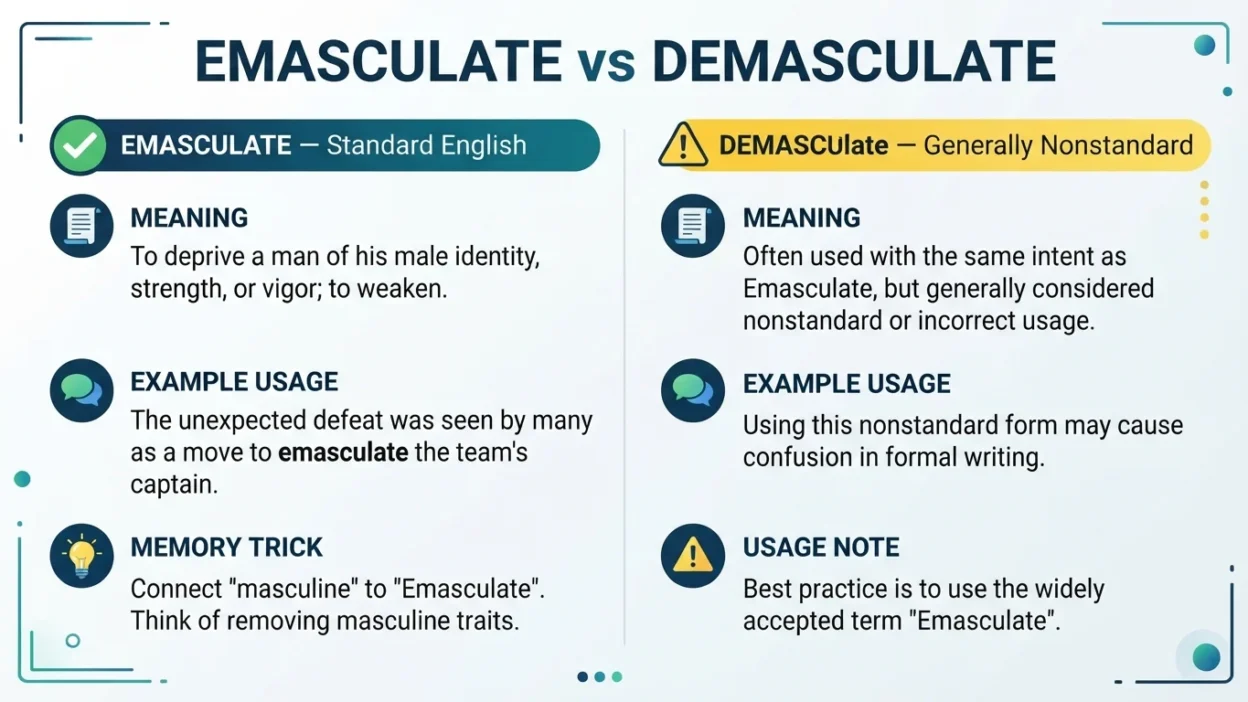
Emasculate is the standard and correct English word. It can mean to deprive a male of the testes or reproductive capacity, or figuratively to make someone feel less masculine, powerful, or confident. Demasculate is generally considered nonstandard and should be avoided in formal or standard English.
Why People Confuse “Emasculate” and “Demasculate”
The confusion mainly comes from English prefixes.
English has many words beginning with de-, such as:
- Deactivate
- Devalue
- Deconstruct
- Decrease
- Demotivate
- Defrost
Because de- can indicate removal, reversal, or reduction, it may seem logical to form demasculate from “masculate.”
However, English vocabulary does not always follow a predictable prefix pattern. The established standard word is emasculate.
Another reason for the confusion is that emasculate is not an everyday word for many speakers. When people encounter it for the first time, they may assume that demasculate is the more logical spelling.
For standard English, remember:
Emasculate = correct
Demasculate = generally nonstandard
Emasculate: Meaning and Definition
Emasculate is a verb.
It has both a literal and a figurative meaning.
Simple Meaning
Emasculate = to deprive a male of the testes or reproductive ability, or to make someone feel weak, powerless, or less masculine.
The figurative meaning is particularly common in modern writing.
For example:
The constant criticism made him feel emasculated.
Here, emasculated means that the person felt weakened, humiliated, or less confident in his masculinity.
Literal Meaning
In a literal or biological context, emasculate can mean to remove the testes or render a male incapable of reproduction.
For example:
The procedure emasculated the animal.
This literal sense is relatively specialized and is more likely to appear in medical, biological, veterinary, or historical contexts.
Figurative Meaning
In everyday writing, emasculate is often used figuratively.
It can mean:
- To make someone feel less masculine
- To undermine someone’s confidence
- To make someone feel powerless
- To deprive someone of authority
- To weaken someone’s effectiveness
For example:
The decision emasculated the manager by taking away his authority.
In this sentence, emasculated does not refer to physical anatomy. It means that the person’s power or authority was significantly reduced.
Emasculate as a Verb
The base form is:
emasculate
Common forms include:
- Emasculate — present/base form
- Emasculated — past tense/past participle
- Emasculating — present participle
- Emasculates — third-person singular
Examples:
The criticism may emasculate him.
The policy emasculated the organization.
He felt emasculated by the situation.
The experience was deeply emasculating.
Demasculate: Is It Correct?
Demasculate is generally not considered the standard English word.
Although a reader may understand what someone means by demasculate, it is not the established standard form you should normally choose in formal, academic, professional, or carefully edited writing.
If you want to express this idea, use:
emasculate
For example:
❌ The experience demasculated him.
✅ The experience emasculated him.
Instead of inventing or using the less-standard form, choose the established word emasculate.
Emasculate vs Demasculate: Comparison Table
| Word | Standard English? | Part of Speech | Meaning | Example |
|---|---|---|---|---|
| Emasculate | ✅ Yes | Verb | To deprive a male of reproductive capacity or make someone feel less powerful/masculine | The criticism emasculated him. |
| Emasculated | ✅ Yes | Verb/adjective | Made someone feel weak, powerless, or less masculine | He felt emasculated. |
| Emasculating | ✅ Yes | Adjective/participle | Causing someone to feel weak or less masculine | The experience was emasculating. |
| Demasculate | ⚠️ Generally nonstandard | Verb | Intended to mean emasculate | Avoid in standard writing. |
When to Use “Emasculate”
Use emasculate when you need to express one of its established meanings.
1. To Make Someone Feel Less Masculine
His friends’ comments made him feel emasculated.
This use focuses on a person’s sense of masculinity, confidence, or identity.
2. To Take Away Someone’s Power
The new rules emasculated the department.
Here, emasculated means weakened or deprived of authority.
3. To Weaken an Organization or Institution
The reforms emasculated the agency’s ability to enforce the law.
In this context, the word is figurative and means that the agency’s effectiveness or authority was reduced.
4. In a Literal Biological Context
The animal was emasculated as part of the study.
This is a specialized use and should be understood from context.
Examples of “Emasculate”
Here are natural examples showing different uses:
- The criticism made him feel emasculated.
- He felt emasculated after losing his position of authority.
- The new regulations emasculated the organization.
- The experience was emotionally emasculating for him.
- Nobody should intentionally emasculate another person.
- The manager felt emasculated when his decisions were repeatedly ignored.
- The policy emasculated the department by removing its authority.
- He worried that asking for help would make him feel emasculated.
- The character is portrayed as increasingly emasculated throughout the story.
- The reforms were criticized for emasculating the institution.
- The humiliation left him feeling emasculated.
- The historical account describes the ruler’s attempt to emasculate his rival.
Common Mistakes
Mistake 1: Writing “Demasculate”
Incorrect:
The situation demasculated him.
Standard:
The situation emasculated him.
Mistake 2: Assuming “Emasculate” Only Means Physical Removal
Emasculate can have a literal biological meaning, but its figurative meaning is also important.
For example:
The decision emasculated the committee.
This means the committee lost power or effectiveness.
Mistake 3: Using “Emasculate” When “Weaken” Is Clearer
Although emasculate can mean weaken, it often carries a stronger implication of lost authority, confidence, effectiveness, or masculinity.
Instead of:
The storm emasculated the bridge.
it may be clearer to say:
The storm weakened the bridge.
Choose emasculate when its specific figurative meaning adds something important.
Mistake 4: Confusing “Emasculated” With “Embarrassed”
These words can overlap in some situations, but they are not exact synonyms.
Embarrassed means feeling uncomfortable, self-conscious, or ashamed.
Emasculated can mean feeling deprived of masculinity, power, authority, strength, or confidence.
For example:
He was embarrassed when he forgot her name.
But:
He felt emasculated when his authority was publicly undermined.
Memory Trick
The easiest way to remember the correct spelling is:
Think “E” for Emasculate
The standard word starts with E:
E + masculine → emasculate
Don’t automatically create demasculate simply because “de-” can mean removal or reduction in other English words.
Remember:
👉 EMASCULATE = standard
👉 DEmasculate = avoid
Another useful connection is:
masculine → emasculate
The spelling of emasculate is closely connected to masculine, making it easier to remember.
American vs British English
Emasculate is standard in both American and British English.
The spelling is the same:
- American English: emasculate
- British English: emasculate
The meaning is also essentially the same in both varieties.
Demasculate is not the preferred standard form in either variety.
Therefore, whether you are writing an American English essay or British English article, use emasculate.
Similar Words
Several words are related to emasculate, but they do not have exactly the same meaning.
Weaken
Weaken means to make something or someone less strong.
The illness weakened him.
This is broader and more neutral than emasculate.
Disempower
Disempower means to take away someone’s power or authority.
The new policy disempowered local officials.
This is often a useful alternative when the focus is specifically on authority rather than masculinity.
Humiliate
Humiliate means to make someone feel deeply ashamed or embarrassed.
The public criticism humiliated him.
Humiliation can contribute to someone feeling emasculated, but the words are not identical.
Undermine
Undermine means to weaken someone’s authority, confidence, reputation, or effectiveness.
The repeated criticism undermined her confidence.
Castrate
Castrate has a specific literal biological meaning involving removal of the testes. It can also have figurative uses.
It is not always interchangeable with emasculate, especially when discussing emotional confidence or social power.
Enfeeble
Enfeeble means to make someone or something weak.
The disease enfeebled the patient.
It is more formal and generally focuses on physical or general weakness.
Emasculate vs Weaken
These words are sometimes confused because emasculate can mean “weaken,” but there is an important difference.
Weaken is broad:
The storm weakened the structure.
Emasculate can suggest a more specific loss of authority, effectiveness, confidence, or masculine power:
The decision emasculated the leader.
If you simply mean “make less strong,” weaken is usually the clearer word.
If you mean “strip away power, authority, effectiveness, or masculine confidence,” emasculate may be more precise.
Emasculate vs Castrate
These words can overlap in literal contexts, but they should not automatically be treated as identical.
Castrate specifically refers to removing the testes or causing loss of reproductive function.
Emasculate can refer to that literal process, but it also has a broader figurative meaning involving masculinity, power, confidence, or authority.
For example:
The animal was castrated.
is a more specific biological statement.
Whereas:
The public criticism emasculated him.
is figurative and refers to his feelings or sense of power.
Final Verdict
When deciding between emasculate and demasculate, choose emasculate. It is the established standard English word and can be used in literal and figurative contexts.
Demasculate may look logical because English frequently uses the prefix de-, but it is not the standard choice. In formal writing, academic work, professional communication, and edited content, avoid it.
The easiest way to remember the difference is to connect emasculate with masculine. If you need the verb meaning to deprive someone of masculine characteristics or, figuratively, to weaken someone’s confidence, authority, or power, emasculate is the word you want.
Frequently Asked Questions
Is “emasculate” or “demasculate” correct?
Emasculate is the standard English word. Demasculate is generally considered nonstandard and should be avoided in formal or standard writing.
What does emasculate mean?
Emasculate means to deprive a male of the testes or reproductive capacity, or figuratively to make someone feel less masculine, powerful, confident, or effective.
What does “emasculated” mean?
Emasculated is the past form of emasculate. Figuratively, it often means that someone feels weakened, powerless, humiliated, or less masculine.
Is emasculate a negative word?
It can have a negative connotation, particularly when used figuratively to describe someone being deprived of confidence, authority, power, or a sense of masculinity.
Is “demasculate” a real word?
You may encounter demasculate, but it is not the standard established word used in careful modern English. Emasculate is the preferred choice.
What is the difference between emasculate and castrate?
Castrate specifically refers to removing the testes or causing loss of reproductive function. Emasculate can have that literal meaning but is also widely used figuratively to mean weakening someone’s masculinity, authority, confidence, or power.
Can emasculate mean “weaken”?
Yes. In figurative contexts, emasculate can mean to weaken or deprive a person, organization, or institution of power, effectiveness, or authority.
What is the noun form of emasculate?
The noun is emasculation.
For example:
The policy resulted in the emasculation of the agency.
Conclusion
The correct choice between emasculate vs demasculate is straightforward: use emasculate. It is the standard English verb and has both literal and figurative meanings. In everyday and modern writing, its figurative sense is particularly important because it can describe someone feeling less masculine, less confident, or less powerful.
Although demasculate may seem logical from the structure of other English words beginning with “de-,” it is generally not the preferred standard form. If you are writing an essay, article, report, professional message, or other formal text, emasculate is the reliable choice.
Remember This
Emasculate = correct standard English. ✅
Demasculate = generally avoid. ❌
Memory trick:
👉 Masculine → Emasculate
👉 Emasculate = make less masculine, powerful, or effective