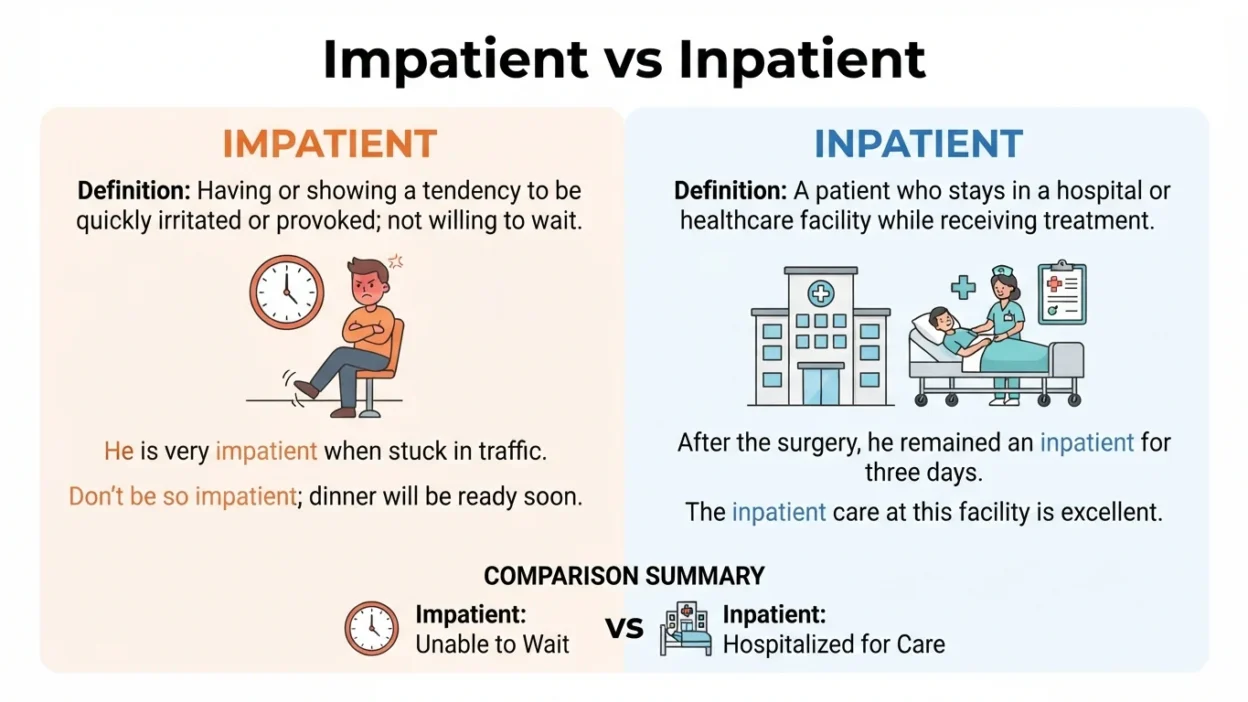
Impatient vs inpatient is a common English word confusion because these words look and sound very similar. However, they have completely different meanings and are used in very different situations. One describes how someone feels when they do not want to wait, while the other is mainly used in healthcare to describe someone who stays in a hospital or receives treatment there.
Understanding the difference between impatient and inpatient can help you avoid embarrassing spelling mistakes and choose the right word in everyday, academic, and professional writing. If you are an ESL learner, student, writer, or simply want to improve your English vocabulary, this guide will explain both words in simple language, with clear examples, a comparison table, common mistakes, and an easy memory trick.
Quick Answer
Impatient means unable or unwilling to wait calmly, or easily annoyed by delay. Inpatient refers to a person who stays in a hospital or healthcare facility for treatment. Remember: impatient = not willing to wait; inpatient = receiving hospital care while staying there.
Why People Confuse “Impatient” and “Inpatient”
The confusion comes from their similar spelling and pronunciation.
Both words begin with “in” and contain the word “patient.” However, their meanings are very different.
The word impatient describes a person’s attitude or behavior.
She became impatient while waiting for the bus.
The word inpatient is mainly a healthcare term.
The doctor spoke with the inpatient about the treatment plan.
A useful distinction is:
- Impatient → a feeling or behavior
- Inpatient → a healthcare status
The words look almost identical, but the prefix and meaning make the difference.
Impatient: Meaning and Definition
Impatient is an adjective that describes someone who is unwilling or unable to wait calmly.
Someone who is impatient may become annoyed, frustrated, restless, or irritated when something takes too long.
Simple Meaning
Impatient = not willing to wait or easily annoyed by delays.
For example:
The children became impatient while waiting for dinner.
This means the children did not want to wait any longer.
Other Uses of “Impatient”
Impatient can also describe someone who wants something to happen immediately.
She is impatient to start her new job.
It can also describe a lack of tolerance for something.
He is impatient with slow decision-making.
Synonyms for Impatient
Depending on the context, synonyms include:
- Restless
- Frustrated
- Irritated
- Eager
- Hasty
- Intolerant
- Anxious
- Pressing
However, these words are not always exact replacements. Impatient specifically suggests difficulty waiting or tolerating delay.
Inpatient: Meaning and Definition
Inpatient is primarily a healthcare term.
An inpatient is a person who is admitted to a hospital or healthcare facility and stays there while receiving medical care.
Simple Meaning
Inpatient = a person who stays in a hospital or healthcare facility for treatment.
For example:
The hospital has several inpatient units.
Here, inpatient relates to people who are receiving care while staying at the facility.
You may also see inpatient care, which means medical treatment provided to someone who remains in a healthcare facility.
Examples include:
- Inpatient treatment
- Inpatient care
- Inpatient services
- Inpatient unit
- Inpatient admission
- Inpatient facility
Inpatient as a Noun and Adjective
Inpatient can function as a noun:
The nurse checked on the inpatient.
It can also function as an adjective:
The hospital provides inpatient services.
This makes it different from impatient, which is an adjective.
Impatient vs Inpatient: Comparison Table
| Word | Part of Speech | Meaning | Example |
|---|---|---|---|
| Impatient | Adjective | Unwilling or unable to wait calmly | She was impatient with the delay. |
| Inpatient | Noun/Adjective | A person receiving treatment while staying in a healthcare facility; relating to such care | He was admitted as an inpatient. |
| Impatient | Adjective | Easily annoyed by waiting or delay | The customer became impatient. |
| Inpatient | Noun | A hospital patient who stays for treatment | The inpatient was moved to another room. |
When to Use “Impatient”
Use impatient when talking about someone’s reaction to waiting, delays, or slow progress.
Use “Impatient” for:
- Waiting in a line
- Waiting for someone
- Delayed results
- Slow progress
- Wanting something immediately
- Becoming annoyed by delays
Examples:
I became impatient after waiting for an hour.
The students were impatient to hear the results.
She gets impatient when people arrive late.
He was impatient with the slow service.
Impatient With
The expression “impatient with” is particularly common.
She is impatient with her coworkers.
He became impatient with the repeated questions.
Impatient To
You can also use “impatient to” when someone is eager for something to happen.
They were impatient to begin the journey.
Here, the word suggests strong eagerness combined with a desire not to wait.
When to Use “Inpatient”
Use inpatient when discussing hospital or healthcare treatment involving an overnight or extended stay in a medical facility.
Examples:
The patient required inpatient care.
She was admitted as an inpatient.
The hospital has a dedicated inpatient department.
The doctor recommended inpatient treatment.
The inpatient unit was renovated last year.
In healthcare contexts, inpatient is often contrasted with outpatient.
Inpatient vs Outpatient
This is one of the easiest ways to understand inpatient.
Inpatient
An inpatient stays in a healthcare facility while receiving treatment.
The patient was admitted for inpatient care.
Outpatient
An outpatient receives medical treatment but does not stay overnight or remain admitted as an inpatient.
She received outpatient treatment and returned home the same day.
The basic distinction is:
Inpatient = stays in the facility
Outpatient = receives care without being admitted
The exact administrative definition of inpatient and outpatient care can vary depending on healthcare systems and policies, but this distinction is useful for everyday English.
Examples of “Impatient”
Here are natural examples using impatient:
- The children became impatient while waiting for lunch.
- I was getting impatient because the train was late.
- She is impatient with people who arrive late.
- He became impatient after waiting for an hour.
- The customer sounded impatient on the phone.
- Don’t be impatient; we’ll be there soon.
- She was impatient to hear the final decision.
- The students grew impatient during the long meeting.
- He can be impatient when things move slowly.
- I was too impatient to wait for the results.
- The manager became impatient with the repeated delays.
- She is impatient to begin her new project.
Examples of “Inpatient”
Here are natural examples using inpatient:
- The hospital provides inpatient care.
- He was admitted as an inpatient.
- The doctor recommended inpatient treatment.
- The inpatient unit is located on the second floor.
- The hospital has several inpatient rooms.
- The patient became an inpatient after being admitted.
- Inpatient services are available around the clock.
- The nurse checked the inpatient’s medical records.
- The facility specializes in inpatient rehabilitation.
- The doctor discussed the patient’s inpatient treatment plan.
Common Mistakes
Mistake 1: Using “Inpatient” for Someone Who Cannot Wait
Incorrect:
I am very inpatient because the bus is late.
Correct:
I am very impatient because the bus is late.
The person is frustrated about waiting, so impatient is correct.
Mistake 2: Using “Impatient” for Hospital Care
Incorrect:
The doctor recommended impatient treatment.
Correct:
The doctor recommended inpatient treatment.
The treatment involves staying in a healthcare facility, so inpatient is correct.
Mistake 3: Confusing Inpatient With Outpatient
These words have opposite healthcare-related concepts.
Inpatient → admitted/stays for care
Outpatient → receives care without being admitted
Mistake 4: Thinking “Patient” Always Means a Medical Patient
The word patient has two important meanings.
As a noun:
The patient is waiting for the doctor.
Here, patient means someone receiving medical care.
As an adjective:
You need to be patient.
Here, patient means able to wait calmly.
That is why impatient means the opposite of being patient in the behavioral sense.
Memory Trick
Here is an easy way to remember the difference:
Impatient = I Can’t Wait
Think:
IMpatient → I’M impatient → I can’t wait!
If someone is frustrated because they have to wait, use impatient.
She is impatient because the food is taking too long.
Inpatient = IN the Hospital
Think:
INpatient → IN the hospital
If someone is staying in a healthcare facility for treatment, use inpatient.
He is an inpatient at the hospital.
So remember:
Impatient = can’t wait
Inpatient = stays IN for medical care
American vs British English
Impatient has the same basic meaning in both American and British English.
For example:
She became impatient while waiting.
Inpatient is also used in both varieties, particularly in healthcare contexts.
The spelling does not normally change between American and British English:
- American English: impatient / inpatient
- British English: impatient / inpatient
The main difference you may notice is not the spelling but differences in healthcare terminology, administrative systems, or preferred descriptions of medical services.
Similar Words
Understanding related words can make the distinction even easier.
Patient
Patient can mean someone receiving medical care or someone who can wait calmly.
The patient spoke with the doctor.
Please be patient.
Outpatient
An outpatient receives medical care without being admitted as an inpatient.
The procedure was performed on an outpatient basis.
Hospitalized
Hospitalized means admitted to a hospital for treatment.
He was hospitalized after the accident.
Restless
Restless describes someone who cannot relax or remain still.
The children became restless during the long wait.
Frustrated
Frustrated describes annoyance or disappointment when something does not happen as expected.
She felt frustrated by the delay.
“Restless” and “frustrated” can sometimes describe an impatient person, but they do not have exactly the same meaning.
Impatient vs Inpatient in a Sentence
Compare these sentences carefully:
The impatient customer complained about the long wait.
The customer is annoyed because they have been waiting.
The inpatient received treatment in the hospital.
The person is staying in a healthcare facility for treatment.
Now compare:
The impatient patient complained about the delay.
Here, both words are correct. The person is a patient receiving medical care and is also impatient because they do not want to wait.
This is a useful example because it shows that patient and impatient can appear together.
Final Verdict
The difference between impatient and inpatient is simple once you connect each word with its context.
Impatient describes someone who is unwilling, unable, or frustrated when waiting. It is an adjective used to describe feelings, behavior, or attitudes.
Inpatient is mainly a healthcare term referring to someone who has been admitted to a medical facility and stays there while receiving treatment. It can be used as both a noun and an adjective.
The easiest rule to remember:
Impatient = can’t wait.
Inpatient = stays in for medical care.
If you are talking about a delay, waiting, frustration, or eagerness, choose impatient. If you are talking about hospital admission or medical care that requires staying in a healthcare facility, choose inpatient.
Frequently Asked Questions
Is it “impatient” or “inpatient”?
Both are correct words, but they have different meanings. Impatient means unable or unwilling to wait calmly, while inpatient refers to someone admitted to a healthcare facility for treatment.
What is an impatient person?
An impatient person has difficulty waiting or becomes annoyed when something takes too long.
For example:
He is impatient when the service is slow.
What is an inpatient?
An inpatient is someone who is admitted to a hospital or healthcare facility and stays there while receiving treatment.
Is “inpatient” only used in hospitals?
It is primarily a healthcare term and is commonly used for hospital or other healthcare-facility treatment that involves admission and staying at the facility.
What is the difference between inpatient and outpatient?
An inpatient stays in a healthcare facility while receiving treatment. An outpatient receives treatment without being admitted as an inpatient.
Is “impatient” a noun or adjective?
Impatient is an adjective.
For example:
She is impatient.
The related noun is impatience.
Can “patient” and “impatient” be used in the same sentence?
Yes.
For example:
The patient became impatient while waiting for the doctor.
Here, patient refers to the person receiving medical care, while impatient describes the person’s behavior.
How can I remember “impatient vs inpatient”?
Use this simple trick:
Impatient = I can’t wait.
Inpatient = in the hospital for treatment.
Conclusion
Although impatient and inpatient look almost identical, their meanings are completely different. Impatient describes a person who does not want to wait or becomes frustrated by delays. Inpatient, on the other hand, is a healthcare term for someone admitted to a medical facility and receiving care while staying there.
The best way to remember the difference is to connect impatient with waiting and inpatient with medical care. If you are talking about someone becoming annoyed because something is taking too long, choose impatient. If you are discussing hospital admission or treatment that requires staying at a facility, choose inpatient.
Remember This
Impatient = unable or unwilling to wait calmly.
Inpatient = someone admitted to a healthcare facility for treatment.
Easy memory trick:
👉 Impatient = “I can’t wait!”
👉 Inpatient = “IN for treatment.”

A passionate linguist who specializes in word relationships and vocabulary building.
He has spent years studying synonyms and semantic patterns across languages.
Arman writes to make language learning simple, precise, and engaging.