He is risen or he has risen is a common English grammar question, especially because both expressions can be found in religious, literary, and historical contexts. At first glance, “is risen” may seem grammatically unusual because modern English normally uses has risen for the present perfect form of the verb “rise.” However, “He is risen” has a long-established traditional and religious use.
The difference becomes clearer when we look at how the verb rise works in modern English and how older forms of English influenced religious language. He has risen is the ordinary modern construction describing an action that has happened. He is risen is an established traditional expression, particularly associated with Christian Easter language, where it emphasizes the resulting state. This article explains both forms, their meanings, grammar, examples, usage, and an easy way to remember the difference.
Quick Answer
“He has risen” is the normal modern English construction. It uses the present perfect tense: has + risen. “He is risen” is also an established expression, especially in traditional or biblical-style Christian language. For ordinary modern writing, use “He has risen.” For the traditional Easter expression, “He is risen” is correct and widely recognized.
Why People Confuse “He Is Risen” and “He Has Risen”
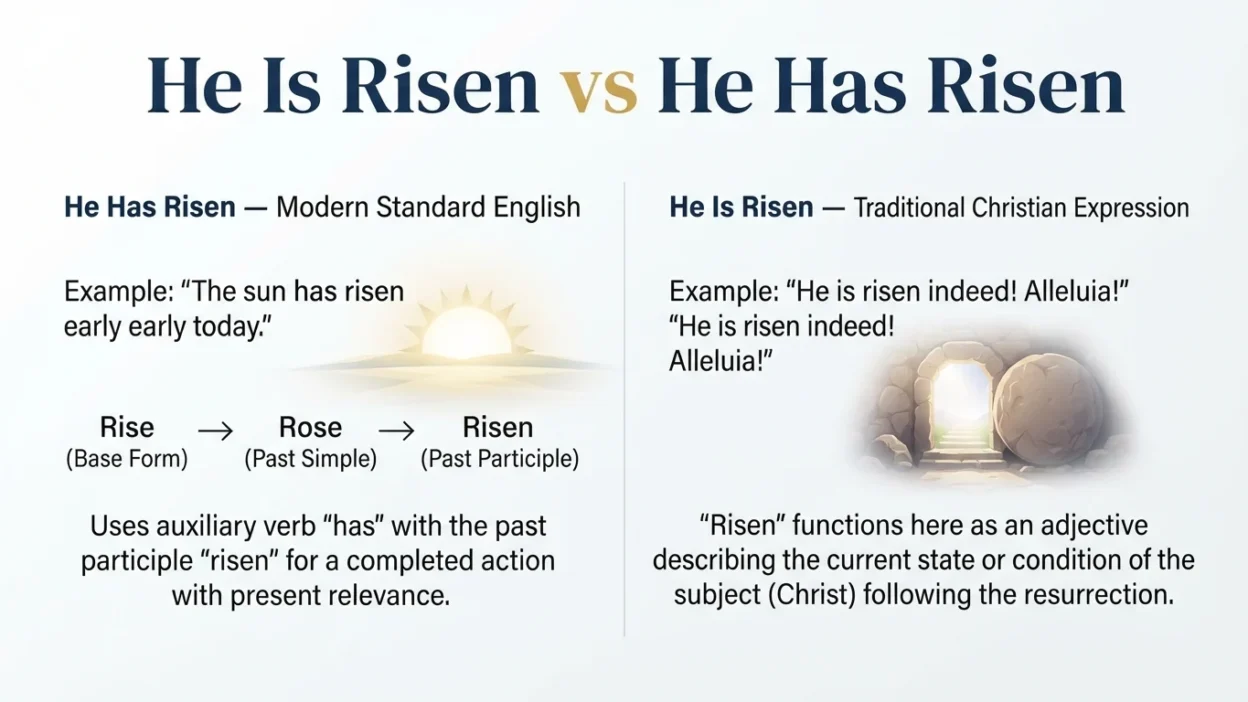
The confusion comes from the fact that risen is the past participle of rise.
The modern forms are:
- Rise → present
- Rose → simple past
- Risen → past participle
Normally, the past participle risen is used with have/has/had:
He has risen.
She has risen early.
They had risen before sunrise.
So why do we sometimes hear:
He is risen?
This is because “is risen” belongs to an older and traditional grammatical pattern that survives in certain expressions. It is particularly familiar from Christian religious language.
Therefore, the two expressions should not simply be treated as one being “correct” and the other being “wrong.”
“He Has Risen”
He has risen is the standard modern English construction.
It uses the present perfect tense:
has + past participle
The verb forms are:
rise → rose → risen
Therefore:
He has risen.
is grammatically parallel to:
She has gone.
He has arrived.
The sun has risen.
Meaning of “He Has Risen”
“He has risen” describes an action that has happened and has relevance to the present.
For example:
The sun has risen.
This means the sun rose earlier and is now above the horizon.
In a religious context:
He has risen.
means that he has risen from the dead, with the result being relevant now.
This is the normal modern grammatical construction.
“He Is Risen”
He is risen is a traditional construction that is strongly associated with Christian religious language.
It is especially familiar as the Easter proclamation:
He is risen!
In this expression, risen functions in a way that emphasizes the person’s state or condition—that he is now risen.
The expression has an intentionally traditional or biblical tone.
It is therefore completely appropriate in contexts where that traditional religious wording is intended.
Why Does “Is Risen” Sound Unusual?
To modern English speakers, “is risen” can sound unusual because we generally expect:
He has risen.
rather than:
He is risen.
Modern English usually uses have/has + risen to express the completed action.
However, older English used certain verbs of movement and change of state with forms of be in constructions that are now largely obsolete. Some traditional expressions preserve this older pattern.
That is why “He is risen” survives as a familiar religious phrase even though it is not the normal construction for everyday modern English.
Comparison Table
| Expression | Grammar | Meaning | Tone/Context |
|---|---|---|---|
| He has risen. | Present perfect | He rose and is now risen; the action has relevance to the present | Modern, standard English |
| He is risen. | Traditional/older construction | He is now in a risen state | Biblical, religious, traditional |
| He rose. | Simple past | He rose at a particular time in the past | Modern English |
| He was raised. | Passive voice | Someone/something raised him; in religious context, can refer to resurrection | Modern and religious contexts |
| He has been raised. | Present perfect passive | He has been raised, with present relevance | Modern English |
When to Use “He Has Risen”
Use “He has risen” when you want the normal modern English construction.
Everyday or Literal Examples
The sun has risen.
He has risen from his chair.
The leader has risen to the occasion.
The water has risen above the normal level.
The temperature has risen significantly.
These examples use has risen because rise is being used as a normal modern verb.
Religious Example
Christians believe that Jesus has risen from the dead.
This is grammatically standard modern English.
You could also write:
The message announces that Christ has risen.
Again, this is the modern present perfect construction.
When to Use “He Is Risen”
Use “He is risen” when you deliberately want the traditional religious expression.
It is especially associated with Easter and the Christian belief in the resurrection of Jesus Christ.
For example:
He is risen!
He is risen indeed!
These expressions have a long-established liturgical and religious use.
If you are writing a traditional Easter greeting, sermon, church message, religious card, or faith-based piece that intentionally uses traditional language, “He is risen” is appropriate.
Examples of “He Has Risen”
Here are examples showing the modern construction:
- He has risen from the dead.
- The sun has risen over the mountains.
- He has risen from his seat.
- The river has risen after several days of heavy rain.
- The temperature has risen dramatically.
- The athlete has risen to the challenge.
- The company has risen in value over the past year.
- He has risen above his difficult circumstances.
- The moon has risen over the horizon.
- He has risen early every morning this week.
Examples of “He Is Risen”
The traditional form is most commonly encountered in religious contexts:
- He is risen!
- He is risen indeed!
- Celebrate because He is risen.
- The Easter message proclaims, “He is risen.”
- The congregation repeated the words, “He is risen indeed.”
- The sermon focused on the truth that He is risen.
- The traditional Easter greeting begins, “He is risen!”
The capitalization of He in religious writing is a stylistic choice and may vary depending on the writer or tradition.
Common Mistakes
Mistake 1: Assuming “He Is Risen” Is Simply Wrong
It is not accurate to say that “He is risen” is simply incorrect.
It is a well-established traditional expression, particularly in Christian English.
However, it is not the normal modern construction for most uses of rise.
Mistake 2: Assuming “He Has Risen” Is Wrong Because “He Is Risen” Is Traditional
The opposite mistake is also common.
He has risen is grammatically correct modern English.
For example:
He has risen from the dead.
There is nothing grammatically wrong with this construction.
Mistake 3: Confusing “Rise” and “Raise”
Rise is normally intransitive, meaning the subject rises by itself.
The sun rises.
Raise is transitive, meaning someone or something raises another thing.
She raised her hand.
This distinction is important when discussing resurrection language.
Mistake 4: Using “Rosed”
The past tense of rise is rose, not “rised” or “rosed.”
Correct:
He rose from the ground.
Correct:
He has risen.
The three principal forms are:
rise → rose → risen
Memory Trick
Here is the easiest way to remember the modern grammar:
Rise → Rose → Risen
Think:
Today: rise
Yesterday: rose
Has/have: risen
Examples:
He rises early.
He rose early yesterday.
He has risen early today.
For the special religious expression, remember:
“He is risen” = traditional Easter language.
So:
👉 He has risen = modern standard grammar
👉 He is risen = traditional religious expression
American vs British English
There is no major American-versus-British spelling difference between “He is risen” and “He has risen.”
Both American and British English use:
He has risen.
as the normal modern present-perfect construction.
Both also recognize:
He is risen.
as a traditional Christian expression.
The difference is primarily style, grammatical history, and context, rather than American versus British English.
“He Is Risen” vs “He Has Risen” in Religious Writing
Religious writing often preserves older expressions that may sound unusual in contemporary everyday English.
This is not unique to “He is risen.” Religious texts and traditions frequently preserve historical vocabulary, sentence structures, and expressions.
Therefore, if you encounter:
He is risen!
in an Easter message, it should not be “corrected” automatically to:
He has risen!
The first expression carries a traditional religious character that is part of its meaning and cultural use.
On the other hand, if you are writing a modern explanatory article about the resurrection, “He has risen” may be the more natural grammatical choice.
Compare:
Traditional Easter greeting:
He is risen!
Modern explanatory sentence:
Christians believe that Jesus has risen from the dead.
Both can be appropriate because the contexts are different.
“He Has Risen” vs “He Rose”
These two expressions are also worth comparing.
He Rose
He rose is the simple past tense.
He rose early yesterday.
It refers to a completed action in the past.
He Has Risen
He has risen is the present perfect.
He has risen from the dead.
It describes a past event with significance or relevance to the present.
The same distinction appears in ordinary English:
The sun rose at 6:00 a.m.
versus:
The sun has risen.
The first focuses on the past event and its time. The second emphasizes the present result.
Is “He Is Risen” Biblical English?
“He is risen” is strongly associated with traditional Christian and biblical-style English, particularly the language surrounding the resurrection and Easter.
The expression has become an established part of Christian English and liturgical tradition.
However, it is useful to distinguish traditional religious language from ordinary modern English grammar. Modern English generally prefers has risen when forming the present perfect of rise.
Therefore, “He is risen” should be understood as a preserved traditional expression rather than as evidence that modern English normally uses is + risen for the present perfect.
Similar Expressions
He Has Risen
Modern standard construction.
He has risen from the dead.
He Rose
Simple past.
He rose early in the morning.
He Is Risen
Traditional religious expression.
He is risen!
He Was Raised
Passive construction.
He was raised from the dead.
He Has Been Raised
Present perfect passive.
He has been raised from the dead.
These expressions can have related meanings in religious contexts, but their grammatical structures and emphasis differ.
Final Verdict
Both “He has risen” and “He is risen” have legitimate uses, but they belong to different grammatical and stylistic contexts.
“He has risen” is the standard modern English form. It uses the present perfect construction has + risen and can be used for ordinary situations as well as modern religious writing.
“He is risen” is a traditional expression, especially associated with Christian Easter language. Although it may sound unusual according to modern English grammar, it is an established religious expression and should not be treated as a simple grammatical error.
The simplest rule:
Modern English → He has risen.
Traditional Easter/religious expression → He is risen.
Frequently Asked Questions
Is “He is risen” grammatically correct?
Yes, “He is risen” is an established traditional expression, especially in Christian religious language. It is not the usual modern present-perfect construction, but it has a recognized historical and religious use.
Is “He has risen” correct?
Yes. “He has risen” is the normal modern English present-perfect construction of the verb rise.
Which is more grammatically correct: “He is risen” or “He has risen”?
For ordinary modern English grammar, “He has risen” is the standard form. “He is risen” is a traditional construction preserved especially in Christian religious language.
Why do Christians say “He is risen”?
“He is risen” is a traditional Christian Easter expression that emphasizes the risen state of Christ and has been preserved through religious and liturgical language.
Can I say “He has risen from the dead”?
Yes. “He has risen from the dead” is grammatically correct modern English and is widely understandable in religious contexts.
Is “risen” a past tense verb?
No. Risen is the past participle of rise.
The forms are:
rise → rose → risen
For example:
He rose yesterday.
He has risen today.
What is the difference between “rise” and “raise”?
Rise means to move upward or get up without taking a direct object.
The sun rises.
Raise means to lift or move something upward.
She raised her hand.
What should I write in an Easter greeting?
If you want the traditional Christian expression, “He is risen!” is the familiar choice. A common traditional response is “He is risen indeed!”
Conclusion
The choice between “He is risen” and “He has risen” depends on context. In ordinary modern English, “He has risen” is the standard grammatical construction because the present perfect uses has + the past participle risen. It can describe everything from the rising sun to a person getting up or, in religious contexts, the resurrection.
“He is risen” has a special place in traditional Christian language. Although the construction is unusual from the perspective of modern everyday grammar, it is an established religious expression associated especially with Easter. Therefore, you should not automatically treat it as an error. If you are writing modern explanatory prose, choose “He has risen.” If you are using the traditional Easter proclamation, “He is risen!” is the appropriate expression.
Remember This
He has risen. ✅
Normal modern English.
He is risen. ✅
Traditional Christian/religious expression.
Rise → Rose → Risen
👉 Modern grammar: Has + risen
👉 Traditional Easter phrase: He is risen

A passionate linguist who specializes in word relationships and vocabulary building.
He has spent years studying synonyms and semantic patterns across languages.
Arman writes to make language learning simple, precise, and engaging.