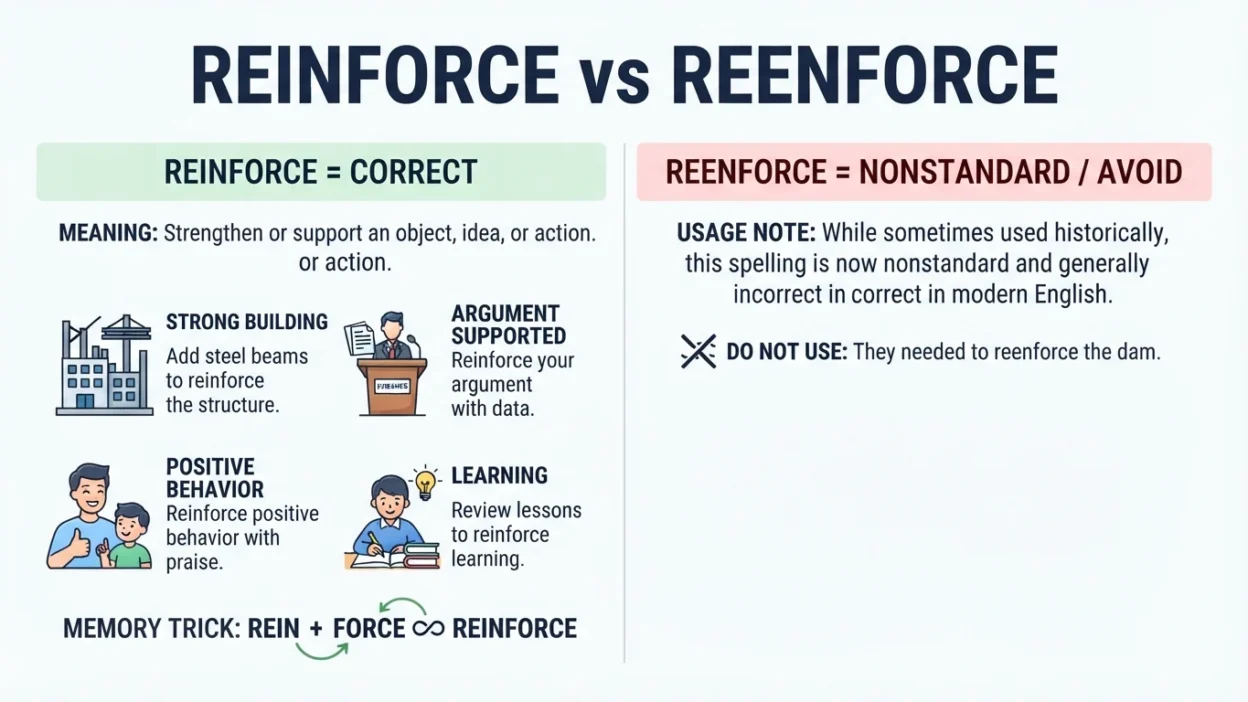
If you are unsure whether the correct spelling is reinforce or reenforce, you are dealing with a common English spelling confusion. The two forms look and sound similar, and the prefix re- can sometimes make English spelling feel unpredictable. However, in standard modern English, there is a clear answer: reinforce is the correct and standard spelling.
Reinforce means to strengthen, support, or make something more effective or powerful. It can describe physical structures, ideas, habits, arguments, beliefs, or people. Reenforce is generally considered a misspelling and should not be used in standard English. In this guide, you’ll learn the difference between reinforce vs reenforce, how to use reinforce correctly, common examples, frequent mistakes, and an easy memory trick.
Quick Answer
Reinforce is the correct spelling. It means to strengthen, support, or make something stronger or more effective. Reenforce is generally considered incorrect in modern standard English. Use reinforce in academic, professional, and everyday writing.
Why People Confuse It
The confusion comes from the pronunciation and the prefix re-.
People may assume that because reinforce begins with re-, it should be spelled:
❌ reenforce
But the standard spelling is:
✅ reinforce
The word is spelled with “rein”, not “reen.”
Remember:
REINFORCE
Not:
REENFORCE
The correct spelling contains “in” after the initial re.
Reinforce: Meaning and Usage
Reinforce is a verb meaning to strengthen, support, or make something more effective.
It can be used in both physical and abstract contexts.
Physical meaning
To make a structure stronger:
Steel beams were added to reinforce the bridge.
Abstract meaning
To strengthen an idea, belief, argument, or behavior:
The evidence reinforced her argument.
Positive feedback can reinforce good behavior.
Common meanings of reinforce
Reinforce can mean:
- Make physically stronger
- Strengthen an argument
- Support an idea
- Encourage a behavior
- Confirm an existing belief
- Make something more effective
- Provide additional support
Reenforce: Is It Correct?
In modern standard English, reenforce is generally treated as a misspelling or nonstandard variant of reinforce.
For formal writing, academic work, professional communication, and SEO content, use:
✅ reinforce
Avoid:
❌ reenforce
For example:
❌ The facts reenforce the conclusion.
✅ The facts reinforce the conclusion.
Comparison Table
| Word | Correct? | Meaning | Example |
|---|---|---|---|
| Reinforce | ✅ Yes | Strengthen or support | The evidence reinforces the argument. |
| Reenforce | ❌ Generally nonstandard | Intended as “reinforce” | Avoid this spelling. |
When to Use “Reinforce”
Use reinforce when something is being strengthened, supported, or made more effective.
Physical structures
The workers reinforced the wall.
Arguments
These findings reinforce the researcher’s conclusion.
Ideas
The example reinforces the importance of education.
Behavior
Rewards can reinforce positive behavior.
Beliefs
The experience reinforced his belief in hard work.
Skills
Regular practice reinforces what students have learned.
Examples of Reinforce
Here are 12 useful examples:
- The workers added steel to reinforce the bridge.
- The evidence reinforced her argument.
- Teachers use practice exercises to reinforce new skills.
- The experience reinforced his confidence.
- Positive feedback can reinforce good habits.
- The walls were strengthened to reinforce the building.
- The study reinforces the importance of regular exercise.
- The manager’s comments reinforced the company’s values.
- Repetition helps reinforce important concepts.
- The new evidence reinforced their original conclusion.
- Extra support was added to reinforce the structure.
- The campaign was designed to reinforce the brand’s message.
Common Mistakes
Mistake 1: Writing “reenforce”
❌ The evidence reenforces the theory.
✅ The evidence reinforces the theory.
The standard spelling is reinforce.
Mistake 2: Writing “reenforced”
❌ The structure was reenforced.
✅ The structure was reinforced.
The past tense is formed by adding -d:
reinforce → reinforced
Mistake 3: Writing “reenforcing”
❌ The program is reenforcing good habits.
✅ The program is reinforcing good habits.
The correct form is:
reinforcing
Mistake 4: Adding an extra “e”
The most common spelling error is inserting an extra e:
❌ re-enforce
❌ reenforce
✅ reinforce
For standard modern English, remember the single-word spelling reinforce.
Memory Trick
Here’s a simple way to remember the spelling:
Think “REIN”
The word begins with:
REIN + FORCE
Just like a rein is used to control or guide a horse, remember:
REIN + FORCE = REINFORCE
Another trick is:
Force makes something stronger.
So connect:
REIN + FORCE → REINFORCE
The key spelling is:
R-E-I-N-F-O-R-C-E
Not:
R-E-E-N-F-O-R-C-E
American vs British English
Reinforce is the standard spelling in both American English and British English.
There is no meaningful American-versus-British spelling difference here.
Examples:
American English:
The evidence reinforces the argument.
British English:
The evidence reinforces the argument.
Both use reinforce.
Similar Words
Several words have a similar meaning to reinforce.
Strengthen
To make something stronger.
The training strengthened her skills.
Support
To help hold something up or provide assistance.
The evidence supports his claim.
Fortify
To make something stronger, especially a structure or defense.
The walls were fortified.
Bolster
To support or improve something.
The new evidence bolstered the argument.
Encourage
To give someone confidence or motivation.
Her teacher encouraged her to continue.
Confirm
To establish that something is true or correct.
The results confirmed the original theory.
These words can overlap with reinforce, but they are not always interchangeable.
FAQs
Is “reinforce” or “reenforce” correct?
Reinforce is the standard and preferred spelling. Reenforce should generally be avoided in modern standard English.
Is “reenforce” a real word?
You may encounter reenforce in some historical or variant usage, but reinforce is the standard spelling used in contemporary English.
What does reinforce mean?
Reinforce means to strengthen, support, encourage, or make something more effective.
What is the past tense of reinforce?
The past tense is reinforced.
The evidence reinforced the conclusion.
Is “reinforcing” correct?
Yes.
The teacher is reinforcing the lesson through practice.
What is the noun form of reinforce?
The noun is reinforcement.
The students need additional reinforcement of the new concepts.
How do you remember reinforce?
Remember:
REIN + FORCE = REINFORCE
The spelling contains “rein,” not “reen.”
Final Verdict
The correct spelling is reinforce, not reenforce, when writing in modern standard English. Reinforce means to strengthen, support, confirm, or make something more effective. It can describe everything from physical structures to arguments, habits, skills, beliefs, and evidence.
If you are writing an essay, article, email, report, or professional document, choose reinforce. The easiest way to remember the spelling is to break it into REIN + FORCE. Once you recognize that pattern, reinforce, reinforced, reinforcing, and reinforcement become much easier to spell correctly.
Remember This
✅ REINFORCE = Correct
❌ REENFORCE = Generally incorrect/nonstandard
Think:
REIN + FORCE = REINFORCE
Related forms:
- Reinforce
- Reinforced
- Reinforcing
- Reinforcement
Conclusion
Reinforce vs reenforce is primarily a spelling question, and the standard answer is straightforward: reinforce is the form you should use in modern English. It means to make something stronger, provide support, or strengthen an idea, behavior, argument, or structure.
Don’t let the pronunciation lead you toward reenforce. Instead, remember the spelling REINFORCE and its related forms. Whether you’re discussing a reinforced building, reinforcing a lesson, or evidence that reinforces an argument, reinforce is the reliable choice.

An expert in English grammar and expressive writing techniques.
She focuses on helping readers expand their vocabulary with clarity.
Elina believes the right word can transform ordinary writing into powerful communication.