Are you wondering whether the correct word is extensible or extendible? These two words are closely related, and both are legitimate English words. The confusion comes from their similar spelling and meaning. In many contexts, they can both describe something that can be extended, expanded, or made larger.
However, extensible is generally the more common choice, especially when discussing software, systems, designs, frameworks, and things that can be expanded with additional features. Extendible is also correct and is often used when emphasizing that something can physically or practically be extended in length, size, or scope. Understanding the difference in usage can help you choose the most natural word for your sentence.
Quick Answer: Extensible vs Extendible
Both extensible and extendible are correct English words. Extensible usually means capable of being extended, expanded, or enhanced, especially in technical contexts. Extendible also means capable of being extended, but it is less common and often focuses more directly on something that can be physically or practically lengthened or enlarged. In modern technical writing, extensible is often preferred.
Why Do People Confuse “Extensible” and “Extendible”?
The confusion is understandable because both words come from the verb extend and contain the same basic idea: something can be extended.
Compare:
The software has an extensible architecture.
and:
The table has an extendible section.
Both sentences describe something that can be expanded or extended, but the contexts differ.
The suffixes -able and -ible can create similar adjectives in English, and there is no simple rule that always tells you which one to choose. This is why it is useful to learn the established usage of each word rather than relying only on spelling rules.
What Does “Extensible” Mean?
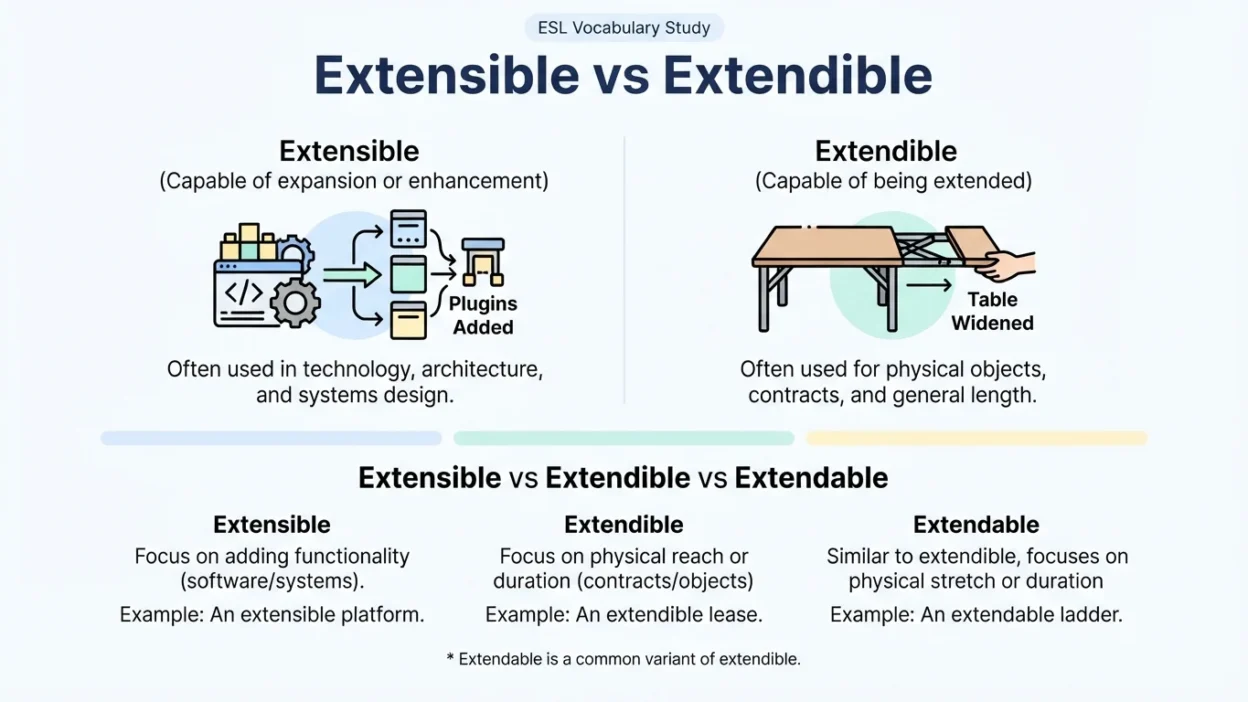
Extensible means capable of being extended, expanded, enlarged, or developed further.
It is especially common when discussing systems that can accept additions or modifications.
Examples
- The software uses an extensible architecture.
- The platform is highly extensible.
- We need an extensible framework for future development.
- The design is flexible and extensible.
In technology, extensible often suggests that something was designed so that new features, components, functions, or capabilities can be added without completely replacing the existing system.
Common technical phrases
- extensible software
- extensible architecture
- extensible framework
- extensible platform
- extensible system
- extensible design
- extensible API
- extensible markup
For example:
The framework provides an extensible structure for developers.
This means developers can build additional functionality onto the existing framework.
What Does “Extendible” Mean?
Extendible also means capable of being extended.
It can describe something that can be made longer, larger, broader, or more extensive.
Examples
- The table has an extendible surface.
- The contract is extendible for another year.
- The ladder has an extendible section.
- The deadline is extendible under certain conditions.
The word is perfectly legitimate, but it is generally less common than extensible.
In some contexts, extendable may also be more natural than either word.
Extensible vs Extendible: Comparison Table
| Feature | Extensible | Extendible |
|---|---|---|
| Correct English word | ✅ Yes | ✅ Yes |
| Basic meaning | Capable of being extended | Capable of being extended |
| Commonness | More common | Less common |
| Technical/software usage | Very common | Less common |
| Physical extension | Can be used | Can be used |
| System expansion | Very natural | Less common |
| Software architecture | Preferred | Uncommon |
| Can describe something lengthened | Yes | Yes |
| Standard spelling | Yes | Yes |
When to Use “Extensible”
Use extensible when talking about something that can be expanded, enhanced, or developed by adding new elements.
It is particularly natural in technical and computing contexts.
Technology
The software is designed to be extensible.
Architecture
The system has an extensible architecture.
Frameworks
Developers can create plugins for the extensible framework.
Design
The platform has an extensible design that supports future features.
General use
The model is extensible to other situations.
A useful association is:
Extensible → expansion, flexibility, systems, features
When to Use “Extendible”
Use extendible when you specifically want to describe something that can be extended.
For example:
The table is extendible.
This suggests that the table can be made longer or larger.
Another example:
The agreement is extendible for an additional six months.
Here, the period of the agreement can be extended.
However, depending on the sentence, extendable may sound more natural:
The agreement is extendable for another six months.
So while extendible is correct, it is not always the most common or natural choice.
Examples of Extensible
- The software has an extensible architecture.
- The platform is highly extensible.
- We need an extensible system for future development.
- The framework is designed to be extensible.
- The application has an extensible plugin system.
- This model is extensible to other industries.
- The API provides an extensible interface.
- The design should remain flexible and extensible.
- The database system uses an extensible structure.
- The company created an extensible technology platform.
Examples of Extendible
- The dining table has an extendible center section.
- The contract is extendible under certain conditions.
- The ladder has an extendible design.
- The deadline is extendible with approval.
- The warranty period is extendible.
- The pole has an extendible section.
- The agreement is extendible for another year.
- The structure has an extendible frame.
- The payment period may be extendible.
- The plan is extendible if additional funding becomes available.
Common Mistakes
Mistake 1: Assuming “extendible” is incorrect
❌ “Extendible is always wrong.”
That is not true.
Extendible is a legitimate English word. It simply occurs less frequently than extensible in many modern contexts.
Mistake 2: Using “extensible” for everything
Although extensible is common, it may not always be the most natural choice.
For example:
The table is extensible.
This is understandable, but extendable or extendible may sound more natural if you are specifically talking about physically making the table longer.
Mistake 3: Treating the words as completely interchangeable
They overlap in meaning, but usage and context matter.
Extensible is especially common for systems, software, frameworks, and structures that can accommodate additions.
Extendible can focus more directly on the possibility of extension itself.
Extensible vs Extendible vs Extendable
A third word is worth mentioning: extendable.
All three words can relate to something that can be extended, but their typical usage differs.
| Word | Typical Use |
|---|---|
| Extensible | Systems, software, frameworks, concepts, designs |
| Extendible | Something capable of being extended; less common |
| Extendable | General situations where something can be extended |
For example:
The software is extensible.
The contract is extendable.
The table is extendible.
These are tendencies rather than absolute rules.
Which Is More Common: Extensible or Extendible?
Extensible is generally more common, especially in modern technical and computing vocabulary.
You are likely to see phrases such as:
- extensible architecture
- extensible framework
- extensible platform
- extensible software
- extensible system
Extendible is less frequent but remains a valid word.
Therefore, if you are writing about technology, software, APIs, frameworks, or systems, extensible will usually be the more natural choice.
American vs British English
There is no major American-versus-British spelling difference between extensible and extendible.
Both forms can be found in American and British English.
The bigger difference is usually context and frequency, rather than regional spelling.
In modern technology writing, extensible is particularly common in both varieties of English.
Memory Trick
Use this simple association:
EXTENSIBLE → EXTENSION + FLEXIBILITY
Think about software or systems that can grow by adding new features.
An extensible platform can grow.
For extendible, think:
Something is extendible if it can be extended.
The important thing is not to assume that extendible is a spelling mistake. It is a real word.
Similar Words
Here are several related words:
Extend
The verb meaning to make something longer, larger, or broader.
We decided to extend the deadline.
Extension
The act or result of extending something.
We requested an extension.
Extendable
Something that can be extended.
The deadline is extendable.
Expandable
Something that can be made larger or broader.
The storage system is expandable.
Flexible
Something that can adapt or change.
We need a flexible system.
Scalable
Something that can grow to handle increased demands.
The company needs a scalable platform.
Final Verdict: Extensible vs Extendible
Both extensible and extendible are correct English words, so this is not a simple case of one being right and the other being wrong.
Extensible is the more common choice, particularly when describing software, technology, systems, frameworks, architectures, and designs that can be expanded with additional features or capabilities.
Extendible is also correct and means capable of being extended. It is less common and may be suitable when talking about something that can be physically or practically lengthened, enlarged, or continued. In some everyday contexts, extendable may sound more natural.
FAQs
1. Is extensible or extendible correct?
Both are correct. Extensible is generally more common, especially in technical contexts, while extendible is less common but still standard.
2. Is extensible more common than extendible?
Yes. Extensible is particularly common in computing, software, architecture, and system design.
3. What does extensible mean?
Extensible means capable of being extended, expanded, enhanced, or developed further.
4. What does extendible mean?
Extendible means capable of being extended. It can refer to something that can be made longer, larger, broader, or continued.
5. Is extendible a real word?
Yes. Extendible is a legitimate English adjective. It is simply less common than extensible in many contexts.
6. Should I use extensible in technical writing?
Usually, yes, when discussing software, systems, frameworks, APIs, architectures, or platforms that can be expanded with additional functionality.
7. Is extendable also correct?
Yes. Extendable is also a standard word meaning capable of being extended. In some general contexts, it may be the most natural option.
Conclusion
Extensible and extendible are both legitimate English words with closely related meanings. The main difference is not correctness but usage and frequency. Extensible is especially common when describing software, technology, systems, frameworks, and designs that can accommodate additional features or capabilities.
Extendible can also mean capable of being extended, but it is less common. If you are writing about a physical object, deadline, contract, or other thing that can be lengthened or continued, extendible may work, although extendable is often another natural choice. When writing about software or technical systems, extensible is usually the more familiar term.
Remember This
Extensible = capable of expansion or enhancement, especially systems and technology.
Extendible = capable of being extended; valid but less common.
Extendable = another common option for something that can be extended.
Examples:
- ✅ Extensible software
- ✅ Extensible architecture
- ✅ Extendible contract
- ✅ Extendible table
- ✅ Extendable deadline
The right choice depends on the context, but extensible is generally the more common modern choice.

A passionate linguist who specializes in word relationships and vocabulary building.
He has spent years studying synonyms and semantic patterns across languages.
Arman writes to make language learning simple, precise, and engaging.