Are you confused about whether to write “soo” or “so”? This is a common question, especially in texting, social media, casual conversations, and informal online writing. Although the two forms look almost identical, so is the standard English word, while soo is generally an informal or nonstandard spelling.
The word so has many important uses in English. It can express degree, describe a result, introduce a reason or purpose, or show agreement. On the other hand, soo is sometimes used intentionally online to stretch the pronunciation of “so,” create emphasis, or imitate a particular tone. Knowing when each form is appropriate will help you communicate clearly and choose the right spelling for formal and informal situations.
Quick Answer: Soo vs So
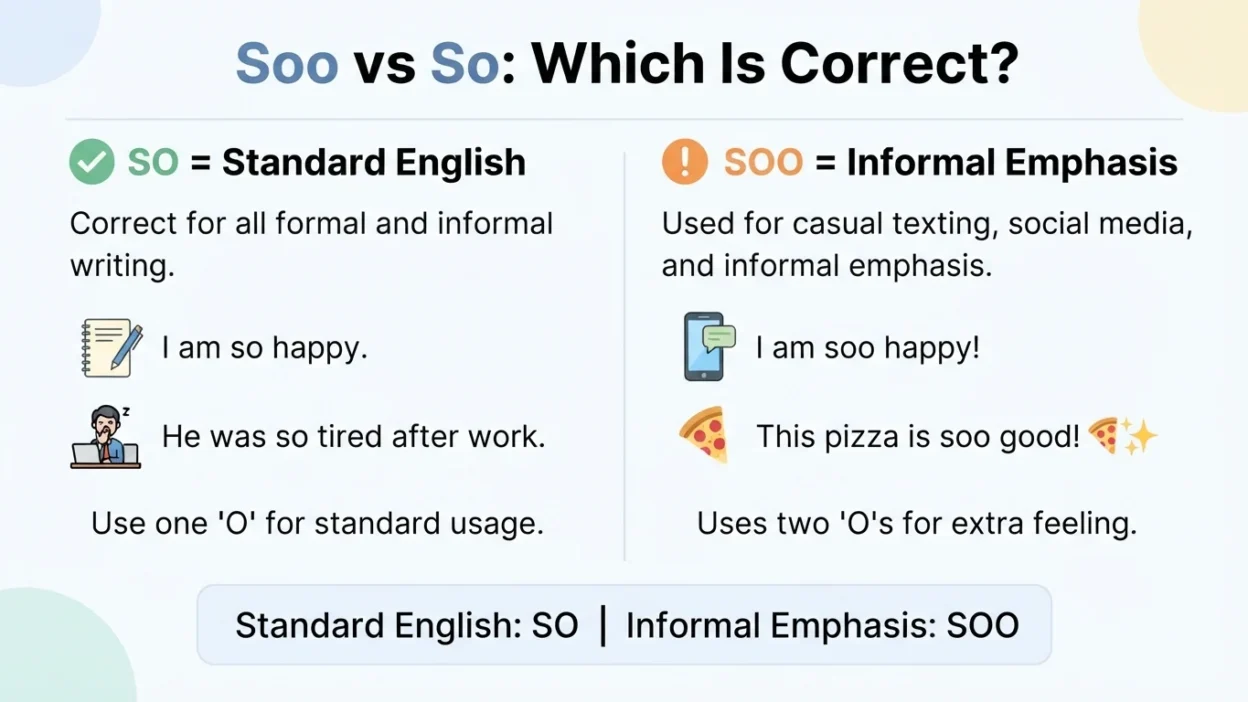
So is the standard and correct spelling in English. Soo is generally not considered standard English, but it may appear in texting, social media, memes, or casual online communication to emphasize the word “so.” For school, work, academic writing, and professional communication, use so.
Why Do People Confuse “Soo” and “So”?
People often write soo because they want to make the word sound longer or more dramatic.
For example:
I am so tired.
In casual texting, someone might write:
I am soo tired!
The extra o is being used for emphasis rather than because soo is the standard spelling.
This is similar to informal spellings such as:
- sooooo
- sooo
- yesss
- nooo
- pleeease
These spellings communicate emotion or exaggeration, but they are not normally appropriate in formal English.
What Does “So” Mean?
So is a standard English word with several meanings and grammatical functions.
1. “So” Can Mean “Very” or “To Such a Degree”
She is so happy.
The movie was so interesting.
Here, so emphasizes the degree of an adjective or adverb.
2. “So” Can Show a Result
It was raining, so we stayed home.
Here, “so” means therefore or as a result.
3. “So” Can Express Agreement
“I love this song.”
“So do I.”
Here, “so” means that the same statement is true for the speaker.
4. “So” Can Mean “In This Way”
Hold the box so.
Here, “so” means in this manner.
5. “So” Can Introduce Purpose
I left early so I could catch the bus.
In this construction, “so” helps express a purpose or intended result.
What Does “Soo” Mean?
Soo is generally not the standard spelling of the ordinary English word so.
However, you may see soo in informal digital communication. Writers sometimes add an extra “o” to show:
- emphasis
- excitement
- frustration
- exaggeration
- affection
- dramatic pronunciation
- a playful tone
For example:
That dress is soo pretty!
The writer does not mean that “soo” is a different English word. They are simply stretching so for emotional effect.
In formal writing, change it to:
That dress is so pretty!
Soo vs So: Comparison Table
| Feature | So | Soo |
|---|---|---|
| Standard English spelling | ✅ Yes | ❌ No |
| Common in formal writing | ✅ Yes | ❌ No |
| Common in texting | ✅ Yes | ✅ Sometimes |
| Used for emphasis online | Sometimes | Often |
| Standard dictionary word for this meaning | ✅ Yes | Generally no |
| Appropriate for academic writing | ✅ Yes | ❌ No |
| Appropriate for professional writing | ✅ Yes | ❌ No |
| Main purpose | Meaning and grammar | Informal emphasis/style |
When to Use “So”
Use so in virtually all standard English writing.
In everyday sentences
I am so tired today.
In academic writing
The results were so significant that further research was recommended.
In professional writing
The meeting was canceled, so we will reschedule it.
In formal communication
Please let me know so I can assist you.
In casual conversations
That was so funny!
The important point is that so works in both formal and informal English.
When Can You Use “Soo”?
You can use soo in highly informal contexts when you intentionally want to stretch the sound of “so.”
For example:
I am soo excited!
That puppy is soo cute!
You are soo lucky!
This type of spelling is common in:
- text messages
- social media
- online comments
- memes
- chats
- playful conversations
However, it should be understood as a stylistic spelling, not the standard form.
For professional emails, essays, assignments, reports, resumes, and formal documents, use so.
Examples: So vs Soo
Here are examples showing how the two forms differ in practical usage.
- ✅ She is so kind.
- ❌ She is soo kind. (informal emphasis only)
- ✅ I was so surprised.
- Soo can appear in texting: “I was soo surprised!”
- ✅ The weather was cold, so we stayed inside.
- ✅ He was so excited about the trip.
- Informally: “He was soo excited!”
- ✅ Please speak slowly so everyone can understand.
- ✅ The test was so difficult.
- Informally: “That test was soo difficult!”
- ✅ I was so happy to see you.
- Informally: “I was soo happy to see you!”
The standard form remains so in every example.
Common Mistakes
Mistake 1: Using “soo” in formal writing
❌ I am soo grateful for this opportunity.
✅ I am so grateful for this opportunity.
Mistake 2: Thinking “soo” is a separate standard word
In most ordinary English contexts, soo is not an alternative spelling that should replace so.
Mistake 3: Using “soo” in academic assignments
❌ The experiment was soo successful.
✅ The experiment was so successful.
Academic writing should use standard spelling.
Mistake 4: Assuming extra letters make a sentence grammatically stronger
Writing:
She is soooo beautiful!
can add emotion in a text message, but it does not make the sentence more grammatically correct.
The standard form is:
She is so beautiful.
Is “Soo” Ever Correct?
There are some contexts where Soo can appear as a proper name or part of a proper noun. For example, Soo may occur in names or place names.
That is different from using soo as an informal spelling of so.
Therefore, context matters. If you simply want to express the standard English word meaning “very,” “therefore,” or “in this way,” use so.
So vs Soo in Texting
Texting and social media have changed the way people use spelling.
Online, people often intentionally modify words to express emotion:
- so → sooo
- no → nooo
- yes → yesss
- please → pleeease
- wow → wowww
These forms can make a message feel more emotional or playful.
For example:
“I missed you sooo much!”
This sounds more expressive than:
“I missed you so much!”
Both communicate the same basic idea, but the first uses nonstandard spelling for emotional emphasis.
American vs British English
There is no meaningful American-versus-British difference between so and soo in standard English.
Both American English and British English use so as the standard spelling.
For example:
American English:
It was so cold yesterday.
British English:
It was so cold yesterday.
The informal spelling soo can appear online in either variety, but it is not a standard American or British spelling.
Similar Words
Depending on the meaning, so can sometimes be replaced by different words or phrases.
| Meaning of “So” | Similar word or phrase | Example |
|---|---|---|
| Very | Extremely | She was extremely happy. |
| Therefore | Therefore | It was late; therefore, we left. |
| As a result | Consequently | It rained; consequently, the game was canceled. |
| In this way | Thus | Hold it thus. |
| To such a degree | That much | I didn’t know it was that much harder. |
| For that reason | Therefore | He was sick, so he stayed home. |
However, these alternatives are not interchangeable in every sentence. So is often the most natural choice in everyday English.
“So” vs “Soo” in Formal and Informal English
| Situation | Recommended Form |
|---|---|
| School assignment | So |
| University essay | So |
| Business email | So |
| Resume | So |
| Formal report | So |
| News article | So |
| Everyday conversation | So |
| Text message | So or informal soo |
| Social media caption | So or stylistic soo |
| Meme | Soo can be used stylistically |
The key is to match your spelling to your audience and purpose.
Memory Trick
Remember:
SO = Standard English
If you are writing something that needs correct spelling, choose so.
Think:
One extra O = extra emotion.
So:
- so = standard
- soo = informal emphasis
If you are writing an essay, email, article, or professional message, stick with so.
Final Verdict: Soo or So?
For standard English, so is the correct spelling.
Use so when you mean “very,” “therefore,” “in this way,” or when it functions as part of a grammatical construction.
Soo is generally an informal internet spelling used to stretch the pronunciation of “so” and add emotion or emphasis. It can be perfectly understandable in casual texting or social media, but it should not replace so in formal, academic, or professional writing.
FAQs
1. Is “soo” a correct English word?
In ordinary usage, soo is not the standard spelling of so. It may be used informally online to create emphasis or exaggeration.
2. Is it “so” or “soo”?
Use so in standard English. Use soo only when intentionally using informal, expressive spelling.
3. Can I use “soo” in a text message?
Yes. In casual texting, soo can be used to make the word sound longer or more emotional.
4. Is “soo” grammatically wrong?
As a standard spelling of the word so, yes, it is nonstandard. However, informal online writing often intentionally uses nonstandard spellings for emotional effect.
5. Can I use “soo” in an essay?
It is best to use so. Academic and formal writing should follow standard English spelling.
6. What does “soo” mean in texting?
In texting, soo usually means so, with the extra “o” adding emphasis, excitement, affection, or exaggeration.
7. Is “so” the same in American and British English?
Yes. So is the standard spelling in both American and British English.
Conclusion
The difference between soo and so is mainly about standard spelling versus informal expression. So is the correct standard English word and can be used in everything from casual conversations to academic and professional writing. It can express degree, result, purpose, agreement, or manner depending on the sentence.
Soo, on the other hand, is generally an informal stylistic spelling. People use it online to stretch the pronunciation and communicate extra emotion, such as excitement or exaggeration. It can work in a playful text or social media post, but it should not be used as the standard spelling in formal writing.
Remember This
SO = standard English
SOO = informal/emotional spelling
- ✅ I am so happy.
- ❌ I am soo happy. (in formal writing)
- 💬 “I am soo happy!” (fine as playful texting)
When in doubt, always choose so.

An expert in English grammar and expressive writing techniques.
She focuses on helping readers expand their vocabulary with clarity.
Elina believes the right word can transform ordinary writing into powerful communication.