Choosing between “team which,” “team who,” and “team that” can be confusing because the word team refers to a group of people, while grammatically it is a collective noun. The relative pronoun you choose depends on whether you are focusing on the people in the team, the team as a group or unit, and the style of English you are using.
In everyday English, “the team that” is often the safest and most natural choice. “The team who” is also widely used when the sentence emphasizes the individual people who make up the team. “The team which” can be grammatically acceptable, particularly when treating the team as an organization or unit, but it is often less natural when the team clearly refers to people. Understanding this distinction will help you choose the right relative pronoun confidently.
Quick Answer: Team Which, Team Who, or Team That?
All three forms can occur, but they are not equally natural in every context. That is a versatile choice for a team and works well in defining relative clauses. Who is commonly used when emphasizing the people on the team. Which can be used when treating the team as a group, organization, or unit, although that is often more natural in everyday English.
Why Do People Confuse “Team Which,” “Team Who,” and “Team That”?
The confusion comes from the fact that team is a collective noun.
A team consists of people, but the word team itself names a group.
Compare:
The team that won the match celebrated afterward.
The team who won the match celebrated afterward.
The team which won the match celebrated afterward.
The first sentence is a very natural standard construction. The second is common when the speaker thinks about the team members as people. The third treats the team more like a single group or organization.
The choice can therefore depend on both grammar and meaning.
What Does “Team That” Mean?
That is a relative pronoun that can refer to people or things in defining relative clauses.
Because of this flexibility, that works particularly well with collective nouns such as team.
Examples
The team that won the championship trained every day.
We thanked the team that helped us.
The team that finished first received the trophy.
Here, that introduces information identifying which team you mean.
Why “that” is useful
It avoids having to decide whether the team should be treated as people or as a group.
For this reason, the team that is often a safe and natural construction.
What Does “Team Who” Mean?
Who is normally used for people.
Because a team is made up of people, speakers often use who when their focus is on the individual members.
For example:
The team who worked on the project deserves recognition.
This construction is common, especially in informal and conversational English.
However, some traditional grammar approaches prefer that or which after a collective noun such as team, arguing that the grammatical head is the group noun rather than the individual members.
A clearer alternative, when you want to emphasize the people, is:
The team members who worked on the project deserve recognition.
This removes the ambiguity completely.
What Does “Team Which” Mean?
Which is normally used for things and animals, although it can also refer to organizations, institutions, groups, or other nonhuman entities.
Therefore, which can be used with team when the team is viewed as a group or organizational unit.
For example:
The team, which was founded in 1995, has a long history.
Here, which refers to the team as an organization or group.
Notice the comma. This is a nonrestrictive relative clause, meaning the information is additional rather than necessary to identify the team.
Another example:
The team, which had already qualified, rested its best players.
In this sentence, which refers to the team as a collective unit.
Team That vs Team Who vs Team Which: Comparison Table
| Expression | Typical use | Naturalness |
|---|---|---|
| Team that | Identifying a particular team; defining information | Very natural |
| Team who | Emphasizing team members as people | Common, especially informal |
| Team which | Treating the team as a group/organization | Correct in suitable contexts |
| Team members who | Clearly referring to individual people | Very clear |
Simple rule
Team + that → safe general choice
Team + who → focus on people
Team + which → focus on the group or organization
When to Use “Team That”
Use that when the relative clause is essential to identifying the team.
The team that won the final received a trophy.
The phrase “that won the final” tells us which team you mean.
More examples:
- The team that scored first eventually lost.
- I support the team that plays in our city.
- The team that completed the project received an award.
- We interviewed the team that developed the software.
That is especially useful when you want a straightforward, neutral sentence.
When to Use “Team Who”
Use who when the focus is on the people who make up the team.
The team who worked all night deserves credit.
This treats the team members as people rather than focusing purely on the team as an organizational unit.
However, for maximum clarity in formal writing, you can say:
The team members who worked all night deserve credit.
This is often better when the individual people are the real subject of the description.
Examples
- The team who helped us was extremely professional.
- The team who designed the product deserves recognition.
- The team who worked on the project stayed late.
- The team who organized the event did an excellent job.
In conversational English, these constructions are common.
When to Use “Team Which”
Use which when team is being treated as a group, organization, or unit, particularly in a nonrestrictive clause.
Our team, which was formed last year, has already won several awards.
Here, the clause “which was formed last year” gives additional information about the team.
Another example:
The national team, which includes several young players, is preparing for the tournament.
Which is particularly natural when the team is being discussed as an entity.
Examples: Team That, Team Who, and Team Which
With “that”
- The team that won the match celebrated afterward.
- We congratulated the team that completed the project.
- The team that scored the final goal won.
- She joined the team that manages the campaign.
With “who”
- The team who helped us was very friendly.
- The team who developed the app received an award.
- The team who organized the event worked hard.
- The team who represented the school performed well.
With “which”
- Our team, which was established in 2020, has grown quickly.
- The team, which includes several experts, completed the project.
- The national team, which had trained for months, won the competition.
- The team, which was originally small, now has dozens of members.
Common Mistakes
Mistake 1: Thinking “who” is always wrong after “team”
That is too strict.
Because a team consists of people, who is widely used when the writer is focusing on the members.
However, team members who is often clearer.
Mistake 2: Thinking “which” is always wrong after “team”
That is also incorrect.
Which can appropriately refer to a team when the team is being treated as a group, organization, or entity.
The team, which was founded in 2010, has a strong reputation.
Mistake 3: Using “which” when you clearly mean the people
If your sentence is specifically about individual members, who is often more natural.
Instead of:
The team which worked on the project deserves credit.
you could write:
The team members who worked on the project deserve credit.
Mistake 4: Ignoring commas
There is an important difference between:
The team that won the match celebrated.
and:
The team, which won the match, celebrated.
The first identifies the team. The second adds extra information about an already identified team.
Defining vs Non-Defining Relative Clauses
This distinction is especially important.
Defining clause
A defining clause provides information needed to identify the noun.
The team that won the final received the trophy.
There are no commas.
Non-defining clause
A non-defining clause provides additional information.
Our team, which won the final, received the trophy.
Commas are used.
In standard written English, that is generally not used to introduce a non-defining relative clause.
So:
❌ Our team, that won the final, received the trophy.
✅ Our team, which won the final, received the trophy.
Team Who vs Team Members Who
If you want to make your sentence especially clear, team members who is an excellent option.
Compare:
The team who designed the system received an award.
with:
The team members who designed the system received an award.
The second sentence clearly identifies the people rather than the team as a single unit.
This can be especially useful in formal, academic, business, and professional writing.
American vs British English
Both American and British English use that, who, and which with collective nouns, but usage can vary depending on whether the speaker conceptualizes the group as a unit or as individual people.
British English sometimes gives more flexibility to collective nouns when considering the members individually, particularly with plural agreement:
The team are preparing for the match.
American English more commonly treats collective nouns such as team as singular:
The team is preparing for the match.
This difference can influence how speakers choose relative pronouns, but it does not create a strict rule that “who” belongs to British English and “that” belongs to American English.
A Simple Way to Choose
Ask yourself what you are talking about.
Are you identifying which team?
Use that:
The team that won the match.
Are you emphasizing the people?
Use who:
The team who worked on the project.
Or, for maximum clarity:
The team members who worked on the project.
Are you adding information about an established team as a group?
Use which:
The team, which was founded in 2015, has expanded.
This three-question method makes the choice much easier.
Similar Expressions
The same idea applies to other collective nouns.
Company
The company that developed the software…
The company which developed the software…
Organization
The organization that supports the program…
The organization which supports the program…
Group
The group that organized the event…
The group who organized the event…
For individual people, however, who is the clearest choice:
The employees who organized the event…
Final Verdict: Team Which, Team Who, or Team That?
There is no single form that works in every sentence.
The team that is a versatile and natural choice, especially when the relative clause identifies which team you mean. The team who is also common when the writer focuses on the people who make up the team, although team members who can make this meaning clearer. The team which is appropriate when the team is treated as a group, organization, or entity, particularly in non-defining clauses.
For everyday writing, that is often the easiest neutral choice. When you specifically mean the individual people, who is useful. When you are adding information about an already identified team as a group, which is often the natural choice.
FAQs
1. Is it “the team who” or “the team that”?
Both can be used. The team that is a common neutral choice, while the team who emphasizes the people who make up the team.
2. Is “the team which” grammatically correct?
Yes. Which can refer to a team when the team is treated as a group or organization, especially in a non-defining relative clause.
3. Which is safest: team who, team which, or team that?
That is often the safest general choice in a defining relative clause.
4. Can I say “the team who won”?
Yes. This construction is common because a team consists of people. In formal writing, the team members who won can be even clearer if you mean the individual members.
5. Can I say “the team which won”?
Yes, depending on the sentence. It is particularly natural when the team is viewed as an organization or group. For a defining clause, many writers may prefer that.
6. Should I use “who” for people?
Generally, yes. Who is the standard relative pronoun for people. With collective nouns such as team, usage is more flexible because the noun refers to a group of people.
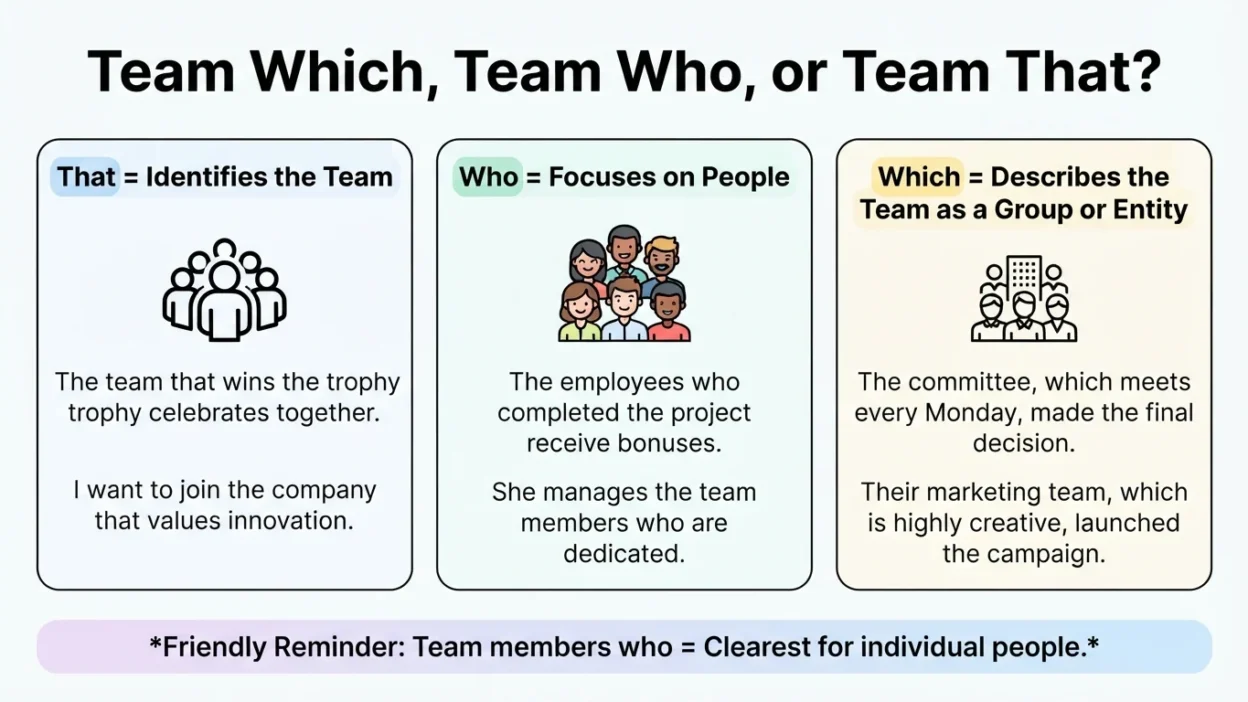
7. What is the easiest rule to remember?
Remember:
That = identifying the team
Who = focusing on the people
Which = describing the team as a group or entity
Conclusion
The choice between team that, team who, and team which depends on what you want the relative clause to emphasize. That is a flexible and natural option when identifying a particular team. Who can be used when the focus is on the people who make up that team, while which can describe the team as an established group, organization, or entity.
If you are unsure, look at the meaning of your sentence rather than trying to memorize one rigid rule. When you mean the individual people, team members who is often the clearest construction. When you are identifying a team, the team that is a reliable choice. When you are adding information about an already identified team, the team, which… is often appropriate.
Remember This
The team that → identifies the team
The team that won the match celebrated.
The team who → focuses on the people
The team who worked on the project received recognition.
The team which → describes the team as a group/entity
The team, which was founded in 2020, has grown rapidly.
For maximum clarity:
The team members who worked on the project received recognition.

An expert in English grammar and expressive writing techniques.
She focuses on helping readers expand their vocabulary with clarity.
Elina believes the right word can transform ordinary writing into powerful communication.