Have you ever wondered whether you should write in person or in-person? You’re not alone. These two forms look almost identical, but the presence or absence of a hyphen changes how they’re used in a sentence. Many writers accidentally use them interchangeably, leading to common grammar mistakes.
The good news is that both in person and in-person are correct. The difference isn’t about spelling—it’s about grammar and sentence structure. In this guide, you’ll learn when to use each form, see practical examples, avoid common mistakes, and understand the differences between American and British English.
Quick Answer
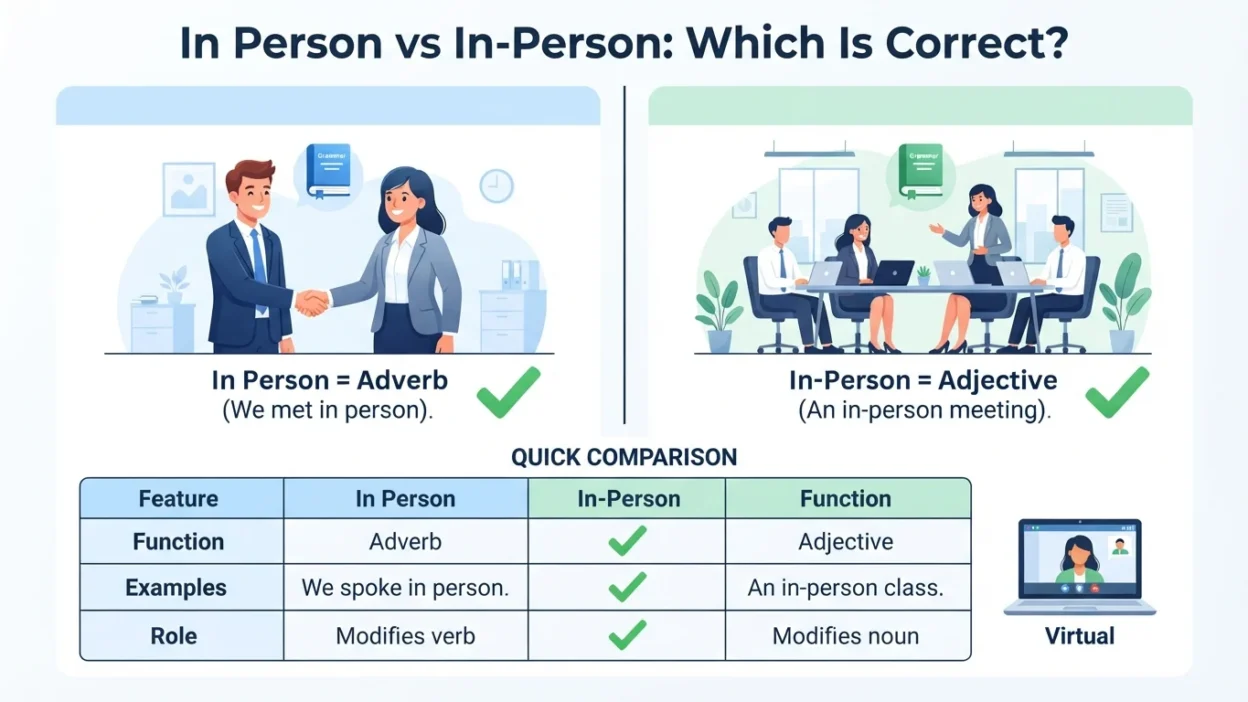
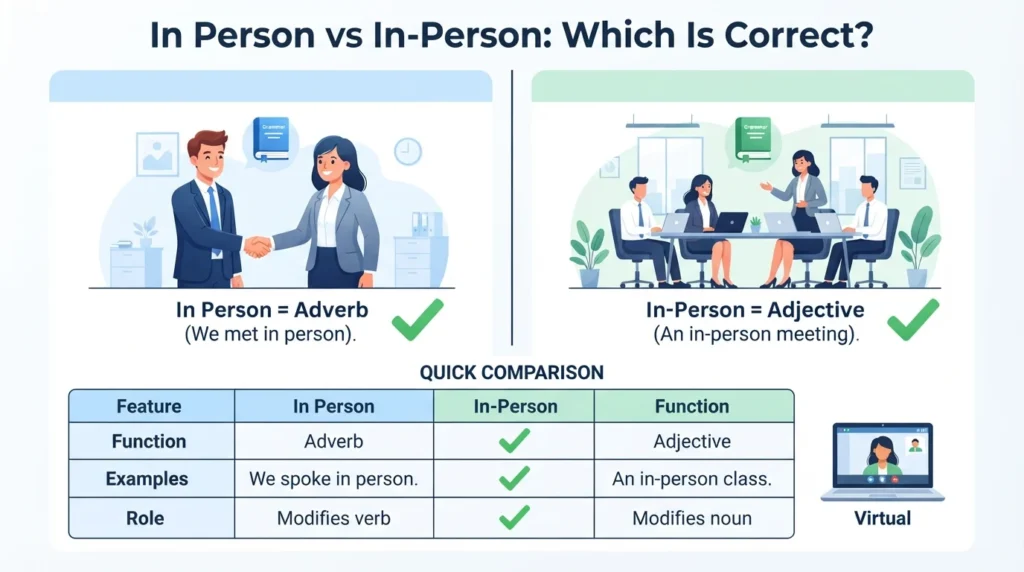
- In person (without a hyphen) is an adverbial phrase that means physically present rather than online, by phone, or through someone else.
- In-person (with a hyphen) is an adjective that describes a noun.
Rule to remember:
- Use in person after a verb.
- Use in-person before a noun.
What Does “In Person” Mean?
In person is an adverbial phrase that means physically present, face-to-face, or at the same location as another person.
It explains how something happens rather than describing a noun.
Examples of “In Person”
- We met in person for the first time.
- She prefers to interview candidates in person.
- You must apply in person.
- The manager spoke to every employee in person.
- I’d rather discuss this in person than over email.
In each sentence, in person describes the action.
What Does “In-Person” Mean?
In-person is a compound adjective. It describes a noun by indicating that something happens face-to-face rather than virtually or remotely.
Because it appears before the noun, it takes a hyphen.
Examples of “In-Person”
- We scheduled an in-person meeting.
- The company hosted an in-person conference.
- Students attended in-person classes.
- The doctor recommended an in-person consultation.
- They organized an in-person interview.
Here, in-person modifies nouns such as meeting, conference, classes, consultation, and interview.
In Person vs In-Person: Comparison Table
| Feature | In Person | In-Person |
|---|---|---|
| Part of speech | Adverbial phrase | Compound adjective |
| Meaning | Physically present | Describing something that happens face-to-face |
| Hyphen | No | Yes |
| Position | Usually after the verb | Before a noun |
| Example | We met in person. | We had an in-person meeting. |
The Main Difference
The easiest way to choose the correct form is to look at the word that follows.
Use in person when no noun immediately follows.
Examples
- I’ll explain everything in person.
- They met in person yesterday.
Use in-person when it comes directly before a noun.
Examples
- We arranged an in-person interview.
- The school resumed in-person learning.
Common Mistakes to Avoid
Many writers either forget the hyphen or add it where it isn’t needed.
Incorrect
- We met in-person yesterday.
Correct
- We met in person yesterday.
Incorrect
- We had an in person meeting.
Correct
- We had an in-person meeting.
Incorrect
- She prefers in-person.
Correct
- She prefers meeting in person.
Easy Memory Trick
A simple trick is:
- Before a noun? Use a hyphen.
- After a verb? No hyphen.
Examples:
- In-person interview ✅
- Interviewed in person ✅
This rule works in almost every situation.
American vs British English
There is no difference between American and British English.
| American English | British English |
|---|---|
| In person | In person |
| In-person meeting | In-person meeting |
| In-person interview | In-person interview |
Both varieties of English follow the same grammar rule regarding the hyphen.
Related Words and LSI Keywords
Using related terms naturally improves topical authority and readability.
- Face-to-face
- On-site
- Offline
- Physical meeting
- Live meeting
- Personal interaction
- Virtual meeting
- Remote meeting
- Office visit
- Direct communication
- Classroom learning
- Video conference
- Hybrid meeting
- Online interview
- Personal consultation
These related phrases help readers better understand the topic while supporting natural SEO.
Expert Writing Tip
Many professional style guides recommend using hyphenated compound adjectives before nouns because they improve clarity and reduce ambiguity. Since remote work, online learning, and virtual events have become more common, phrases like in-person meeting, in-person interview, and in-person event now appear frequently in business, education, and healthcare writing.
To maintain consistency, always apply the same rule throughout your document. Clear grammar enhances readability and creates a better experience for your audience.
Frequently Asked Questions
Is “in person” correct?
Yes. In person is correct when it functions as an adverbial phrase after a verb.
Is “in-person” correct?
Yes. In-person is correct when it functions as an adjective before a noun.
Which is correct: “in person meeting” or “in-person meeting”?
In-person meeting is correct because in-person describes the noun meeting.
Should “in person” always have a hyphen?
No. Only use a hyphen when it acts as an adjective before a noun.
Is there a difference in American and British English?
No. Both American and British English follow the same hyphenation rule.
Is “face-to-face” the same as “in person”?
They are very similar and often interchangeable, although face-to-face emphasizes direct interaction between people.
Can I write “meet in-person”?
No. The correct phrase is meet in person because it follows the verb.
Summary
Understanding the difference between in person and in-person is simple once you know their grammatical roles. In person is an adverbial phrase used after a verb to indicate that someone is physically present rather than communicating online or by phone. In-person, on the other hand, is a compound adjective used before a noun to describe meetings, interviews, classes, events, or other face-to-face activities.
Whether you’re writing a business email, academic paper, or blog post, using the correct form makes your writing clearer and more professional. Remember the simple rule: if it comes before a noun, use the hyphen; if it follows a verb, leave the hyphen out. Applying this guideline consistently will help you avoid one of the most common grammar mistakes in modern English.

A creative writer with a deep interest in word usage and meaning.
He explores synonyms to enhance both academic and creative expression.
Zayn’s work aims to make language richer and more accessible for everyone.