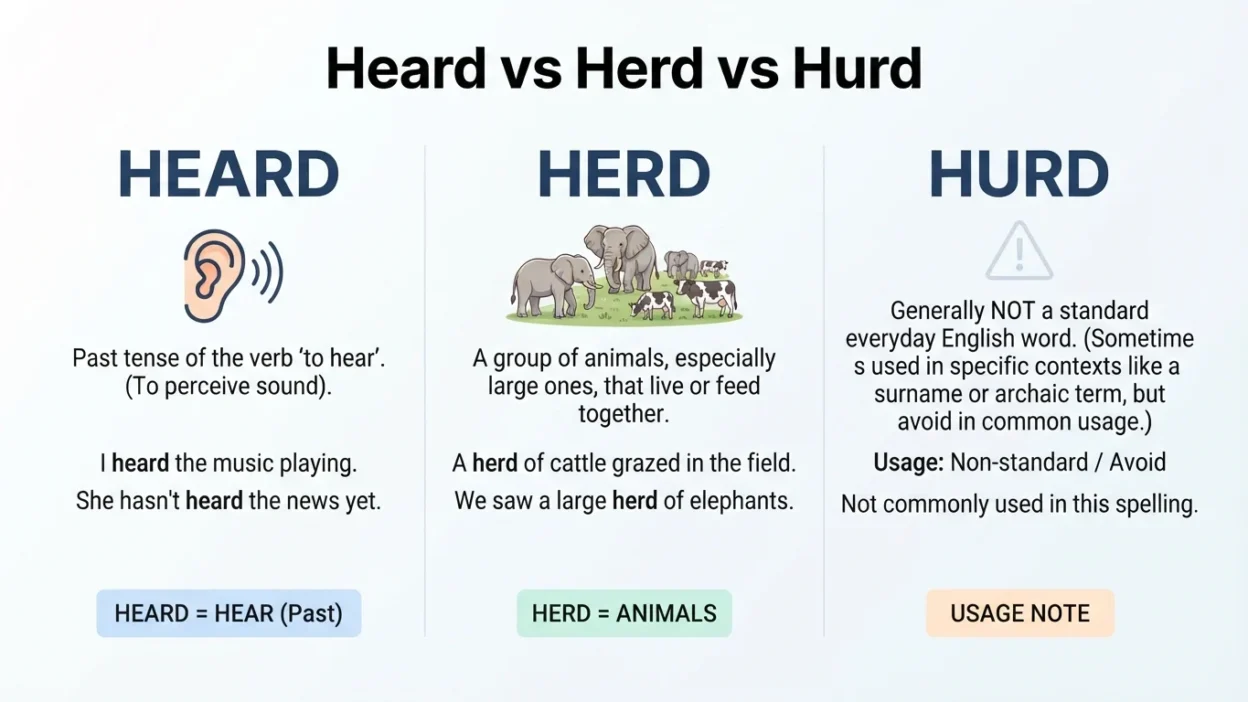
Heard, herd, and hurd are commonly confused because heard and herd sound exactly alike in standard English, while hurd looks very similar but has a completely different status. If you have ever wondered whether you should write heard or herd, the answer depends entirely on what you mean.
The most important point is simple: heard is the past tense and past participle of hear, while herd is usually a noun referring to a group of animals or a verb meaning to gather or guide animals or people. Hurd is not normally used as a standard English word in everyday writing. It may appear as a proper name, surname, or in specialized contexts, but it is not the correct spelling of either heard or herd.
Quick Answer
Heard means perceived a sound or received information through listening. Herd means a group of animals or the act of gathering/moving them together. Hurd is generally not a standard everyday English word. If you mean the past tense of hear, use heard. If you mean a group of animals, use herd.
Why People Confuse It
The main reason heard and herd are confusing is pronunciation.
In standard English, heard and herd are pronounced the same. They are homophones: words that sound alike but have different spellings and meanings.
For example:
- I heard a strange noise.
- A herd of cows crossed the road.
When spoken aloud, the listener has to use the context to determine which word the speaker means.
Hurd adds another layer of confusion because it looks like a possible spelling variation. However, it is not the normal spelling for either meaning.
Heard
Heard is the past tense and past participle of the verb hear.
The basic verb forms are:
hear → heard → heard
It means to perceive a sound with your ears, listen to something, or receive information.
Examples
- I heard a loud noise outside.
- She heard the announcement.
- We heard a strange sound.
- Have you heard the news?
- I heard that they moved to another city.
Simple Meaning
Think:
Heard = listened to or perceived a sound
If something reaches your ears and you perceive it, you heard it.
Common Expressions With Heard
- heard a noise
- heard the news
- heard a sound
- heard from someone
- heard about something
- heard of someone
- have heard
- never heard of
Example:
I heard from my friend yesterday.
Here, heard from means received communication from someone.
Herd
Herd has two common uses.
Herd as a Noun
As a noun, herd means a group of animals, especially animals that live, feed, or move together.
Examples include:
- a herd of cattle
- a herd of cows
- a herd of elephants
- a herd of deer
- a herd of buffalo
Examples
- A herd of elephants crossed the road.
- We saw a large herd of cattle.
- The shepherd watched the herd carefully.
- A herd of deer moved through the forest.
Herd as a Verb
Herd can also be a verb meaning to gather, drive, or guide animals or people in a particular direction.
Examples:
- The farmer herded the cattle into the field.
- The shepherd herded the sheep toward the barn.
- The guide herded the tourists onto the bus.
In informal contexts, herd can also describe moving a group of people together.
Hurd
Hurd is not normally the correct spelling for either heard or herd in everyday English.
If you are trying to write:
“I heard a noise.”
Do not write:
❌ I hurd a noise.
The correct spelling is:
✅ I heard a noise.
If you mean a group of animals:
❌ A hurd of cows
The correct spelling is:
✅ A herd of cows.
Hurd can occur as a proper name or surname, but that does not make it an interchangeable spelling of heard or herd.
Comparison Table
| Word | Part of Speech | Meaning | Example |
|---|---|---|---|
| Heard | Verb | Past tense/past participle of hear | I heard a noise. |
| Herd | Noun | Group of animals | A herd of cows was nearby. |
| Herd | Verb | Gather or guide a group | They herded the animals inside. |
| Hurd | Proper name/specialized use | Not normally a standard everyday English word | Hurd may appear as a surname. |
When to Use Each
Use “Heard” for Listening or Sound
Use heard whenever you are talking about hearing something.
I heard music.
She heard someone calling her.
Have you heard the news?
A useful test is:
Can I replace the word with “listened to” or “perceived”?
If yes, you probably need heard.
Use “Herd” for Animals
Use herd when referring to a group of animals.
A herd of cows was grazing.
We saw a herd of elephants.
Use “Herd” as a Verb for Moving a Group
Use herd when someone gathers or guides animals or people.
The farmer herded the sheep into the field.
Avoid “Hurd” in Ordinary English
If you are choosing between heard, herd, and hurd, hurd is almost certainly not the word you need in normal English writing.
12 Examples of Heard, Herd, and Hurd
Examples With “Heard”
- I heard a strange noise last night.
- She heard someone knocking at the door.
- Have you heard the latest news?
- We heard music coming from the next room.
- He heard his name being called.
- I have never heard of that author.
Examples With “Herd”
- A herd of cows was grazing in the field.
- We watched a herd of elephants near the river.
- The farmer moved the herd into the barn.
- The shepherd herded the sheep toward the hill.
- A large herd of deer crossed the road.
- The rancher carefully herded the cattle into the enclosure.
Example With “Hurd”
- Hurd may appear as a person’s surname, but it is not the standard spelling of heard or herd.
Common Mistakes
Mistake 1: “I Hurd It”
❌ I hurd what you said.
✅ I heard what you said.
Remember that the past tense of hear is heard, not hurd.
Mistake 2: “A Heard of Cows”
❌ We saw a heard of cows.
✅ We saw a herd of cows.
A group of animals is a herd.
Mistake 3: “A Hurd of Elephants”
❌ A hurd of elephants crossed the road.
✅ A herd of elephants crossed the road.
Mistake 4: “I Herd the News”
❌ I herd the news yesterday.
✅ I heard the news yesterday.
The word relates to the verb hear, so use heard.
Memory Trick
Here is a simple way to remember the difference:
HEARD → HEAR
Heard contains hear in its spelling:
HEAR → HEARD
So whenever you are talking about listening or sound, think heard.
HERD → ANIMALS
Think:
Herd = a group of animals
A herd of cows.
A herd of elephants.
A herd of deer.
HURD → NOT THE NORMAL WORD
If you are writing ordinary English and think you need hurd, stop and check the meaning. You probably mean heard or herd.
American vs British English
There is no significant American-versus-British difference in the spelling or basic meanings of these words.
Both American English and British English use:
- heard for the past tense of hear
- herd for a group of animals
- herd as a verb meaning to gather or guide
The pronunciation of heard and herd is also essentially the same in standard varieties of both forms of English, although individual accents can vary.
Similar Words
Understanding related words can make the distinction easier.
Hear
Hear is the base form of the verb.
I can hear music.
Heard
Heard is the past tense and past participle.
I heard music.
I have heard that song before.
Hearing
Hearing is the present participle or gerund.
She is hearing a strange noise.
Herd
Herd refers to a group of animals or the action of gathering/moving them.
A herd of cattle is nearby.
Flock
Flock is another collective noun, commonly used for birds and some other animals.
A flock of birds flew overhead.
Pack
Pack is commonly used for groups of certain animals, such as wolves or dogs.
A pack of wolves moved through the forest.
Heard vs Herd in a Sentence
Compare these sentences:
I heard a herd of cows.
This sentence contains both words, and each has a different function.
Heard = perceived the sound.
Herd = group of cows.
Another example:
She heard the farmer talking about the herd.
Again:
- heard → listening/perception
- herd → group of animals
This is an excellent way to see why context matters when these homophones are spoken.
Final Verdict
Heard, herd, and hurd are not interchangeable.
Use heard when you mean the past tense or past participle of hear:
I heard a noise.
Use herd when you mean a group of animals:
A herd of cows was nearby.
Use herd as a verb when you mean to gather or guide animals or a group:
The farmer herded the cattle into the field.
Hurd is generally not a standard everyday English word. It may appear as a surname or in specialized contexts, but it should not be used as an alternative spelling of heard or herd.
Frequently Asked Questions
Is “heard” or “herd” correct?
Both are correct words, but they have different meanings. Heard is the past tense of hear, while herd means a group of animals or the act of gathering/moving them.
Is “hurd” a correct English word?
Hurd is not normally used as a standard everyday English word. It can occur as a proper name or surname, but it is not the standard spelling of heard or herd.
Are heard and herd homophones?
Yes. Heard and herd are homophones because they are pronounced alike in standard English but have different spellings and meanings.
What is the plural of herd?
The plural is herds.
Example:
Several herds of cattle were grazing nearby.
What is the past tense of herd?
The past tense is herded.
Example:
The farmer herded the sheep into the field.
Is “I hurd you” correct?
No. In standard English, write:
I heard you.
What is the easiest way to remember heard vs herd?
Remember:
Heard → hear → sound or listening
Herd → animals → group
Conclusion
The difference between heard, herd, and hurd becomes easy once you focus on meaning rather than pronunciation. Heard is connected to the verb hear and is used when talking about sounds, listening, or receiving information. Herd refers to a group of animals and can also be used as a verb for gathering or guiding a group. Although the two words sound the same, their spellings and meanings are completely different.
Hurd, meanwhile, should generally not be used as an everyday English spelling. If you are writing about something you listened to, choose heard. If you are describing a group of animals, choose herd. When in doubt, remember the simplest rule: heard = hear; herd = animals.
Remember This
HEARD = past tense of HEAR
HERD = group of animals
HERD = gather or guide a group
HURD = generally not standard everyday English
Easy memory trick:
HEARD → HEAR → SOUND
HERD → ANIMALS → GROUP

An expert in English grammar and expressive writing techniques.
She focuses on helping readers expand their vocabulary with clarity.
Elina believes the right word can transform ordinary writing into powerful communication.