Giving and given are both correct forms of the verb give, but they are used in different grammatical situations. Because both words come from the same verb, English learners often confuse them when forming sentences, especially when using continuous and perfect tenses.
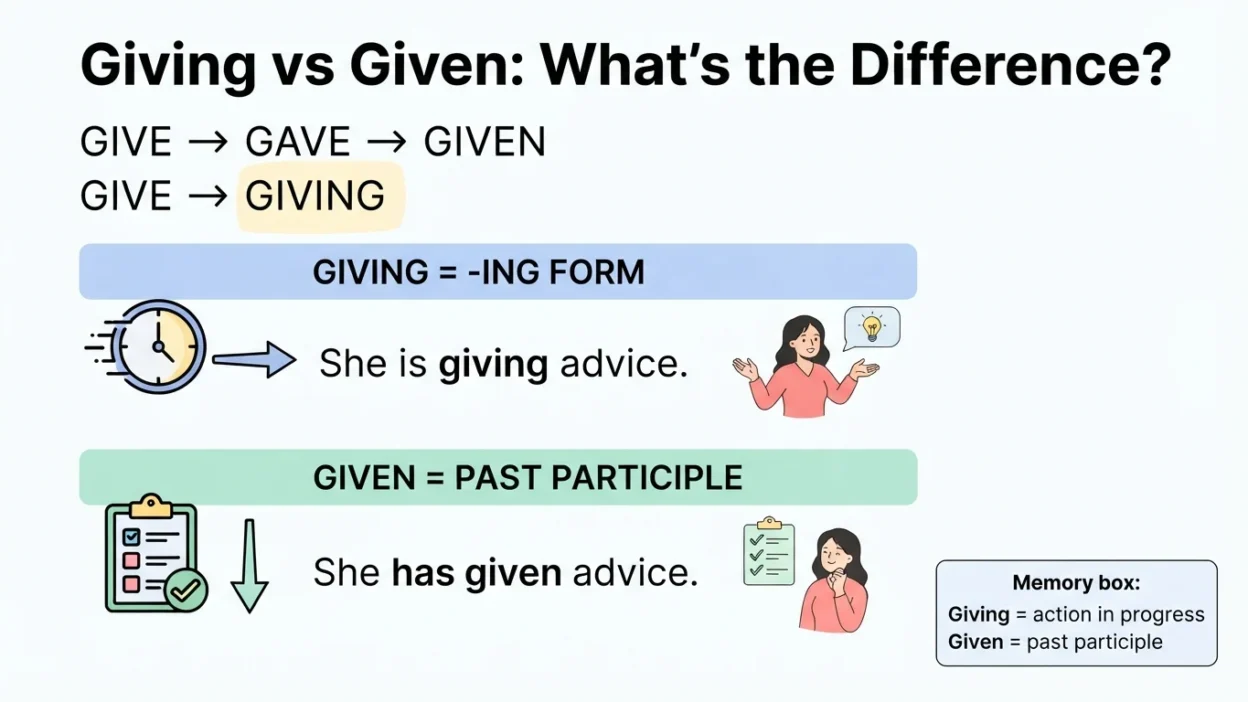
The key difference is simple: giving is the -ing form of give, while given is the past participle. “Giving” is commonly used with forms of be, such as is giving or was giving, while “given” is usually used with have, has, or had, or in passive constructions such as was given. Understanding this difference will help you choose the correct form in everyday and professional English.
Quick Answer
Giving is the present participle or -ing form of give, used in continuous constructions and as a gerund. Given is the past participle of give, used with have, has, or had and in passive constructions. The basic forms are give → gave → given, with giving as the -ing form.
Why Do People Confuse Giving and Given?
The confusion happens because giving and given both come from the verb give, but they perform different grammatical jobs.
The main forms of give are:
| Verb Form | Example |
|---|---|
| Give | I give her advice. |
| Gave | I gave her advice yesterday. |
| Given | I have given her advice. |
| Giving | I am giving her advice. |
The important point is that gave is the simple past form, while given is the past participle.
So:
❌ I have gave him the book.
✅ I have given him the book.
And:
❌ I am given him the book.
✅ I am giving him the book.
Giving
Giving is the present participle and -ing form of give.
It is commonly used with forms of be to create continuous tenses.
Examples
- I am giving him some advice.
- She is giving a presentation.
- They are giving away free samples.
- He was giving me directions.
- We were giving our opinions.
- She has been giving lessons for years.
Giving as a Gerund
“Giving” can also function as a noun, known as a gerund.
Examples:
- Giving is better than receiving.
- Giving someone your time can be meaningful.
- I enjoy giving gifts.
- Giving advice is easy; following it can be harder.
Here, “giving” refers to the activity or action itself.
Given
Given is the past participle of give.
The basic irregular verb pattern is:
Give → Gave → Given
Given is commonly used with have, has, or had.
Examples
- I have given him the information.
- She has given me permission.
- They had given us enough time.
- We have given the matter careful consideration.
- He had given his answer already.
Given in Passive Sentences
“Given” is also frequently used in passive constructions.
Examples:
- I was given a new assignment.
- She was given an opportunity.
- They were given extra time.
- He was given a warning.
- We were given clear instructions.
Notice the difference:
She is giving me a book.
She is performing the action.
She was given a book.
She received the action.
Giving vs Given: Comparison Table
| Feature | Giving | Given |
|---|---|---|
| Base verb | Give | Give |
| Form | -ing form | Past participle |
| Main use | Continuous tenses | Perfect tenses and passive voice |
| Example | She is giving advice. | She has given advice. |
| Passive use | Generally not used as the main past participle | Very common |
| Can act as a noun? | Yes | No, not normally |
| Verb pattern | Give → giving | Give → gave → given |
When to Use Giving
Use giving when describing an action that is happening or was happening over a period of time.
Present Continuous
She is giving a speech.
The action is happening now.
Past Continuous
She was giving a speech when I arrived.
The action was in progress in the past.
Future Continuous
She will be giving a presentation tomorrow.
The action will be in progress at a future time.
After Certain Verbs
“Giving” can also follow verbs such as:
- enjoy
- avoid
- consider
- keep
- practice
- stop
Examples:
I enjoy giving advice.
She kept giving me excuses.
He stopped giving interviews.
When to Use Given
Use given when you need the past participle of give.
With Have, Has, or Had
I have given him the information.
She has given me permission.
They had given us enough time.
In Passive Voice
He was given a second chance.
They were given new instructions.
She was given an award.
In Perfect Passive Constructions
The students have been given extra time.
The employees had been given clear instructions.
Here, given remains the past participle of give.
Giving vs Given Examples
Here are examples that show the difference clearly:
- I am giving her a present.
- I have given her a present.
- She is giving me advice.
- She has given me advice.
- They were giving away free samples.
- They had given away all the samples.
- He is giving a speech.
- He was given an award.
- We are giving the students more time.
- The students were given more time.
- She enjoys giving gifts.
- She has given many gifts over the years.
Notice the pattern:
Giving = performing or describing the ongoing action
Given = completed action or passive construction
Common Mistakes
Mistake 1: Using “Gave” After Have or Has
❌ She has gave me the book.
✅ She has given me the book.
After has/have/had, use the past participle given.
Mistake 2: Using “Given” for an Ongoing Action
❌ She is given me advice.
✅ She is giving me advice.
The continuous structure requires the -ing form.
Mistake 3: Confusing “Was Giving” and “Was Given”
These sentences have different meanings:
She was giving him a gift.
She was performing the action.
She was given a gift.
She received the gift.
Mistake 4: Writing “Have Gave”
❌ They have gave us permission.
✅ They have given us permission.
Remember:
have + past participle = given
Giving vs Gave vs Given
These three forms are especially important.
Give
Present/base form:
I give him advice.
Gave
Simple past:
I gave him advice yesterday.
Given
Past participle:
I have given him advice.
The complete pattern is:
Give → Gave → Given
And the -ing form is:
Give → Giving
Memory Trick
Use this simple pattern:
GIVE → GAVE → GIVEN
Think:
- Give = present
- Gave = simple past
- Given = past participle
And:
GIVE + ING = GIVING
A quick grammar shortcut:
am/is/are/was/were + giving
has/have/had + given
was/were + given = passive
Examples:
She is giving.
She has given.
She was given.
American vs British English
There is no major difference between American and British English in the use of giving and given.
Both varieties use:
She is giving me a book.
and:
She has given me a book.
Both also use given in passive constructions:
He was given a chance.
The grammar rules are essentially the same in American and British English.
Similar Words and Forms
Give
The base form.
Please give me a chance.
Gave
The simple past form.
She gave me a gift yesterday.
Given
The past participle.
She has given me a gift.
Giving
The -ing form.
She is giving me a gift.
Gift
A noun referring to something given to someone.
She gave me a beautiful gift.
Remember that give is the verb, while gift is usually a noun.
Frequently Asked Questions
Is “giving” or “given” correct?
Both are correct, but they are used differently. Giving is the -ing form of give, while given is the past participle.
Is “I am given” correct?
Yes, but it normally has a passive meaning.
I am given instructions every morning.
If you mean that you are performing the action of giving, use:
I am giving instructions.
Is “I have giving” correct?
No. After have, use the past participle:
I have given.
If you want a continuous perfect construction, use:
I have been giving.
Is “I am giving” correct?
Yes. I am giving is the present continuous form of give.
Is “I have given” correct?
Yes. I have given uses the present perfect tense.
What is the past tense of give?
The simple past tense is gave.
She gave me a present yesterday.
What is the past participle of give?
The past participle is given.
She has given me a present.
What is the difference between “was giving” and “was given”?
Was giving is active and means someone was performing the action. Was given is passive and means someone received the action.
Final Verdict
Giving and given are both correct forms of the irregular verb give, but they cannot normally be substituted for one another.
Use giving for the -ing form, especially in continuous tenses or when the action functions as a noun. Use given as the past participle, particularly after have, has, or had, and in passive constructions.
The easiest pattern to remember is:
Give → Gave → Given
Give → Giving
If you are talking about an action in progress, think giving. If you are using have/has/had or forming a passive sentence, think given.
Conclusion
The difference between giving and given becomes much easier once you understand their grammatical roles. Giving describes an ongoing action or functions as a gerund, while given is the past participle used in perfect tenses and passive constructions. For example, “She is giving me advice” describes an action in progress, while “She has given me advice” describes a completed action.
Remember that give is an irregular verb, so its forms do not follow the regular -ed pattern. The correct forms are give, gave, given, with giving as the present participle. Once you memorize this pattern, mistakes such as “has gave” or “is given” when you mean an ongoing active action become much easier to avoid.
Remember This
Giving = -ing form
She is giving me advice.
Given = past participle
She has given me advice.
Gave = simple past
She gave me advice yesterday.

An expert in English grammar and expressive writing techniques.
She focuses on helping readers expand their vocabulary with clarity.
Elina believes the right word can transform ordinary writing into powerful communication.